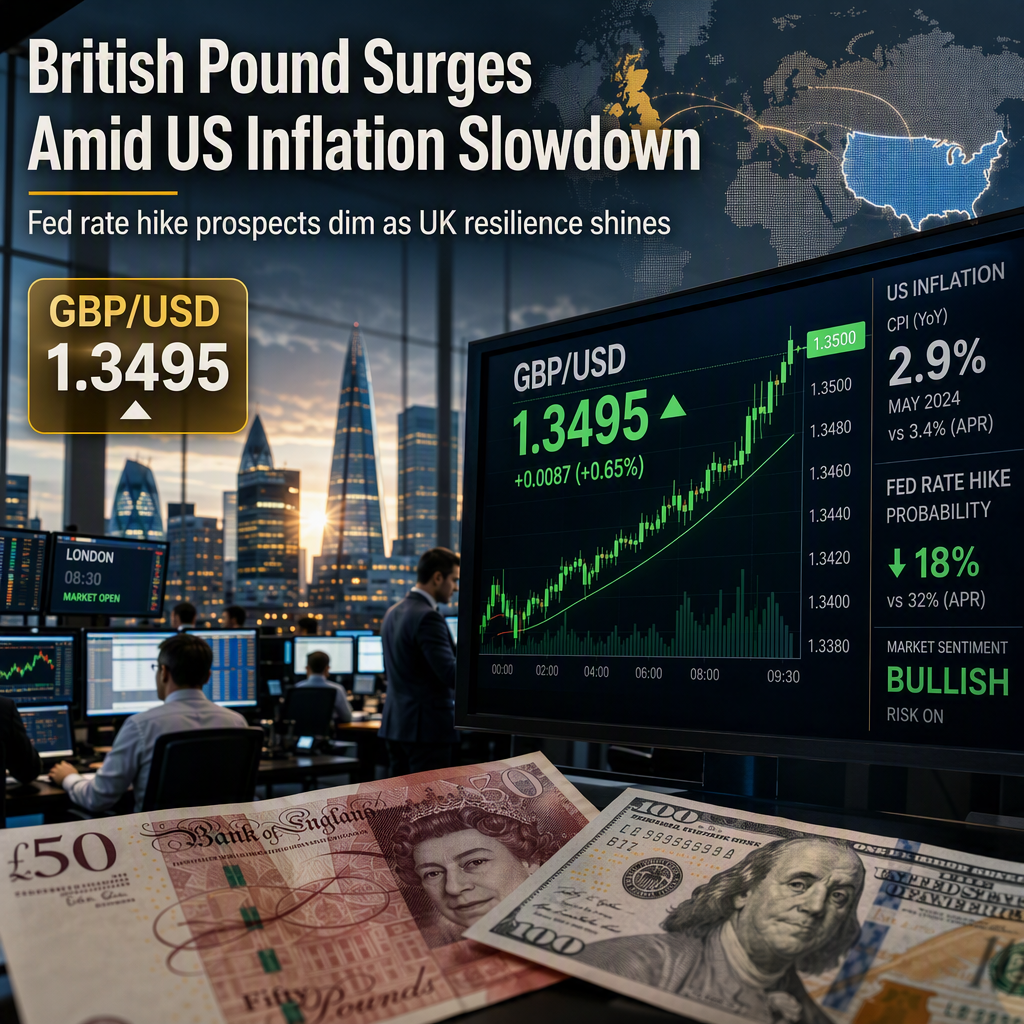
The British Pound (GBP) strengthened against the US Dollar (USD), with the GBP/USD pair approaching 1.3495 during early European trading hours on Friday, as market expectations for further Federal Reserve (Fed) rate hikes eased following softer-than-expected US inflation data [1]. US wholesale costs for goods and services were flat in July, missing the market consensus of a 0.2% increase, after a 0.1% decline in June. The core Producer Price Index (PPI), excluding food and energy, rose 0.2% month-on-month in July, down from 0.4% in June and below the forecasted 0.3% gain. On an annual basis, headline PPI increased 4.7% year-on-year, while core PPI rose 4.2% [1].
These inflation readings prompted traders to further reduce the probability of a Fed rate hike in September, with market pricing now reflecting a 34.8% chance, down from 40% immediately after the PPI data, according to the CME FedWatch Tool [1]. However, ongoing geopolitical tensions in the Middle East, particularly concerning the Strait of Hormuz, could support the US Dollar as a safe-haven asset and potentially limit further GBP gains. A senior IRGC official asserted Iran's control over the Strait, following US President Trump's comments about US dominance in the area [1].
In the UK, the economy grew by 0.4% quarter-on-quarter in Q2 2026, matching market expectations but slowing from 0.6% in Q1, according to the Office for National Statistics. Bank of England (BoE) Chief Economist Huw Pill indicated that the stronger-than-expected growth supports the case for higher borrowing costs to bring inflation back to target [1]. Societe Generale highlighted that the main risk to the UK outlook remains the trajectory of the US-Iran conflict, though UK activity data has so far shown resilience to external shocks [1].
Technical analysis suggests GBP/USD maintains a constructive near-term outlook, trading above key moving averages and with the Relative Strength Index (RSI) at 59, indicating positive momentum without overbought conditions [1].
CONCLUSION
The British Pound's recent gains are underpinned by softer US inflation data, which has reduced expectations for further Fed rate hikes. While UK economic activity remains resilient, geopolitical risks in the Middle East could influence market sentiment and currency movements in the near term.