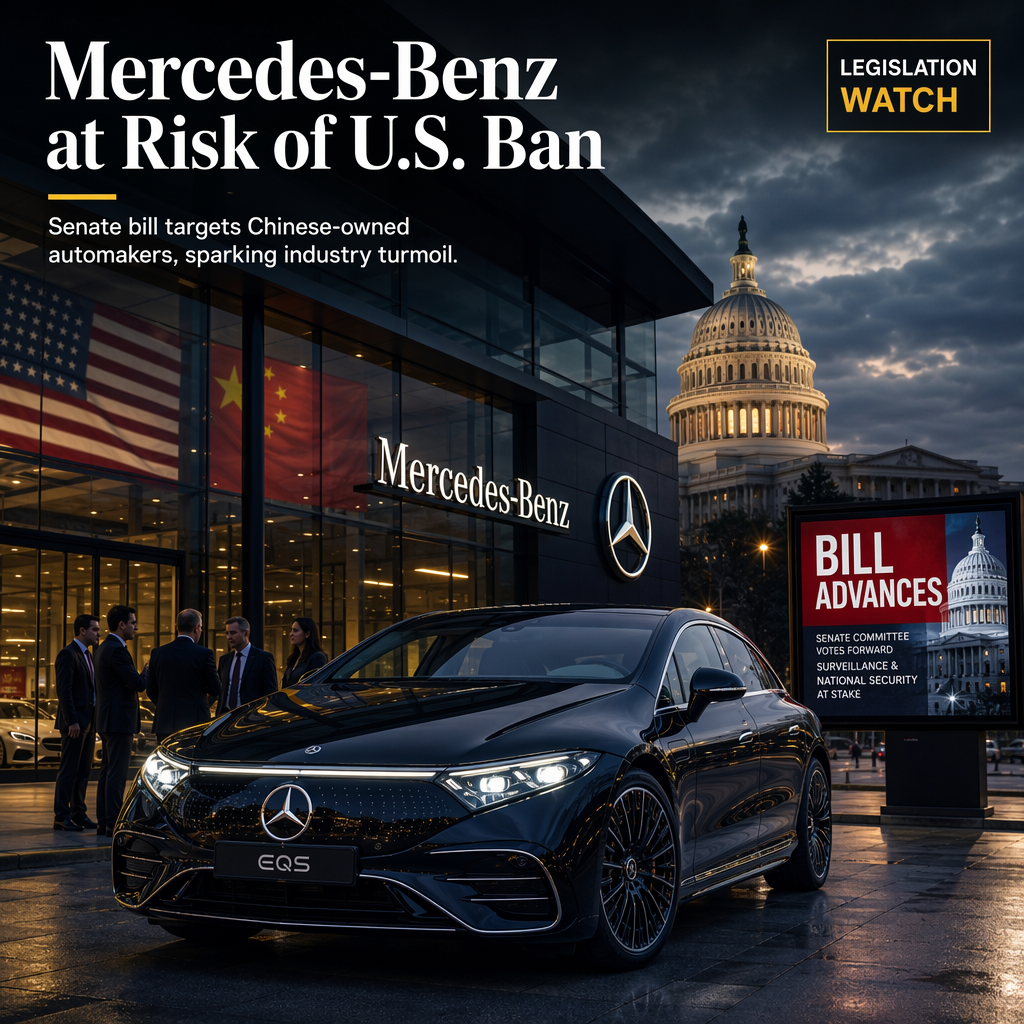
Mercedes-Benz is at risk of being banned from selling connected vehicles in the United States due to a Senate bill aimed at automakers with significant Chinese ownership. The Senate Commerce Committee recently advanced legislation that would prohibit the sale of connected vehicles by companies with more than 15% Chinese ownership, directly impacting Mercedes-Benz, which has nearly 20% of its shares held by two Chinese investors [1].
The bipartisan bill, sponsored by Sens. Elissa Slotkin (D-Mich.) and Bernie Moreno (R-Ohio), seeks to codify and expand existing Biden administration restrictions. The sponsors argue the measure is necessary to prevent data collected by connected vehicles from being transmitted to the Chinese government, with Slotkin describing Chinese cars as 'surveillance packages on wheels' and Moreno warning of the potential 'destruction of our industrial base' if Chinese influence is not curtailed [1].
Sen. Ted Cruz (R-Texas), chair of the Commerce Committee, cautioned that the bill could effectively exclude Mercedes-Benz from the U.S. market unless amended. Cruz accused General Motors (GM) of supporting the bill to eliminate Mercedes-Benz as a competitor and boost its Cadillac brand, though GM denied targeting any specific automaker and stated its support for policies that ensure a level playing field for U.S. manufacturers [1].
Mercedes-Benz responded by emphasizing its significant U.S. operations and its support for legislation that protects national security, while also expressing its commitment to ensuring that any new laws do not disrupt its business in the U.S. The bill does provide a mechanism for manufacturers to seek Commerce Department authorization for vehicles that would otherwise be banned [1].
Additionally, Moreno noted that GM plans to move production of its Chinese-made Buick Envision to the U.S. by the 2028 model year, and that Ford has agreed to transfer production of Chinese-made Lincolns to the U.S., which he described as a 'big victory' [1].
CONCLUSION
The Senate bill poses a significant threat to Mercedes-Benz's ability to sell connected vehicles in the U.S. due to its Chinese ownership structure. While the legislation is intended to protect national security and American manufacturing, it has sparked debate over its potential market impact and fairness. The outcome will depend on possible amendments and the implementation of authorization processes for affected automakers.