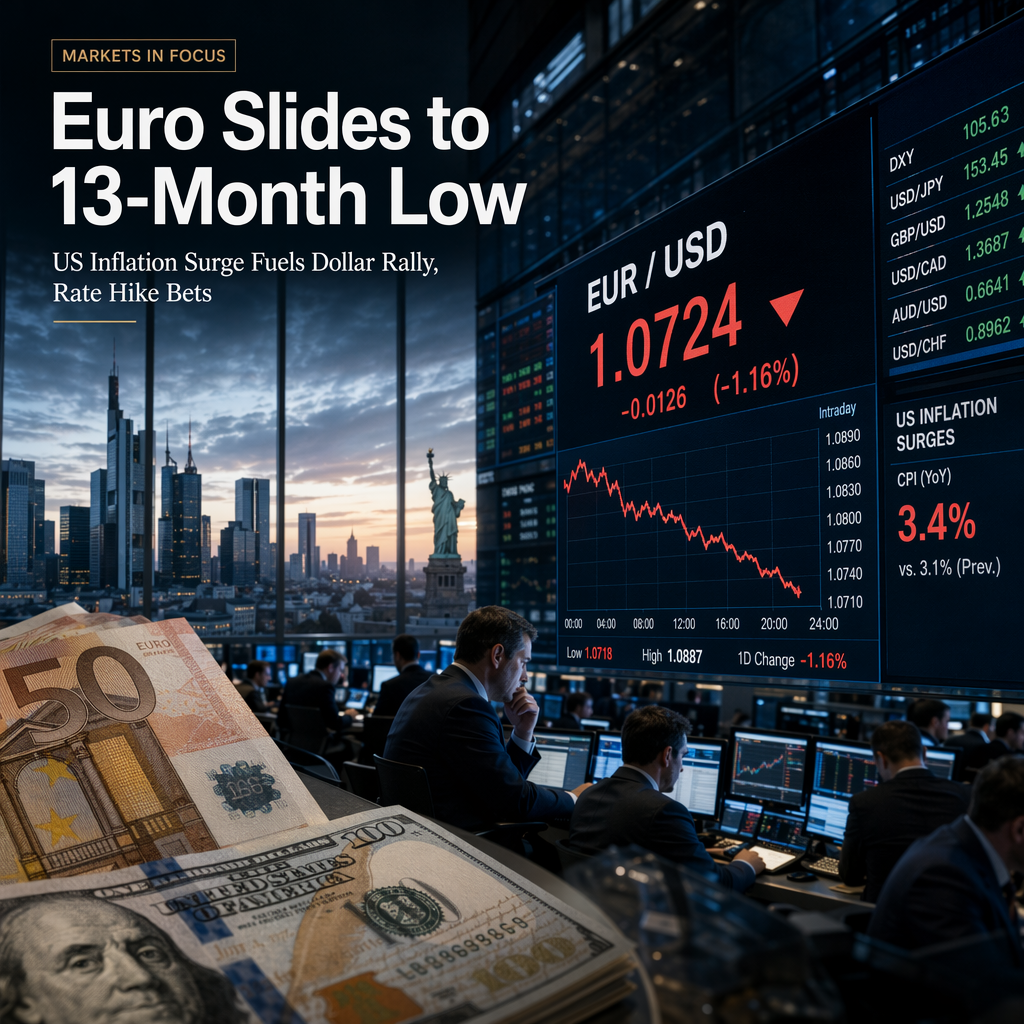
The Euro weakened to around 1.1365 against the US Dollar during early Asian trading hours on Friday, approaching a 13-month low. This decline comes as US inflation, measured by the headline Personal Consumption Expenditures (PCE) Price Index, rose to 4.1% year-over-year in May, up from 3.3% in April. This marks the first time in three years that the PCE index has exceeded 4.0%, driven in part by higher energy prices linked to the Middle East conflict. The core PCE, the Federal Reserve's preferred inflation gauge, also increased to 3.4% year-over-year in May, the highest reading since October 2023, compared to 3.3% previously [1].
These inflation figures have heightened market expectations for a US interest rate hike, with financial markets pricing in a nearly 63.4% chance that the Federal Reserve will raise rates at its September 15-16 meeting, according to the CME FedWatch tool [1]. The anticipation of higher US rates has strengthened the US Dollar and put additional pressure on the Euro.
Meanwhile, dovish comments from European Central Bank (ECB) policymakers have further weighed on the Euro. Although the ECB raised its deposit rate by 25 basis points to 2.25% at its June policy meeting, ECB President Christine Lagarde stated that the central bank does not need to respond aggressively to the spillover effects of the Middle East conflict. Lagarde acknowledged that the inflation shock in the Eurozone is significant but not yet sufficient to drive up longer-term inflation expectations [1].
The market is also awaiting the release of the Michigan Consumer Sentiment Index report later on Friday, which could provide further direction for the EUR/USD pair. The Euro remains sensitive to economic data releases, with indicators such as inflation, GDP, and consumer sentiment surveys playing a key role in influencing its value [1].
CONCLUSION
The Euro's slide toward a 13-month low reflects rising US inflation and increased expectations for a Federal Reserve rate hike, which have strengthened the US Dollar. Dovish signals from the ECB and ongoing economic uncertainty in the Eurozone have added to the Euro's weakness. Market participants are closely watching upcoming data releases for further cues on the currency's direction.