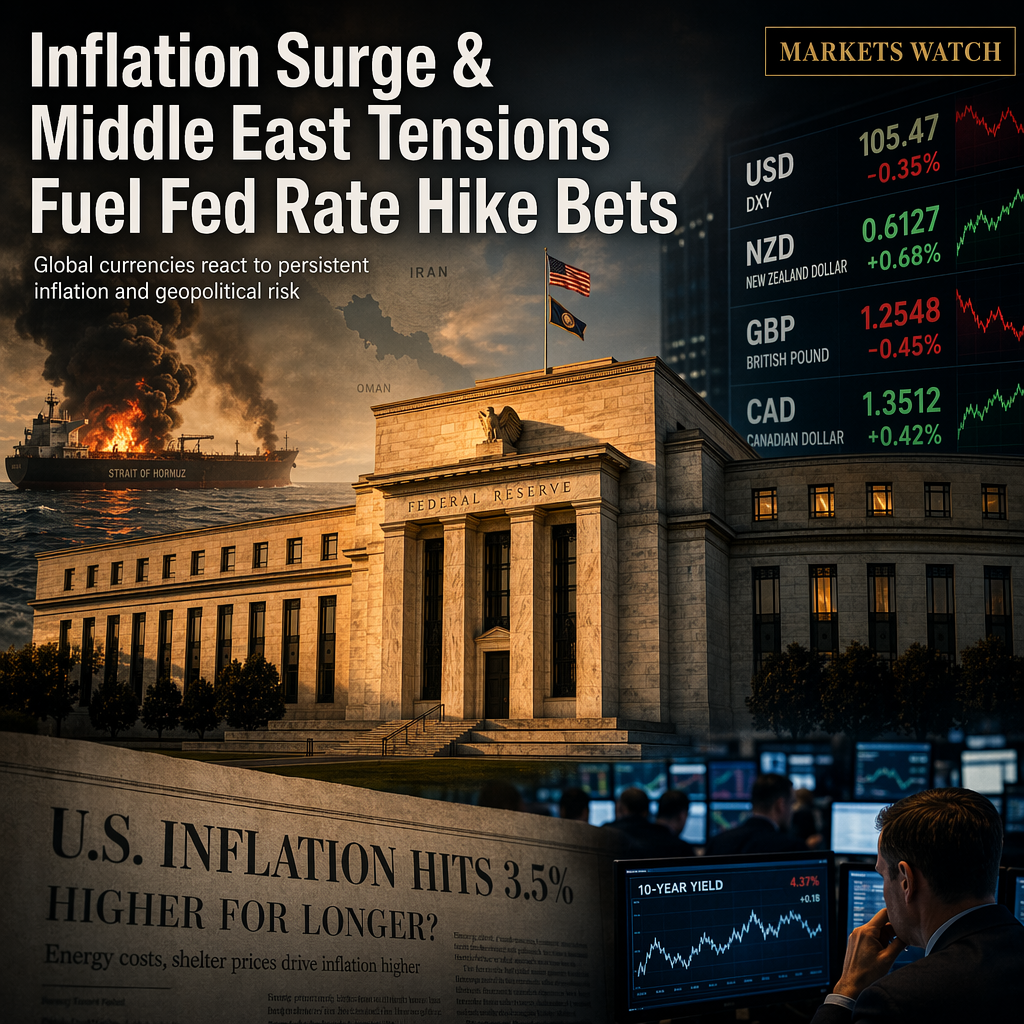
A surge in US inflation and escalating geopolitical tensions in the Middle East have fueled expectations for further Federal Reserve (Fed) rate hikes, significantly impacting major currency pairs and commodity-linked currencies. The US Personal Consumption Expenditures (PCE) Price Index climbed to 4.1% year-over-year in May, up from 3.3% in April, marking the first time the headline figure has breached 4.0% in three years and well above the Fed’s 2% target [1][2][4]. The core PCE index, the Fed’s preferred inflation gauge, also rose to 3.4% year-over-year from 3.3%, the highest since October 2023 [1][2][4]. This persistent inflation, attributed in part to rising energy prices amid Middle East conflict, has led markets to price in a 63.4% probability of a Fed rate hike at the September 15–16 meeting, according to the CME FedWatch Tool [1][2][4].
The New Zealand Dollar (NZD/USD) weakened below 0.5650, trading near 0.5635 for the eighth consecutive day of losses, pressured by both Fed rate hike expectations and Middle East tensions [1]. The Reserve Bank of New Zealand (RBNZ) kept its Official Cash Rate at 2.25% in May, with analysts now expecting the next hike to be delayed until September, and the OCR peaking at 3.25% by early 2027 [1].
The US Dollar Index (DXY) advanced to around 101.50, supported by the hawkish Fed outlook and persistent inflation [2]. BMO Chief US Economist Scott Anderson commented that high PCE inflation will keep the Fed on hold, with further hikes possible, and noted that stubborn service inflation may not be easily reduced by falling energy prices [2].
Geopolitical developments also played a significant role. Reports of Iran’s Islamic Revolutionary Guard Corps attacking a Singapore-flagged cargo ship in the Strait of Hormuz led to a modest recovery in crude oil prices and bolstered safe-haven demand for the US Dollar [3][4]. The Canadian Dollar (USD/CAD) gained ground, trading around 1.4200, as higher oil prices supported the commodity-linked currency, though the downside was limited by the strong US Dollar [4].
The British Pound (GBP/USD) maintained a positive bias but remained below 1.3200, with gains capped by both the safe-haven USD demand and renewed political risk following UK Prime Minister Keir Starmer's resignation on June 22 [3]. The GBP/USD pair appears poised to register losses for the second consecutive week, with market participants awaiting further US data and developments in the Middle East [3].
CONCLUSION
Persistent US inflation and renewed Middle East tensions have heightened expectations for Fed rate hikes, strengthening the US Dollar and pressuring other major currencies. Commodity-linked currencies like the Canadian Dollar benefited from rising oil prices, while the New Zealand and British Pounds faced headwinds from both domestic and global factors. Market sentiment remains cautious, with further moves likely dependent on upcoming US data and geopolitical developments.