
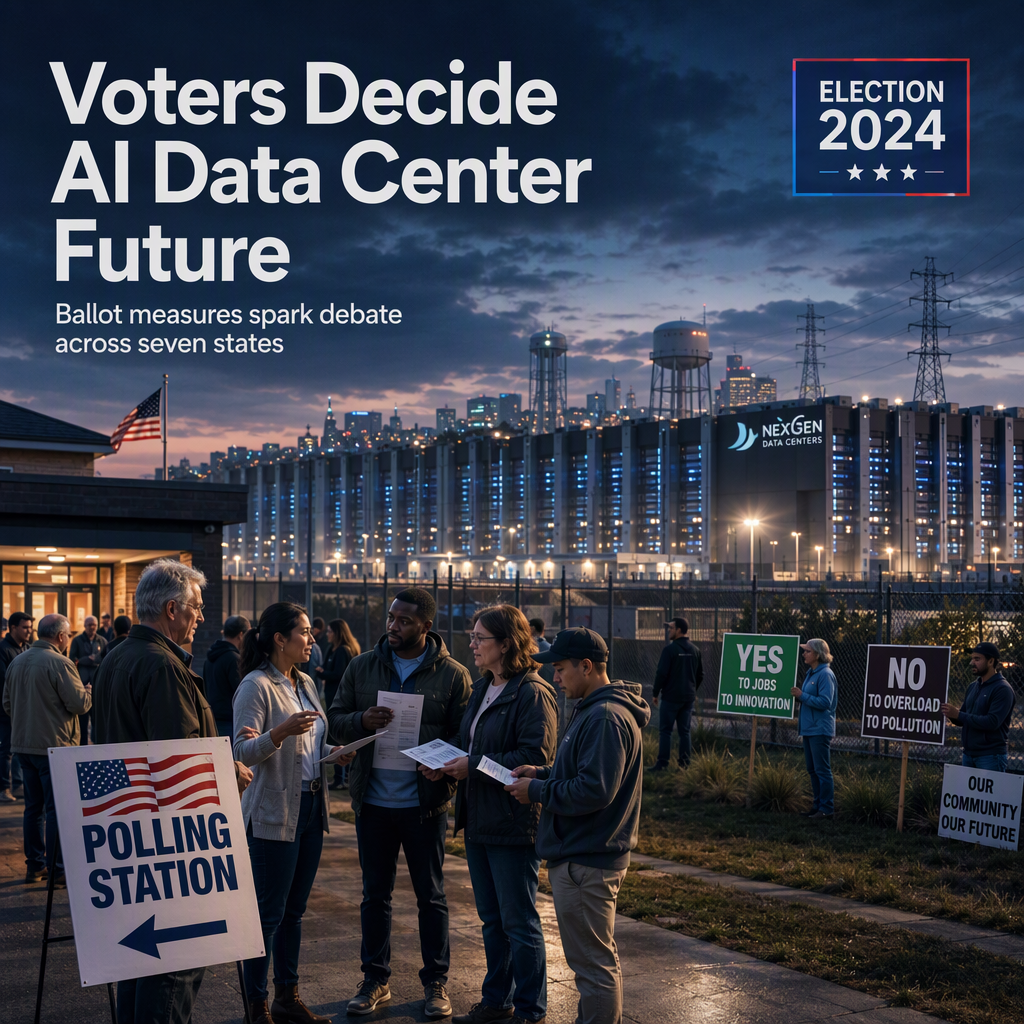
The rapid expansion of data centers fueling America's artificial intelligence (AI) boom is set to become a major issue in the upcoming midterm elections, with 34 data center-related ballot measures appearing across seven states: California, Florida, Illinois, Kansas, Nevada, Ohio, and Wisconsin [1]. These measures reflect growing public and political scrutiny over the economic and environmental impacts of large-scale data center development [1].
A recent Fox News national poll highlights widespread public skepticism, with 71% of voters opposing the construction of AI data centers in their area, including 46% who strongly oppose them. However, 52% support building such facilities in remote locations, while 44% remain opposed [1]. Overall, 60% of voters hold a negative view of AI, compared to 37% with a positive view—a 23-point gap that has more than doubled since July, indicating rising concerns [1].
The poll also reveals a partisan divide: voters with favorable views of AI tend to lean Republican, while those with unfavorable views lean Democratic. This divide is even more pronounced regarding data centers, with Republicans performing better among supporters and Democrats among opponents [1]. The issue has become a significant political fault line, influencing both national and state-level campaigns [1].
In Texas, Governor Greg Abbott (Republican) has ordered a pause on new data center permits and grid connections pending a statewide audit of their impact on the power grid and water supplies. His Democratic challenger, Gina Hinojosa, supports temporary moratoriums on data center development [1]. Meanwhile, debates over tax breaks for the industry are ongoing in the state's Senate race [1]. In Ohio, 20 data center-related measures will appear across 17 jurisdictions, more than any other state, with the issue featuring prominently in the Senate race between Democratic challenger Sherrod Brown and Republican Senator Jon Husted [1].
The outcome of these ballot measures and political contests could significantly influence the future trajectory of data center expansion and AI infrastructure in the United States [1].
CONCLUSION
The upcoming midterm elections will play a pivotal role in determining the regulatory and developmental landscape for data centers and AI infrastructure in the US. With widespread public skepticism and sharp partisan divides, the results could have lasting implications for the tech industry's growth and its intersection with local communities and resources.