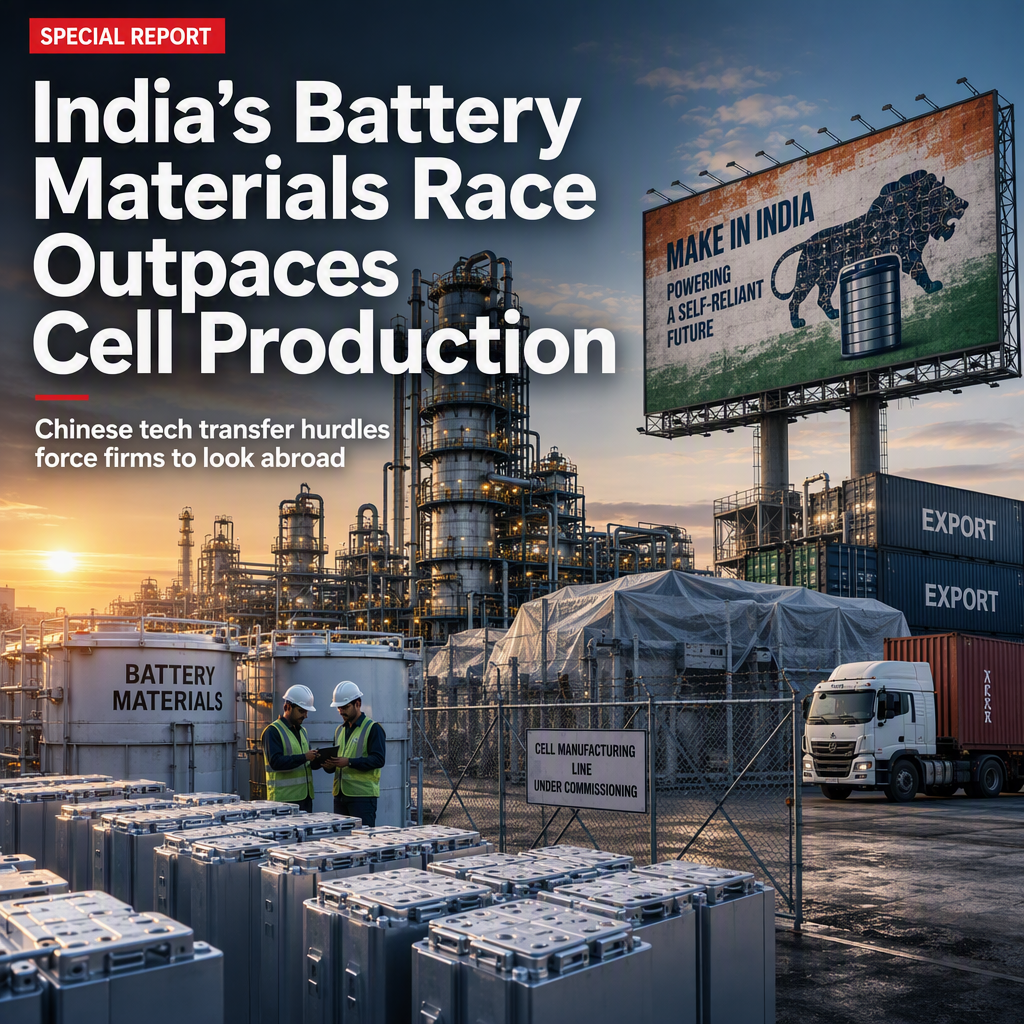
Indian chemical companies are investing billions of rupees in plants to produce lithium-ion battery materials, but these investments are facing a significant challenge due to a lack of domestic customers. This situation has arisen because Chinese restrictions on technology transfers have delayed the development of lithium-ion cell manufacturing in India, despite plans announced by companies such as Ola Electric under a government subsidy program [1]. Most Indian firms have had to delay or stall their cell manufacturing efforts as a direct result of these Chinese technology transfer restrictions [1].
This has led to a scenario where investment in battery materials is racing ahead of the creation of local cell production capacity, creating a bottleneck in the supply chain. As a result, chemical companies are seeking customers and partnerships abroad, since the domestic market for battery-grade chemicals and materials remains underdeveloped [1]. Industry executives highlight this as a mismatch between India's ambitions to become a battery manufacturing hub and the practical challenges of acquiring critical know-how and technology, which is currently dominated by Chinese suppliers. One executive stated, 'We have the materials but not the market. Until cell manufacturing takes off, our investments are looking for buyers overseas' [1].
Despite government subsidies and incentives, the pace of progress in actual lithium-ion cell production has slowed. Companies are now exploring export opportunities and joint ventures with foreign partners to make their investments viable. The current landscape suggests that unless the technology transfer issue is resolved, India's battery materials sector will continue to outpace its cell manufacturing capabilities [1].
CONCLUSION
India's battery materials sector is advancing rapidly, but a lack of domestic cell manufacturing—caused by Chinese technology transfer restrictions—is forcing companies to look abroad for customers and partners. Without resolution of these technology transfer issues, the imbalance between materials production and cell manufacturing is likely to persist, limiting India's ambitions to become a battery manufacturing hub.