
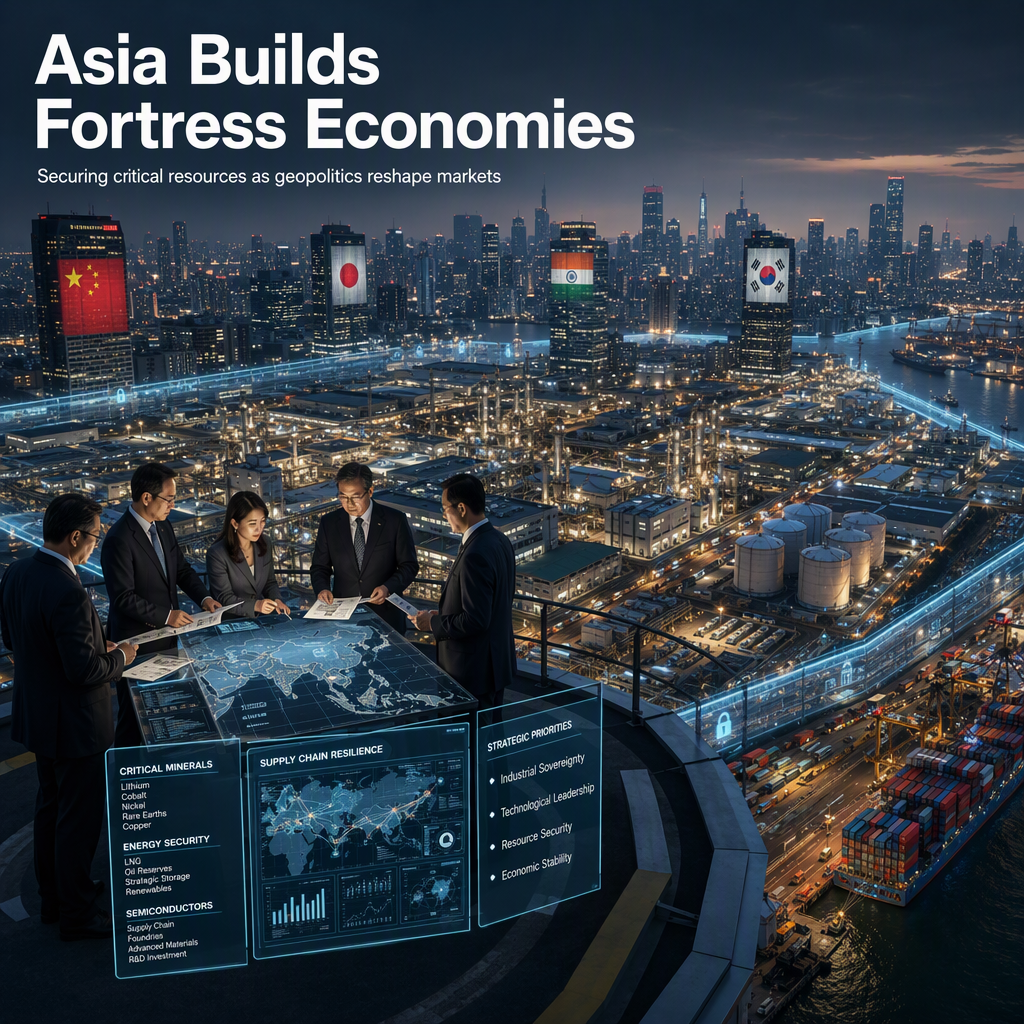
Asian countries are increasingly adopting 'fortress economy' strategies, focusing on securing critical resources, technology, and supply chains in response to intensifying geopolitical rivalries and global uncertainties [1]. The 'fortress economy' concept involves building self-sufficient economic systems that reduce reliance on global trade and prioritize domestic supply chains for essential sectors such as energy, technology, and food [1].
Concrete initiatives include China's expansion of its Made in China 2025 program to achieve technological self-reliance in semiconductors, artificial intelligence, and green energy, as well as Japan's multi-billion dollar investments to reshore production of key components and establish strategic reserves for rare earths and energy resources [1]. India is advancing its Atmanirbhar Bharat (self-reliant India) policy to boost domestic production across sectors like electronics and defense, while South Korea is investing heavily in semiconductor fabrication and battery technology to protect its industries from global shocks [1].
Financially, governments across Asia are allocating significant capital to stockpile resources and develop domestic alternatives. China's sovereign wealth funds and state-owned enterprises are investing in overseas mines and energy projects to secure long-term supply, while Japan and South Korea are signing long-term contracts with energy exporters and forming strategic partnerships to diversify supply sources [1].
These moves are resulting in increased government intervention in Asian markets and a shift in capital flows toward sectors considered critical for national security. Investors are closely monitoring government policies, regulatory changes, and new trade barriers that could impact profitability and risk [1]. Analysts suggest that this trend may lead to higher costs for consumers and businesses, as well as a more fragmented global economy [1].
CONCLUSION
Asian nations are rapidly implementing fortress economy strategies, reshaping investment flows and increasing government intervention in critical sectors. This shift is likely to raise costs and contribute to a more fragmented global economic landscape, with significant implications for investors and market participants.