
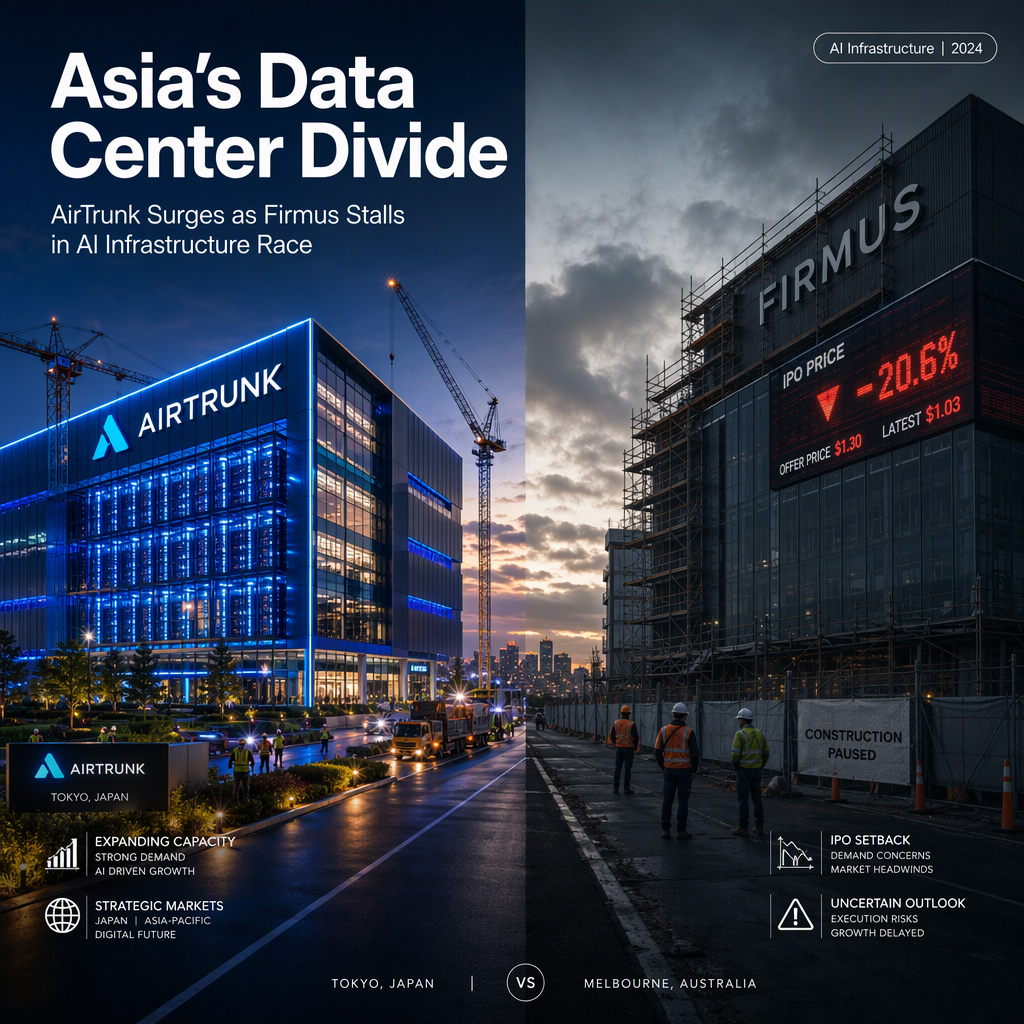
Australia's data center sector is experiencing significant developments as two major operators, AirTrunk and Firmus, pursue divergent strategies in response to surging demand for artificial intelligence (AI) infrastructure across Asia. AirTrunk, backed by Blackstone, announced plans to triple its total data center investment in Japan to as much as $30 billion over the next five years, up from a previous $8 billion commitment. CEO Robin Khuda stated that customers are 'happy to pay a premium' for capacity in Japan, emphasizing the country's strategic importance and the unprecedented scale of digital transformation in Asia. AirTrunk's expansion targets hyperscale customers, including major cloud service and technology companies, and focuses on high energy efficiency and sustainability to meet rising environmental expectations. No specific locations or timelines for new facilities were disclosed [1].
In contrast, Firmus, another Australian data center operator backed by Nvidia, Coatue Management, Blackstone, and Jane Street, has scrapped its planned $5 billion initial public offering (IPO) due to weak demand and market volatility. The IPO, which would have been the second-largest in Australia's history, was abandoned after the company concluded that the terms did not reflect its business strength or long-term growth outlook. Firmus had aimed for an equity valuation of $30.6 billion, nearly triple its $10.5 billion valuation from August, but faced investor skepticism over the rapid valuation increase, high capital requirements, and execution risks. The company will now seek private funding and consider alternative options [2].
Firmus currently operates two modular AI factories in Melbourne and Singapore, with five more in early development across the Asia-Pacific. Analysts noted that Firmus has about $30 billion in debt, implying an enterprise value of approximately $60 billion. Jun Bei Liu, co-founder of Ten Cap, commented that the Firmus situation is a 'reality check' for the AI investment boom, highlighting a broader investor shift towards scrutinizing the economics and returns of AI infrastructure projects. The recent pullback in U.S.-listed chipmakers, which fell 3.4% following concerns about OpenAI's revenues, further underscores market caution despite the ongoing AI-driven expansion [2].
While AirTrunk's aggressive investment signals confidence in the region's growth prospects, Firmus' IPO withdrawal reflects heightened investor selectivity and concerns about the sustainability of rapid valuation increases and large-scale capital spending in the AI infrastructure space [1][2].
CONCLUSION
The contrasting moves by AirTrunk and Firmus underscore both the opportunities and challenges in Asia-Pacific's booming data center market. AirTrunk's expansion highlights robust demand and investor confidence, while Firmus' failed IPO signals growing caution and a focus on sustainable returns. The market remains dynamic, with investor sentiment increasingly shaped by execution risks and the economics of large-scale AI infrastructure investments.