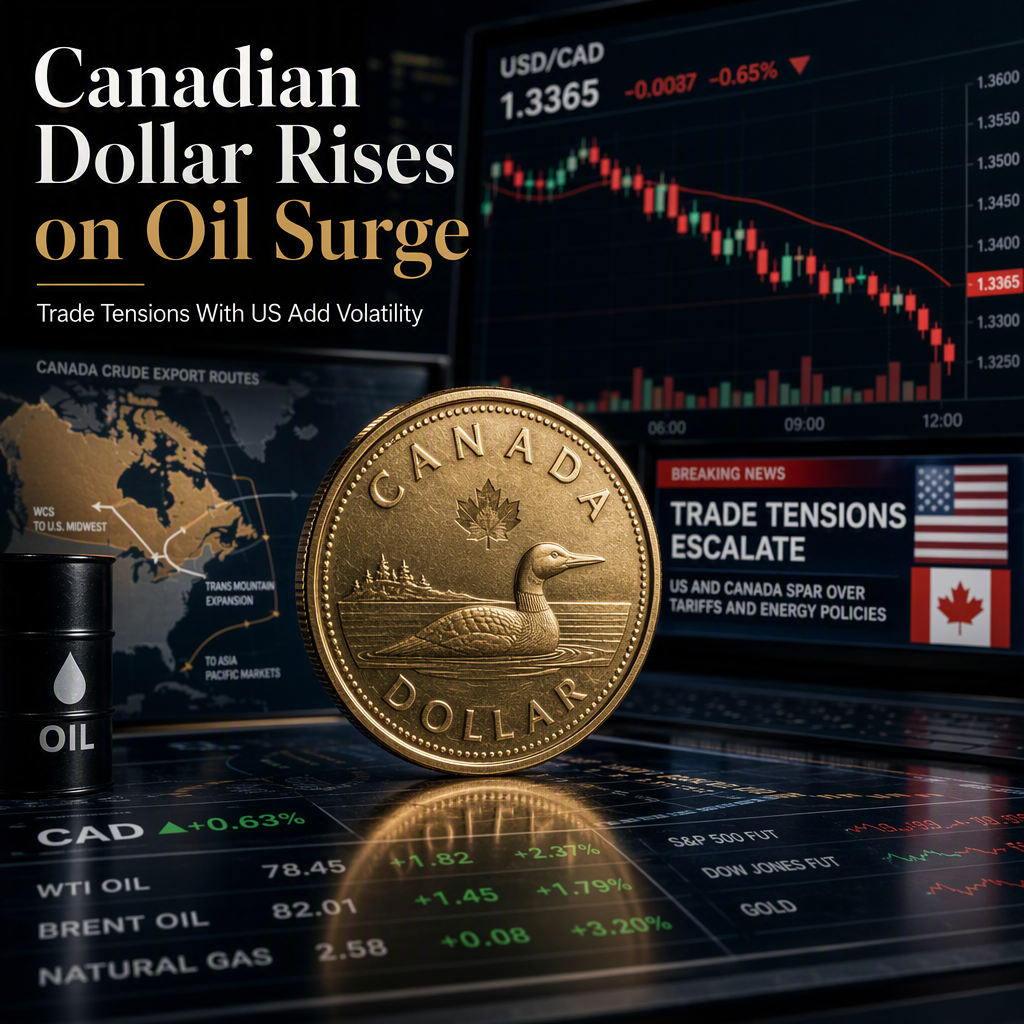
The Canadian Dollar (CAD) has gained ground against the US Dollar (USD), with the USD/CAD pair remaining subdued for the third consecutive day, trading around 1.3780 during Asian hours on Wednesday [1]. This movement is attributed to elevated oil prices, which benefit the commodity-linked CAD due to Canada’s status as a major crude exporter [1]. Crude oil prices surged following a US strike on several Iranian tankers near Kharg Island, escalating geopolitical tensions and raising concerns about potential disruptions to global oil supplies [1]. In response, Tehran launched ballistic missiles toward Jordan and issued warnings to vessels in the Persian Gulf, urging crews near Kuwaiti and Bahraini ports to abandon their ships [1].
Simultaneously, US-Canada trade tensions have intensified. According to BBC reports cited in the article, US President Donald Trump is banning select Canadian products, including alcohol, dairy, and motor vehicles, as Canadian retaliatory tariffs on American goods come into force [1]. These new US restrictions, set to take effect by September 29, follow Canada’s implementation of tariffs on billions of dollars’ worth of imported American goods [1]. Strategists at Scotiabank highlight that US trade frictions are broadening, with President Trump increasing pressure on the Federal Reserve (Fed) to cut interest rates, even threatening a broader trade war unless the Fed acts [1]. Vice President Vance also suggested last week that the Fed should ease policy [1].
From a technical perspective, USD/CAD maintains a bearish near-term bias, trading below both the short- and medium-term Exponential Moving Averages (EMAs). The pair is capped by the nine-day EMA at 1.3819 and the 50-day EMA at 1.3920, with the 14-day Relative Strength Index (RSI) at about 38, indicating that downside pressure outweighs buying interest [1].
No direct market reaction or forward-looking analyst opinions regarding the Canadian Dollar or the broader market were provided in the second article, which focused on the New Zealand Dollar and Chinese inflation data [2].
CONCLUSION
The Canadian Dollar has strengthened on the back of higher oil prices and escalating trade tensions between the US and Canada, with technical indicators pointing to continued downside pressure on USD/CAD. The situation remains fluid as geopolitical risks and trade policy developments continue to influence market sentiment.