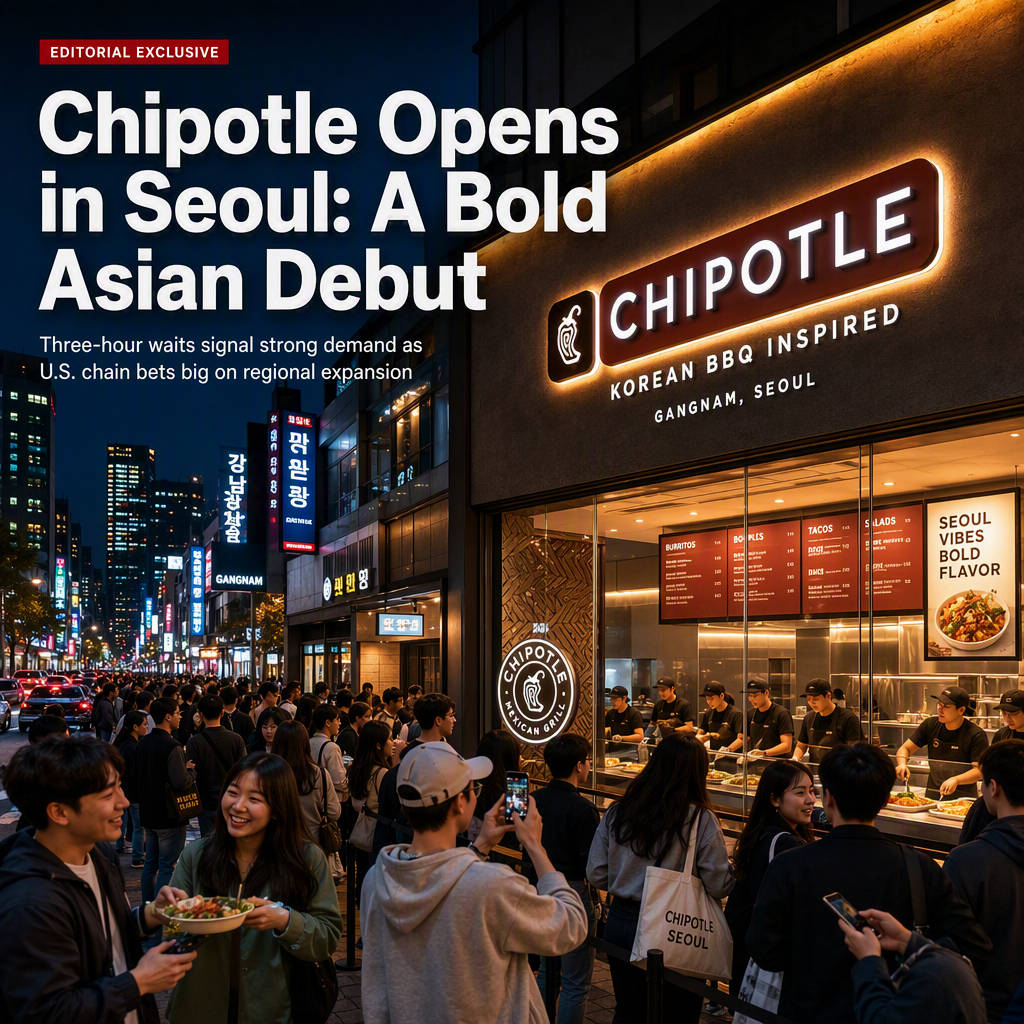
Chipotle opened its first Asian restaurant in Seoul’s Gangnam district in early September, marking a significant step in its international expansion strategy through a joint venture with South Korean food company Sangmidang Holdings [1]. The launch generated substantial buzz, with some South Korean diners reportedly waiting up to three hours for a Chipotle bowl, and social media filled with posts offering menu tips and humorous commentary about the long lines [1]. This Seoul location represents Chipotle’s first-ever joint venture, with S&C Restaurants Holdings structured as 51% owned by Big Bite Company (an affiliate of Sangmidang) and 49% by Chipotle [1].
Nate Lawton, Chipotle's chief business development officer, described the partnership as 'an important evolution of our global growth strategy,' emphasizing the value of Sangmidang's local market knowledge and experience scaling restaurant brands across Asia, including previously bringing Shake Shack to South Korea [1]. Lawton noted that Korea is a testbed for building a scalable, repeatable model for Chipotle’s entry into new regions, rather than focusing solely on the performance of a single restaurant [1].
Chipotle’s joint venture partner indicated plans to launch in Singapore in the first half of 2027, furthering the company’s Asian expansion [1]. According to Mintel, South Korean consumer interest in Mexican food is strong, with 42% having eaten it in the past three months and another 37% expressing interest [1]. Heng Hong Tan of Mintel highlighted that both South Korea and Singapore offer favorable conditions for international fast-casual brands due to their globally connected, well-traveled consumers [1]. However, Chipotle faces competition from established local and international chains such as Cuchara in South Korea and Guzman y Gomez and Stuff’d in Singapore [1].
Expanding in Asia requires building local supply infrastructure, which Chipotle and its partner have begun to establish in South Korea [1]. The company also has an established presence in Canada and Europe and is expanding through partnerships in the Middle East and Mexico [1].
CONCLUSION
Chipotle’s Seoul opening marks a pivotal move in its Asian expansion strategy, leveraging a joint venture model to build local infrastructure and brand awareness. Strong consumer interest and favorable market conditions suggest growth potential, though competition remains a challenge. The company’s focus is on creating a scalable model for future regional launches, with Singapore targeted for 2027.