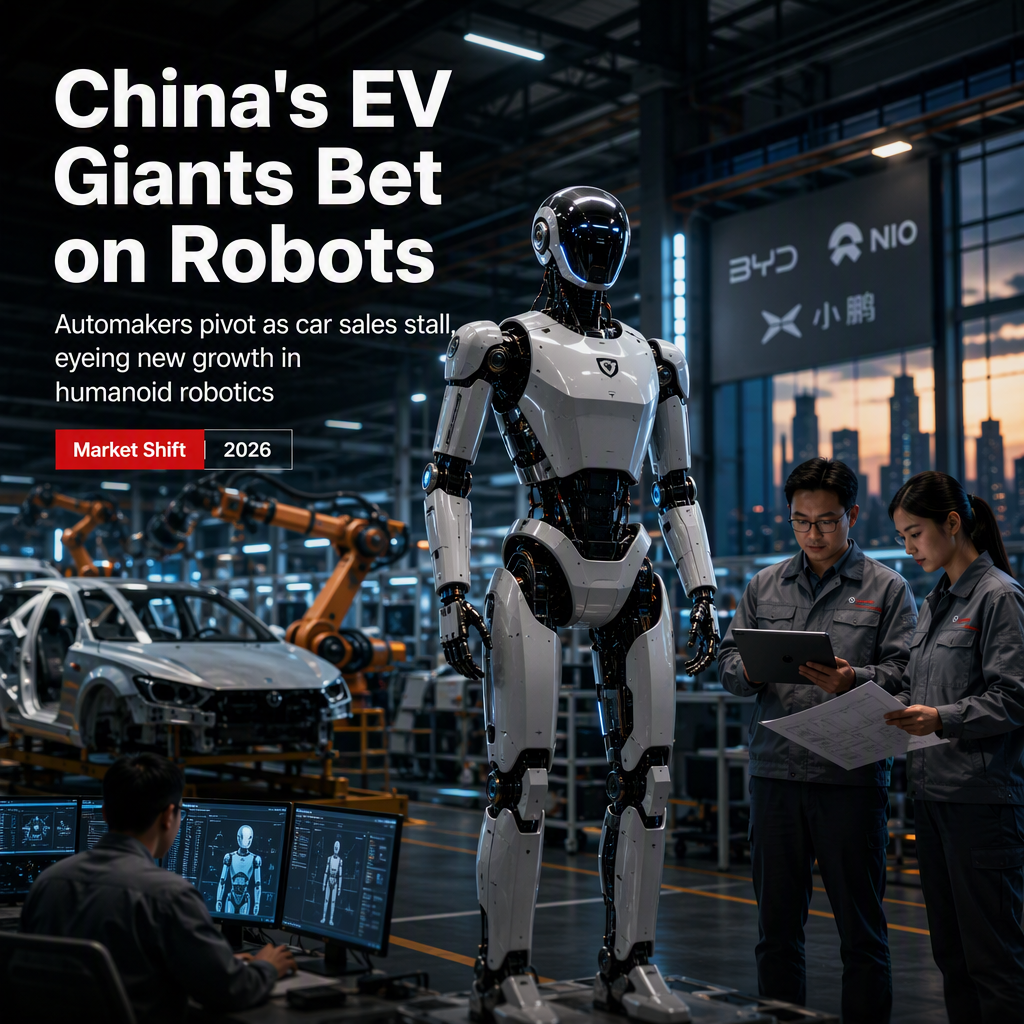
Chinese electric vehicle (EV) manufacturers, including Xpeng, Xiaomi, Li Auto, Geely, and others, are increasingly shifting their focus toward humanoid robotics as growth in the domestic EV market slows and profitability weakens [1]. According to Kevin Li, associate director at Counterpoint Research, this strategic diversification aims to reshape 'capital valuation narratives' and establish a second growth curve for these companies [1]. The move comes as China's EV sales are on track for their worst year since 2021, with Xpeng shares dropping more than 45% year-to-date, making them the worst performer among major EV players, while BYD shares are down over 13% due to slumping sales [1].
The average profit margin in China's vehicle manufacturing sector was just 1.5% in the first half of 2026, based on data from the China Association of Automobile Manufacturers cited by Counterpoint [1]. In response, companies like Xpeng have announced robot production plans, and the venture arm of Nio has invested in humanoid robotics startups such as LimX Dynamics and Acorn Robot, according to PitchBook data [1]. As of August, Chinese automakers accounted for more than half of the nearly 20 car companies worldwide that have entered the humanoid robotics sector through in-house development, investment, or incubation [1].
Despite these efforts, investor enthusiasm for the robotics narrative remains muted. Xpeng shares declined after the company raised $900 million for its robotics business last month, which the company described as the largest single round in China's 'embodied' AI industry. This fundraising valued Xpeng's robotics unit at over $6.3 billion, nearly matching the $6.5 billion estimated value for Xpeng's EV business, according to Citi [1].
Jing Yang, director of Asia-Pacific corporate ratings at Fitch Ratings, commented that diversifying into robotics is a natural strategic move for EV companies facing slowing growth and weakening profitability, as it allows them to pursue alternative growth drivers, achieve economies of scale for shared advanced technologies, and potentially improve profitability over the medium term [1]. Xiaoyi Lei, senior research analyst at Jefferies Hong Kong, noted that Chinese automakers have advantages in robotics development, such as Xpeng's ability to reuse 85% of its supply chain for robotics projects [1].
CONCLUSION
China's leading EV makers are aggressively diversifying into humanoid robotics to counteract slowing sales and shrinking profit margins in the automotive sector. While these moves have yet to win over investors, industry analysts see potential for improved profitability and technological synergies in the medium term. The market impact is significant, as this strategic pivot could reshape the competitive landscape for both EVs and robotics in China.