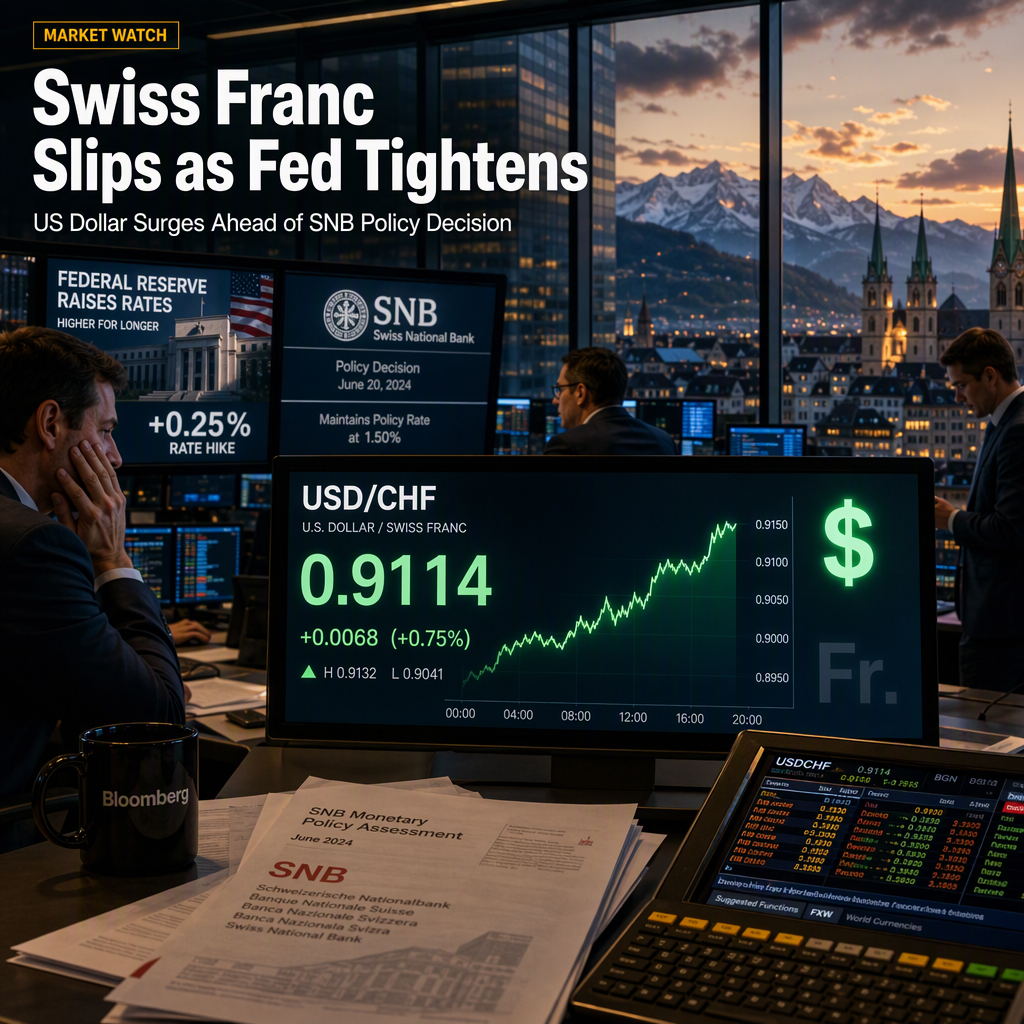
The Swiss Franc (CHF) weakened against the US Dollar (USD) on Wednesday, with USD/CHF edging higher and snapping a four-day losing streak. At the time of writing, the currency pair trades around 0.8234, near the more than one-year high of 0.8263 reached last week [1]. This movement follows the Federal Reserve’s (Fed) hawkish rate hike at its September 15-16 policy meeting, where the Fed raised rates by 25 basis points—the first hike in three years—in response to persistent inflation and elevated energy prices linked to the war in the Middle East [1]. The Fed’s updated projections place the median rate forecast at 4.1% for both 2026 and 2027, signaling one more hike this year and no cuts next year [1]. Recent comments from Fed officials, including Richmond Fed President Tom Barkin and Boston Fed President Susan Collins, have reinforced the hawkish outlook, emphasizing the need for a more restrictive federal funds rate to ensure inflation returns to target [1]. The US Dollar Index (DXY) is trading around 100.90, its highest level since July 30, reflecting strong demand for the Greenback [1]. On the Swiss side, the Swiss National Bank (SNB) maintains a 0% policy rate, leaving the CHF at a yield disadvantage compared to the USD [1]. The SNB is set to announce its next policy decision on Thursday, with markets widely expecting rates to remain unchanged [1]. Economists at DBS Group Research anticipate the SNB will keep its policy rate steady but may raise its near-term inflation forecast due to elevated energy prices and ongoing uncertainty in the Middle East [1]. DBS notes that the SNB may pay closer attention to second-round effects, such as processed food, transport, tourism, and restaurants, as it evaluates the breadth of price pressures [1]. The hawkishness of any forecast upgrade will depend on whether the SNB sees the oil shock feeding into underlying inflation, with the policy signal hinging on how far these cost increases permeate the broader economy [1]. DBS also suggests that recent Fed and ECB hikes could provide a stronger counterweight to haven demand for the CHF, potentially easing pressure on the Swiss currency [1].
CONCLUSION
The Swiss Franc’s weakness ahead of the SNB rate decision is driven by the Fed’s hawkish stance and rate hike, which has boosted the US Dollar. While the SNB is expected to keep rates unchanged, elevated energy prices and persistent inflation risks may prompt a more cautious outlook. Market participants are closely watching the SNB’s inflation forecasts and policy signals for further direction.