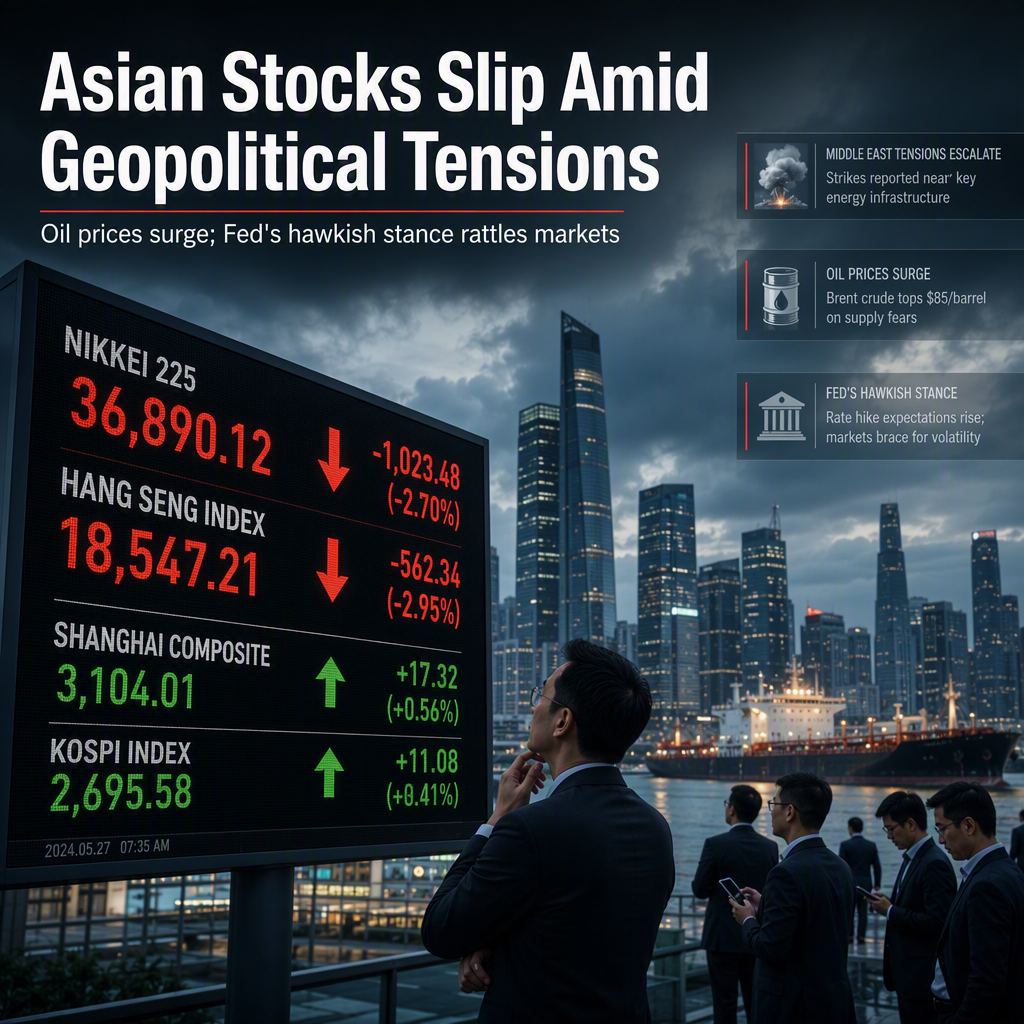
Asian equity markets experienced slight downward pressure at the start of the week, driven by renewed geopolitical tensions in the Middle East and increased expectations for further interest rate hikes by the US Federal Reserve. The Nikkei 225 index fell by 0.25% to near 66,250, while the Hang Seng declined 0.36% to just below 22,500. In contrast, Chinese stock markets posted gains of up to 0.7%, and South Korea's KOSPI rose 0.46% to around 6,820 [1].
The market downturn was attributed to escalating tensions between the United States and Iran. According to Bloomberg, Iran retaliated by attacking US bases in Jordan after the US struck Iranian rocket launchers that were preparing to deploy mines into the Strait of Hormuz. This conflict led to a sharp increase in oil prices, with WTI crude trading 2.5% higher at approximately $84.85 at the time of reporting [1]. Higher oil prices are seen as a negative factor for many Asian economies due to their heavy reliance on oil imports [1].
Additionally, hawkish comments from Federal Reserve Chair Kevin Warsh at the Jackson Hole Symposium reinforced the central bank's commitment to reducing inflation. As a result, market expectations for the Fed to keep interest rates unchanged at its September meeting dropped to 39.4%, down from nearly 60% a week earlier, according to the CME FedWatch tool [1].
The combination of geopolitical risks and shifting monetary policy expectations contributed to a cautious market sentiment across Asia, with investors closely monitoring developments in both the Middle East and US monetary policy.
CONCLUSION
Asian stock markets faced moderate declines amid renewed Middle East tensions and rising expectations for US interest rate hikes. Higher oil prices and hawkish Fed signals weighed on investor sentiment, particularly in economies dependent on energy imports. Market participants are expected to remain cautious as they track geopolitical developments and upcoming Fed decisions.