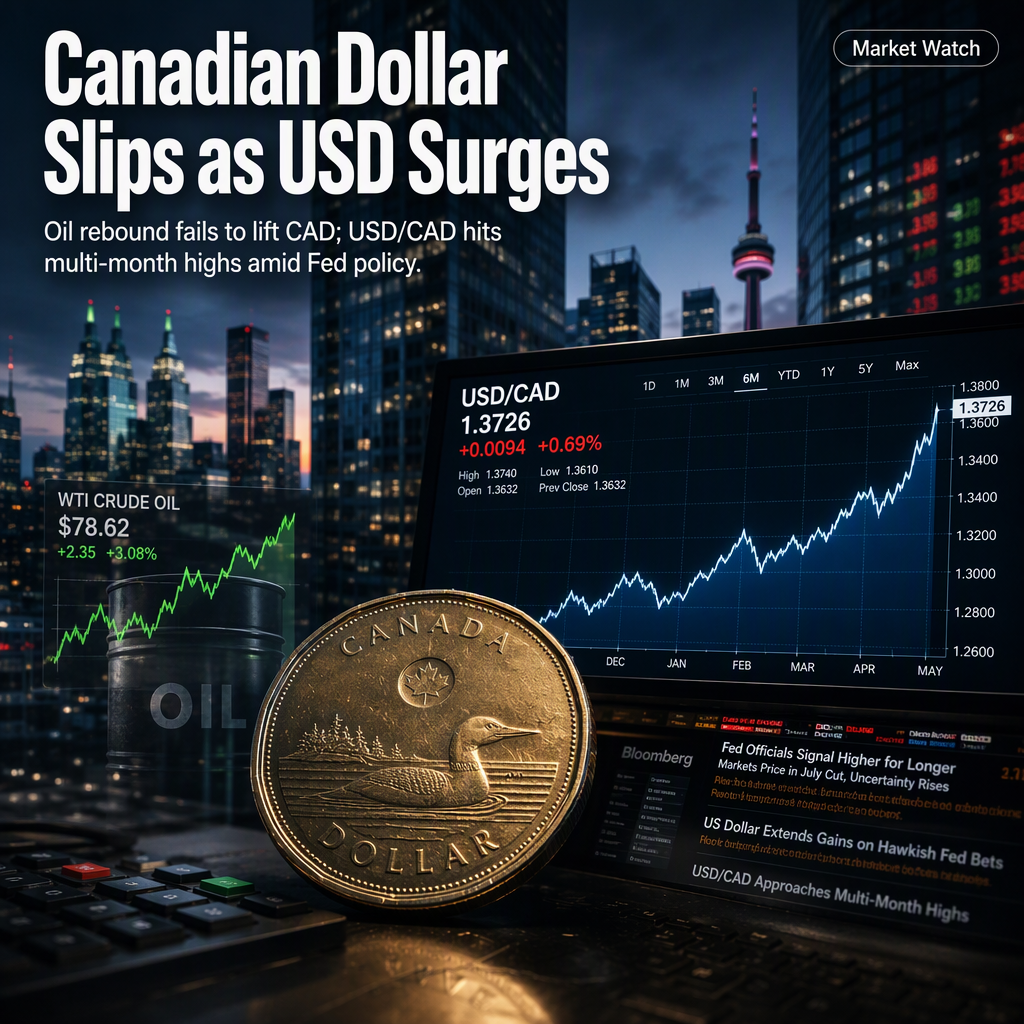
The Canadian Dollar (CAD) continues to weaken against the US Dollar (USD), with USD/CAD trading around 1.4090 and up 0.21% on the day, reaching its highest levels since late July [1][2]. Scotiabank strategists Shaun Osborne and Eric Theoret attribute the CAD's underperformance to wide yield spreads and typical negative Q4 seasonality, noting that October and November returns for the CAD versus the USD are usually negative [1]. Despite the CAD being the 'best of the rest' among G10 currencies after the USD, modest USD gains have pushed the pair higher, with technical analysis indicating a bullish trend targeting 1.4125, while support is seen at 1.4050/60 and 1.3990/00 [1].
Oil prices, a key driver for the Canadian Dollar, have rebounded with West Texas Intermediate (WTI) rising above $90 and gaining 0.70% at the time of reporting, following a sharp decline in previous days [2]. However, this recovery in oil has failed to provide support to the CAD against the stronger USD [2]. The rebound in oil prices is attributed to diplomatic developments involving the US and Iran, including potential reopening of the Strait of Hormuz and Saudi Arabia's efforts to restore alternative export routes, which have eased concerns about global oil supply [2].
On the US side, the Federal Reserve has raised interest rates for the first time in three years and signaled the possibility of another hike this year, maintaining a restrictive monetary policy stance that continues to support the USD [2]. While the recent decline in oil prices has helped ease concerns about another acceleration in US inflation, US Treasury yields remain below recent multi-year highs, which could limit further USD gains and restrain another leg higher in USD/CAD [2].
Technical analysis from both sources highlights a bullish outlook for USD/CAD, with the pair holding above key moving averages and resistance levels. The immediate resistance is at 1.4100, followed by 1.4130, while support is seen at 1.4025 and deeper at 1.3974 and 1.3945 [1][2]. The Relative Strength Index (RSI) is around 68, suggesting firm upside momentum but also indicating that the pair is approaching overbought territory, which could slow the advance [2].
CONCLUSION
Despite a rebound in oil prices, the Canadian Dollar remains under pressure due to wide yield spreads, negative Q4 seasonality, and a firm US Dollar supported by the Federal Reserve's restrictive policy. Technical indicators point to continued bullish momentum for USD/CAD, with the pair approaching key resistance levels. Market participants should monitor both oil price developments and US monetary policy signals for further direction.