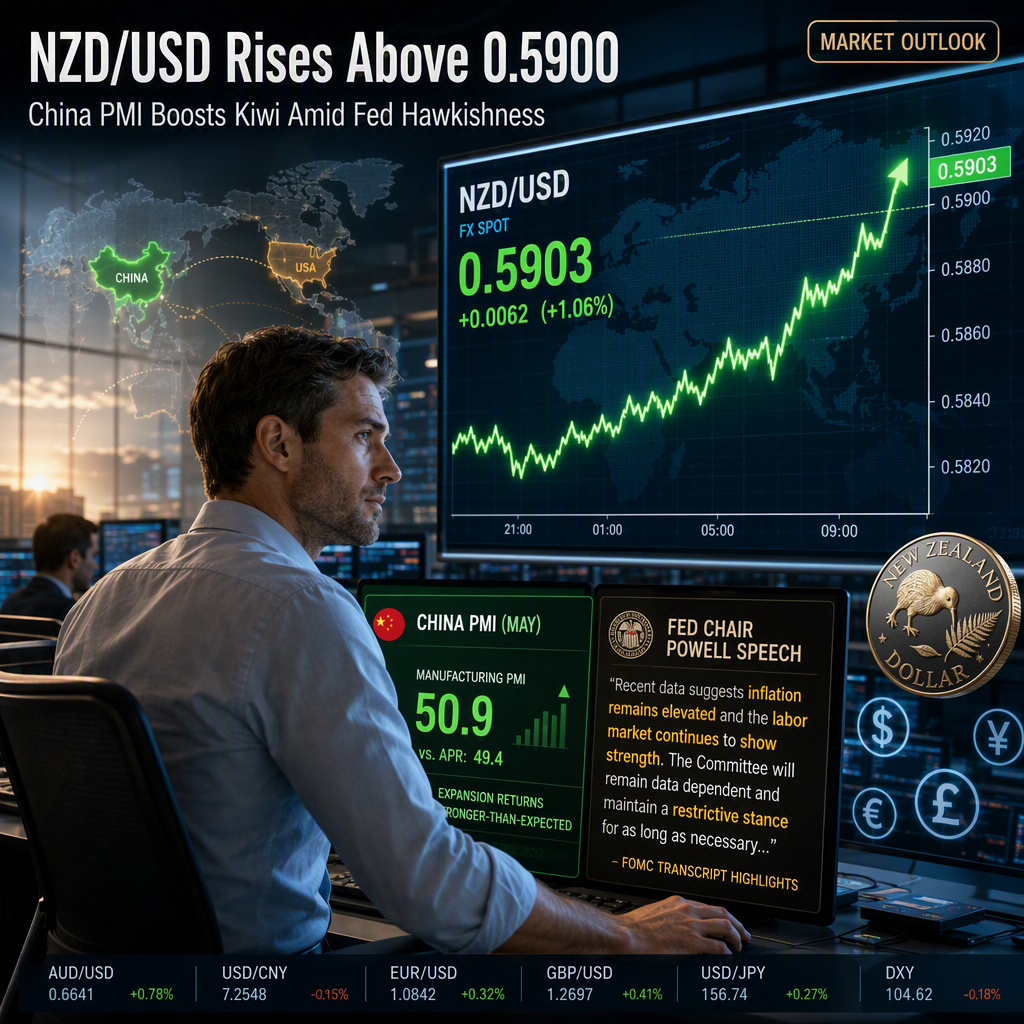
The New Zealand Dollar (NZD) strengthened against the US Dollar (USD), with the NZD/USD pair approaching 0.5915 during early European trading hours on Monday. This upward momentum was attributed to stronger-than-expected Chinese economic data, which provided support to the China-proxy NZD. Specifically, China's Manufacturing Purchasing Managers' Index (PMI) rose to 49.8 in August from 49.2 in July, surpassing the market consensus of 49.7, while the Non-Manufacturing PMI remained steady at 49.0 in August, according to the National Bureau of Statistics (NBS) [1].
However, the gains for NZD/USD faced potential headwinds from a strongly hawkish speech by Federal Reserve Chair Kevin Warsh at the Jackson Hole Economic Symposium. Warsh emphasized that, despite better-than-expected summer PCE and CPI readings, underlying inflation trends have not meaningfully improved, and further tightening may be necessary to curb price pressures. Following his remarks, the probability of a Fed rate hike in September, as measured by the CME FedWatch tool, increased to 56.9% from 39.9% prior to the speech [1].
Looking ahead, market participants are focused on upcoming US economic data releases, including Nonfarm Payrolls (NFP) and the Unemployment Rate, which could influence expectations for the September Fed meeting [1]. On the New Zealand side, strategists at Brown Brothers Harriman anticipate that the Reserve Bank of New Zealand (RBNZ) will maintain a hawkish policy stance at its upcoming meeting. They expect the RBNZ to reiterate that further increases in the Official Cash Rate (OCR) are likely, as the current rate remains within the bank’s neutral range estimate of 2.20%-4.10%. This outlook is supported by ongoing above-target inflation and solid domestic growth [1].
Fed Chair Warsh's speech was notably more hawkish than usual, with a FXS Speechtracker score of 7.4 compared to a historical average of 6.5. He highlighted healthy consumer spending, stable labor markets, and rapid business investment, but stressed that financial conditions remain loose and inflation expectations are still fragile, reinforcing the Fed's commitment to its 2% PCE inflation target [1].
CONCLUSION
The NZD/USD pair found support from robust Chinese PMI data, but faces resistance from a more hawkish US Federal Reserve stance and rising expectations of a September rate hike. Market attention now turns to upcoming US economic data and the RBNZ's policy guidance, both of which could further influence currency movements.