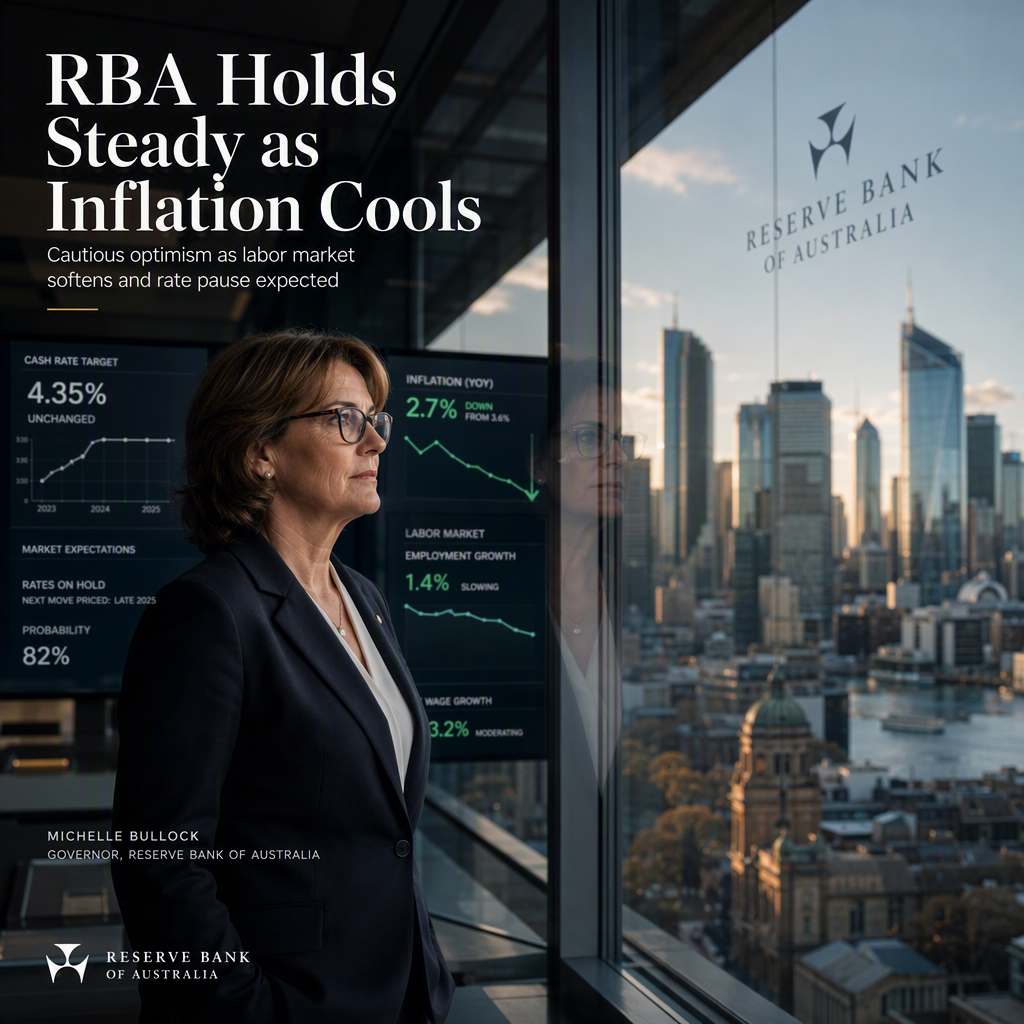
Standard Chartered’s Nicholas Chia anticipates that the Reserve Bank of Australia (RBA) will maintain its cash rate at 4.35% during the upcoming 11 August meeting, with no further rate hikes expected for the remainder of the year [1]. This outlook is supported by Q2 trimmed mean inflation holding steady at 0.8% quarter-on-quarter, which is below the RBA’s previous forecast of 0.9% [1]. The easing of short-term inflation expectations in July, now below pre-war levels, and a softening labor market—evidenced by a rising unemployment rate in June—further reinforce the likelihood of an extended pause in monetary tightening [1]. Despite these signs, job vacancies remain stable and employment growth is robust, indicating some continued tightness in the labor market [1].
Governor Bullock has highlighted the economy’s unfavourable starting point, citing excess demand and a positive output gap as reasons for caution [1]. Housing prices experienced a significant decline in July, likely reflecting the delayed effects of previous rate hikes and ongoing uncertainty regarding budgetary tax changes [1]. While Standard Chartered’s base case is that the RBA is finished with rate hikes for the foreseeable future, they note a risk of another hike in Q4 if demand does not slow sufficiently to contain underlying price pressures [1].
The decline in oil prices in June is seen as a partial driver for the rebound in consumer confidence and robust household spending, particularly in air travel and recreational activities [1]. Additionally, the services PMI rebounded to a six-month high in July, led by increased new orders and output price inflation at levels last observed in April and May [1].
CONCLUSION
The RBA is expected to maintain its current cash rate amid easing inflation and a softening labor market, with Standard Chartered viewing further hikes this year as unlikely. However, persistent demand and underlying price pressures could prompt a rate increase in Q4. Market sentiment remains cautiously optimistic, with consumer confidence and spending showing resilience.