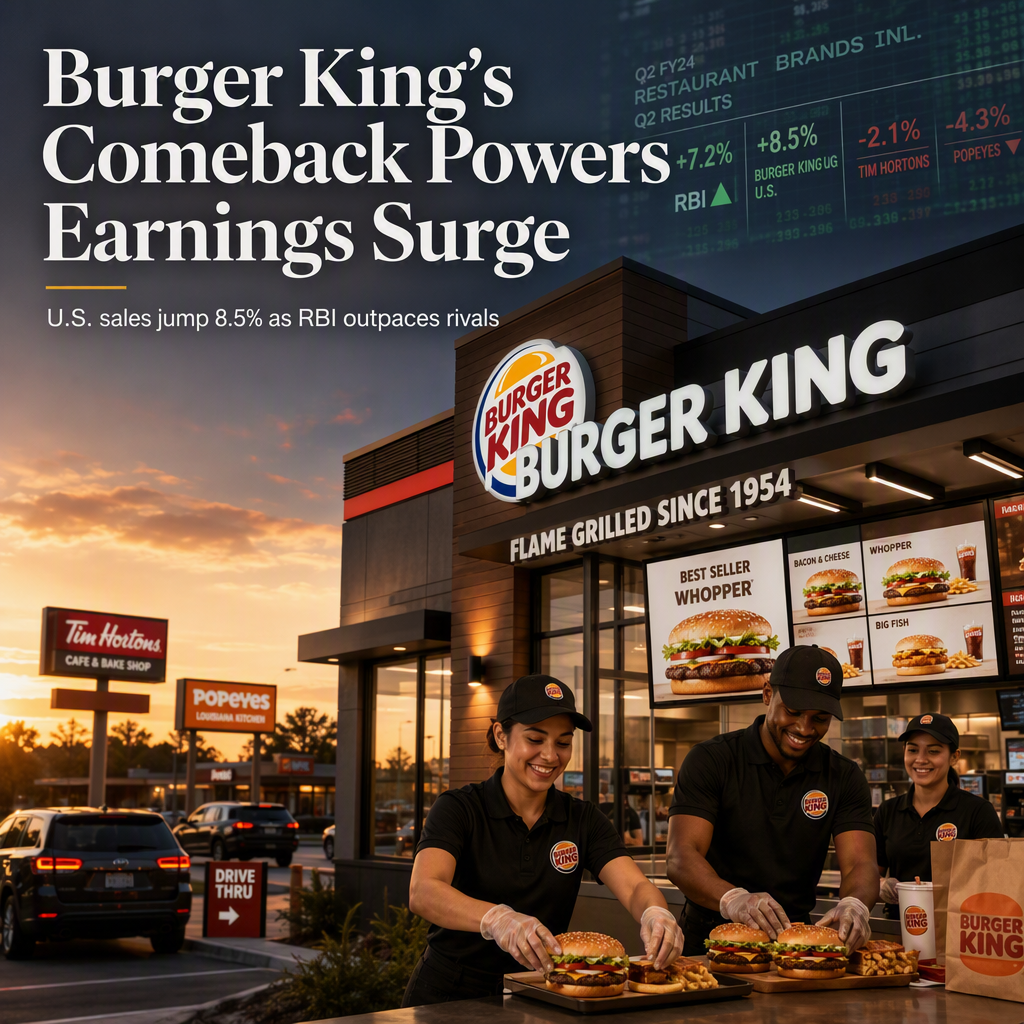
Restaurant Brands International reported quarterly earnings that exceeded analysts' expectations, driven by robust growth at Burger King in both the U.S. and international markets [1]. The company posted adjusted earnings per share of $1.07, surpassing the expected $1.03, while revenue reached $2.52 billion, matching Wall Street forecasts [1]. Net income attributable to shareholders rose sharply to $507 million, or $1.45 per share, compared to $189 million, or 57 cents per share, in the same quarter last year [1].
Burger King's U.S. same-store sales surged 8.5%, reflecting successful turnaround efforts including restaurant renovations, improved marketing, and a renewed focus on core menu items such as the Whopper [1]. This performance notably outpaced rival McDonald's, which reported U.S. same-store sales growth of only 0.8% in the second quarter and expressed disappointment with its results [1]. Internationally, Burger King also delivered strong results, with same-store sales growth of 5.4% [1].
However, other brands under Restaurant Brands International did not perform as well. Tim Hortons' same-store sales in Canada and overall remained essentially flat, while Popeyes Louisiana Kitchen experienced a 5.2% decline in U.S. same-store sales, attributed to increased competition and value-conscious consumers [1].
CEO Josh Kobza emphasized that Burger King's turnaround demonstrates the effectiveness of investing in fundamentals and executing well, a strategy being applied across all brands within the company [1].
CONCLUSION
Restaurant Brands International's strong earnings were primarily fueled by Burger King's impressive U.S. and international sales growth, highlighting successful turnaround strategies. While Burger King gained market share, other brands like Tim Hortons and Popeyes faced challenges. The overall market takeaway is positive, with Burger King's performance driving optimism for the company's future growth.