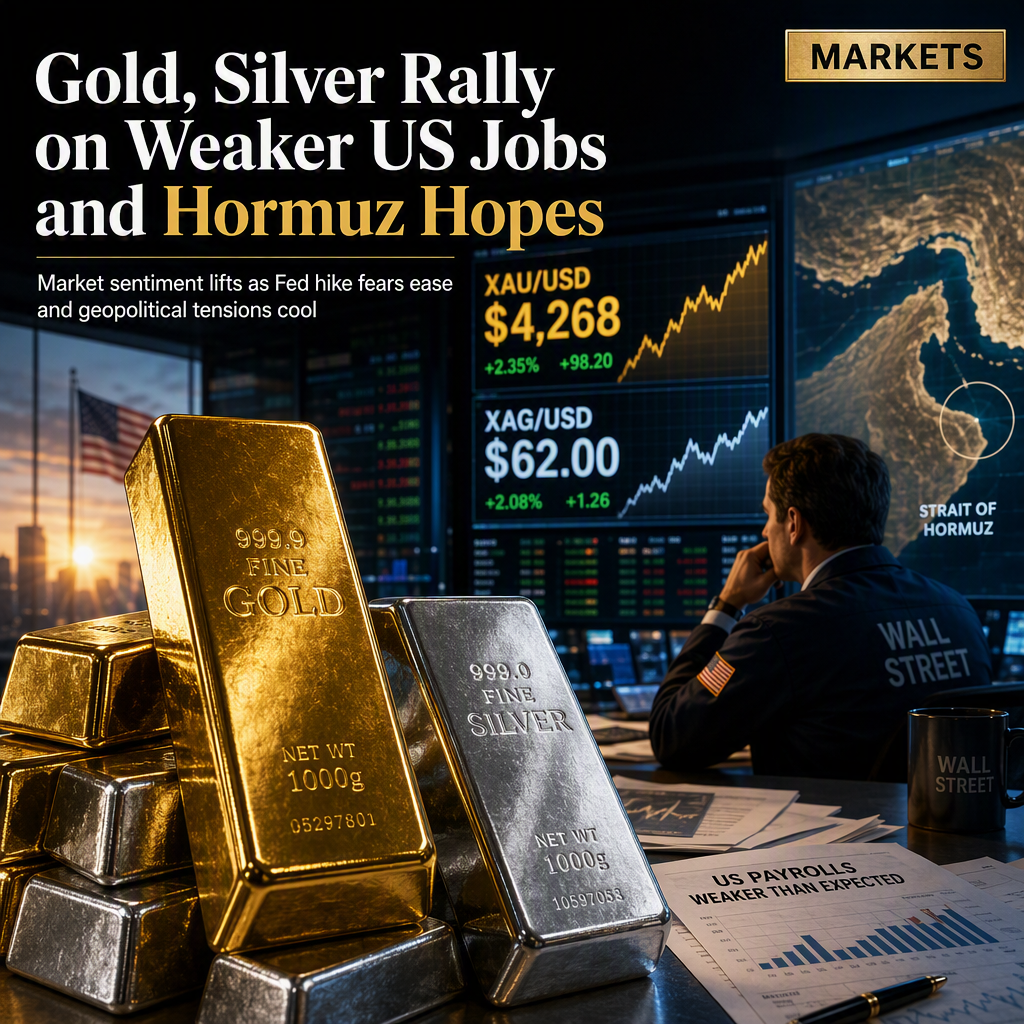
Gold and silver prices have both rallied, with gold reaching its highest level since late June and silver holding firm near $62 per ounce, as markets react to weaker-than-expected US payrolls data and optimism over a potential deal to reopen the Strait of Hormuz [1][2][3]. Gold (XAU/USD) traded as high as $4,295 per ounce before settling around $4,268 on Thursday, marking its fourth consecutive winning session and consolidating gains of nearly $200 this week [2][3]. Silver (XAG/USD) maintained two-day gains at around $62.00, trading above its 20-day EMA of $59.43, with technical indicators suggesting a bullish near-term bias and underlying demand [1].
The ADP employment report for July showed a significant slowdown, with only 44,000 jobs added compared to consensus expectations of 65,000, reinforcing the view that US job growth is cooling [1][3]. This weaker labor data has reduced market expectations for a Federal Reserve rate hike in September, providing support for non-yielding assets like gold and silver [1][2][3]. Analysts at TD Securities and MUFG both highlight the moderating trend in employment data and note that political factors are increasingly influencing the US dollar, which has fallen to six-week lows at 99.78 on the dollar index [1][2][3].
Another key catalyst for precious metals has been progress toward a deal between the US and Iran to reopen the Strait of Hormuz, with Iran announcing an agreement with Oman on new shipping arrangements and a joint statement being prepared [1][3]. This development has helped keep oil prices in check, with Brent trading below $80 per barrel, and has eased some of the geopolitical tensions that have weighed on risk assets [1][3].
Technical analysis shows gold confirming a bullish reversal after breaking above a descending triangle, with immediate resistance at $4,300 and the mid-June high of $4,380 in focus [2]. Momentum indicators for gold are in overbought territory, suggesting a possible corrective pause, but dips are expected to find buyers [2]. Silver's momentum remains positive, with the July high at $63.28 as the next key hurdle and support at $59.43 [1].
Despite the recent rally, gold remains over 20% below its all-time high of $5,589 per ounce reached in late January 2026, and has endured a challenging six months following a strong rally earlier in the year [3].
CONCLUSION
Gold and silver prices have surged on the back of weaker US payrolls data and easing geopolitical tensions, reducing expectations for further Fed rate hikes. Technicals suggest continued underlying demand, though gold remains well below its all-time highs. Market sentiment is positive, with risk assets buoyed by both macroeconomic and geopolitical developments.