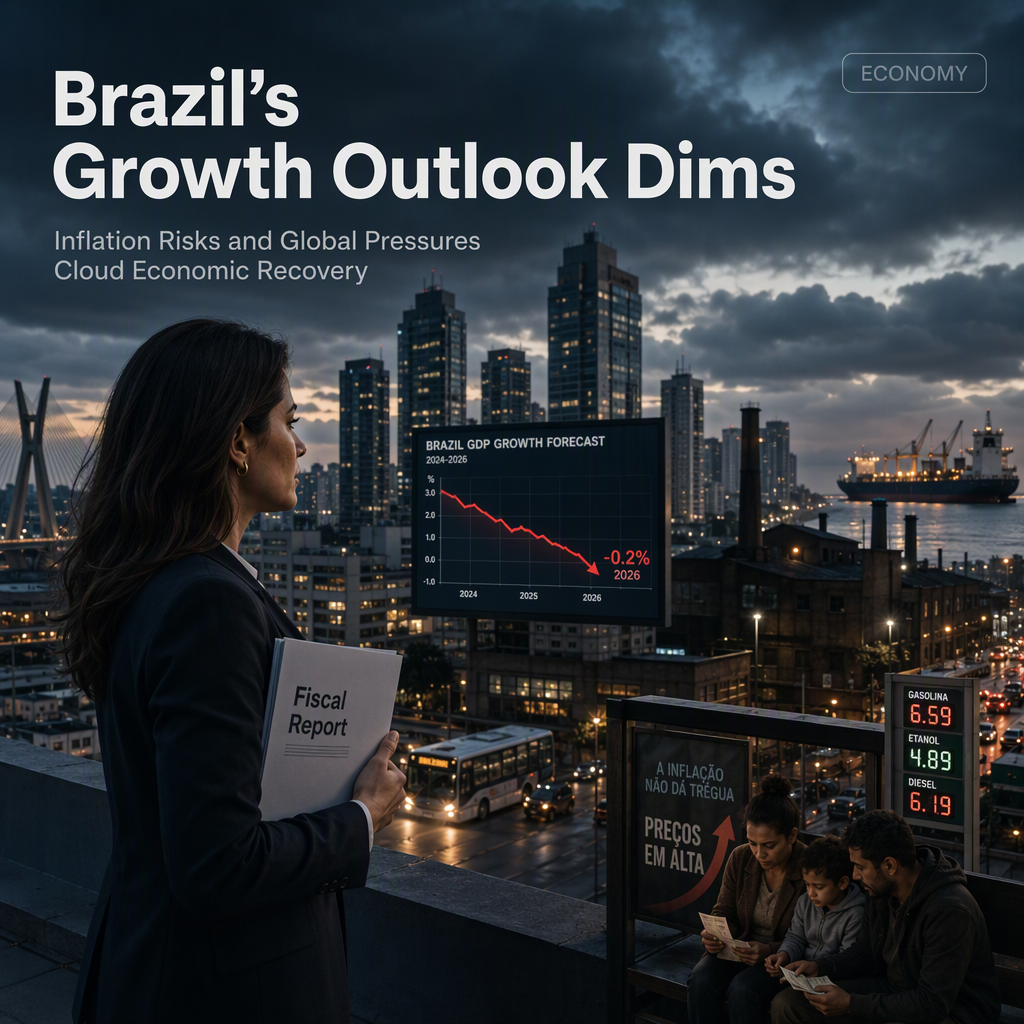
Brazil's Finance Ministry has released updated macro-fiscal forecasts, signaling a more cautious outlook for the country's economic growth and inflation trajectory. The Ministry lowered its GDP growth forecast for 2026 to 2.0% from 2.3%, aligning with Societe Generale's projection, and reduced its 2027 forecast to 2.3% from 2.5%. Societe Generale, however, expects an even sharper slowdown, projecting 1.5% growth in 2027, citing restrictive monetary policy, weaker services activity, and a softer industrial outlook as key factors [1].
The report highlights that Brazil is experiencing a gradual cyclical slowdown, with both services and manufacturing sectors impacted by high borrowing costs. Household consumption is increasingly constrained, as debt-service payments have reached a historical high of 28.9% of income, despite household indebtedness stabilizing. This record debt-service burden is limiting the positive effects of strong wage growth and a tight labor market on consumer spending [1].
Externally, Brazil faces a more challenging environment due to higher oil prices, renewed Federal Reserve tightening, elevated global bond yields, and China's ongoing economic slowdown. Additionally, China's shift toward exporting higher-tech manufactured goods such as EVs, batteries, and semiconductors is intensifying competitive pressure on global industry, including Brazil's [1].
On the inflation front, the government revised its 2026 IPCA inflation forecast down to 4.9% from 5.1%, but raised its 2027 forecast from 3.6% to 3.8%. Inflation has eased to 4.2% year-over-year in August, aided by lower food, fuel, and electricity prices. However, the Finance Ministry warns of upside risks to inflation from higher oil prices, fuel pass-through, food prices (potentially affected by El Niño disruptions and fertilizer supply risks), and a possible reversal in the livestock cycle, which could have lingering effects through 2027 [1].
Societe Generale views the government's assumption of a moderate growth recovery in 2027 as optimistic, given the expected fading of fiscal support after the election, increased weather-related risks to agriculture, and continued household debt burdens. The bank forecasts a sharper slowdown than the government, emphasizing the challenges Brazil faces in its rebalancing phase [1].
CONCLUSION
Brazil's revised macro-fiscal projections reflect a more cautious stance on growth and inflation, with persistent debt-service burdens and external headwinds posing significant challenges. Upside risks to inflation remain, particularly from oil prices and agricultural disruptions. Market participants should prepare for a potentially slower recovery and heightened inflationary pressures through 2027.