
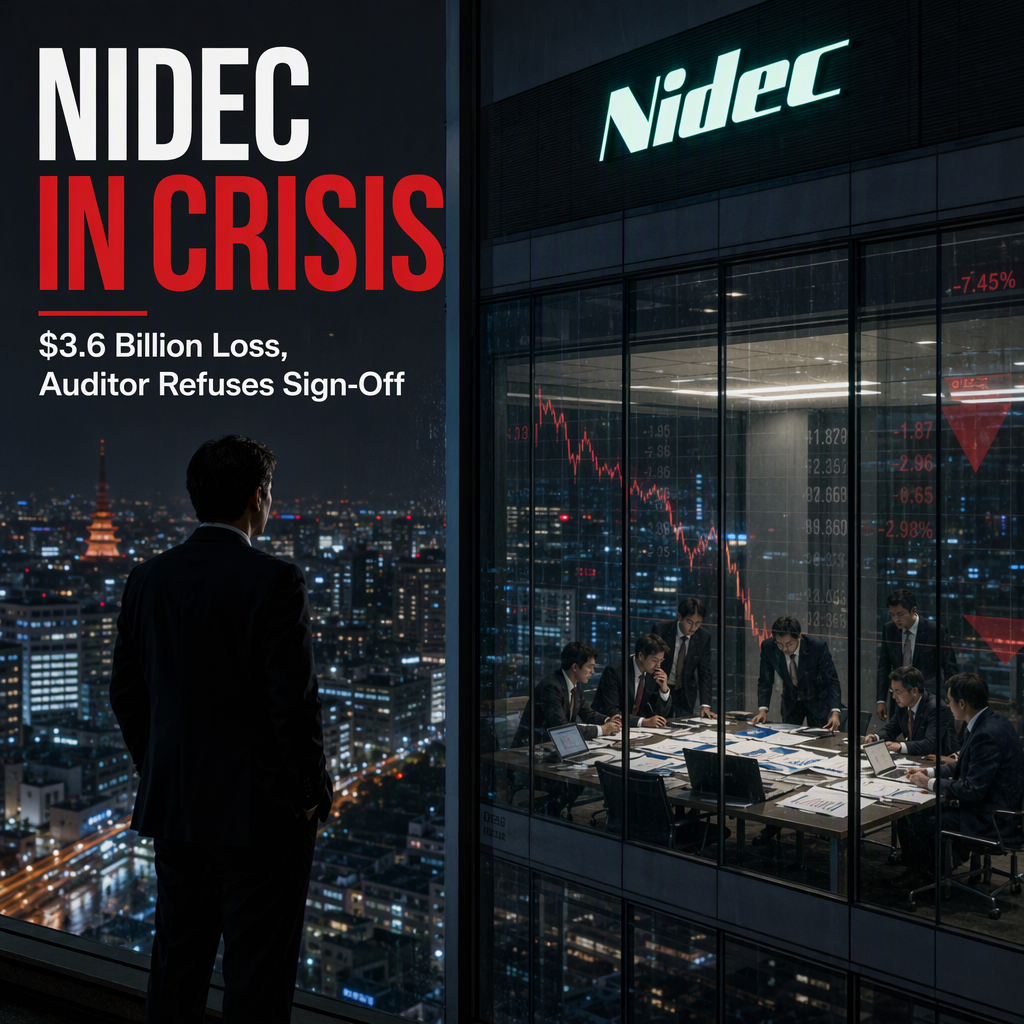
Nidec, the Japanese motor manufacturer, has reported a net loss of 564 billion yen ($3.6 billion) for the fiscal year ended March, primarily due to a significant write-down in its electric vehicle (EV) e-axle business, which integrates motors, gearboxes, and power electronics [2]. This impairment loss is part of a broader series of financial and quality control scandals that have plagued the company, including the recognition of over $3.8 billion in impairment losses and hundreds of cases of quality control misconduct [1].
The company's financial turmoil has been compounded by governance issues, with its accounting firm declining to sign off on the delayed earnings report [1][2]. As a result, Nidec was designated as a "security on special alert" by the Tokyo Stock Exchange last year, and now faces a fast-approaching deadline to demonstrate improvements in its internal controls and governance or risk delisting [1]. The auditor's refusal to vouch for the accuracy of the financial report has intensified calls for the removal of individuals responsible for false statements and improper conduct [1].
In response, Nidec has initiated a series of restructuring measures, including the planned sale of its electronic parts unit to Carlyle and the replacement of its chief executive, Kishida, with the technology head [1][2]. The company is also scaling back its EV drive parts operations, ending its China joint venture, and exiting production in Cambodia due to regional instability [2]. Management has attributed the impairment losses to past expansion and a focus on profit, and is now working to improve governance and restore investor confidence [2].
Market sentiment remains cautious, with analysts and technical experts noting that while leadership changes and restructuring may help, tangible improvements in transparency and quality control are necessary for a sustained recovery [1]. Nidec's stock price is expected to remain volatile, with traders advised to monitor support levels closely as the risk of further downside persists unless clear progress is made in governance reforms [1]. Investors and analysts are closely watching the company's next steps as it attempts to stabilize its core businesses and return to profitability [2].
CONCLUSION
Nidec's $3.6 billion loss and ongoing governance crisis have placed the company under intense regulatory and market scrutiny. While restructuring efforts and leadership changes are underway, investor sentiment remains bearish until concrete improvements in governance and quality control are demonstrated. The risk of delisting and continued volatility will persist unless Nidec can restore confidence through decisive action.