
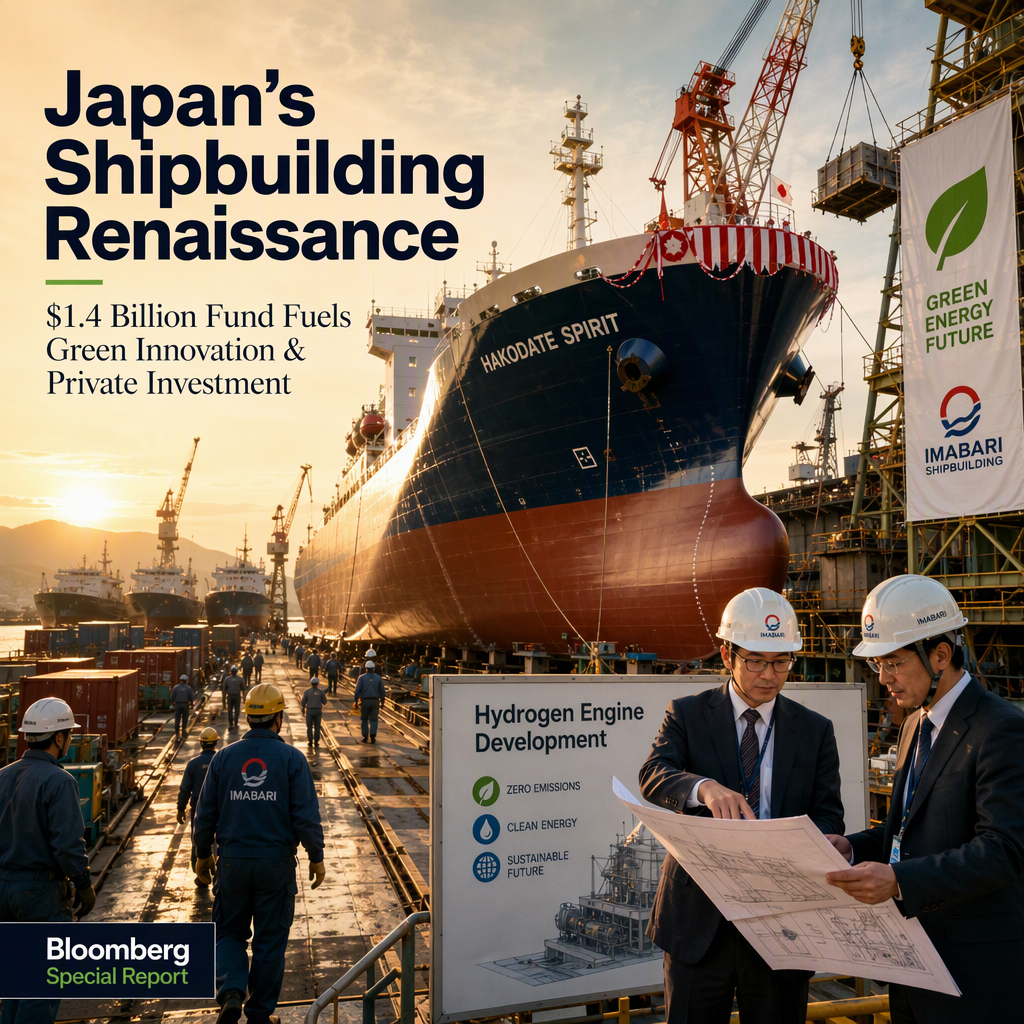
The Japanese government has launched a $1.4 billion fund aimed at revitalizing the country's shipbuilding industry, which is now beginning to attract significant private-sector investment in various projects. This initiative is part of a broader strategy to double Japan's shipbuilding capacity by 2035, a goal that is gaining momentum as demand for new ships surges. Hakodate Dock's shipyard, for example, currently has an order backlog exceeding three years, highlighting the robust demand and the industry's turnaround from previous downsizing in response to challenging market conditions [1].
Major shipbuilders such as Imabari have benefited from the government's subsidies, which are designed to enhance the sector's global competitiveness. In addition to financial support, Japanese shipbuilders are investing in advanced technologies, including the development of a large-ship hydrogen engine that reduces CO2 emissions by 95%. This technological innovation is a direct response to stricter environmental standards and the increasing market demand for greener shipping solutions [1].
Despite these positive developments, the industry continues to face significant challenges. Rising material costs and a shortage of skilled labor threaten to impede the sector's recovery and expansion. Both government and industry leaders are actively working to address these issues to ensure the sustainability of growth and the achievement of the 2035 capacity target [1].
CONCLUSION
Japan's shipbuilding industry is experiencing a revival, driven by substantial government support and a surge in private investment. While the sector is making strides in green technology and capacity expansion, ongoing challenges such as material costs and labor shortages must be addressed to sustain this momentum.