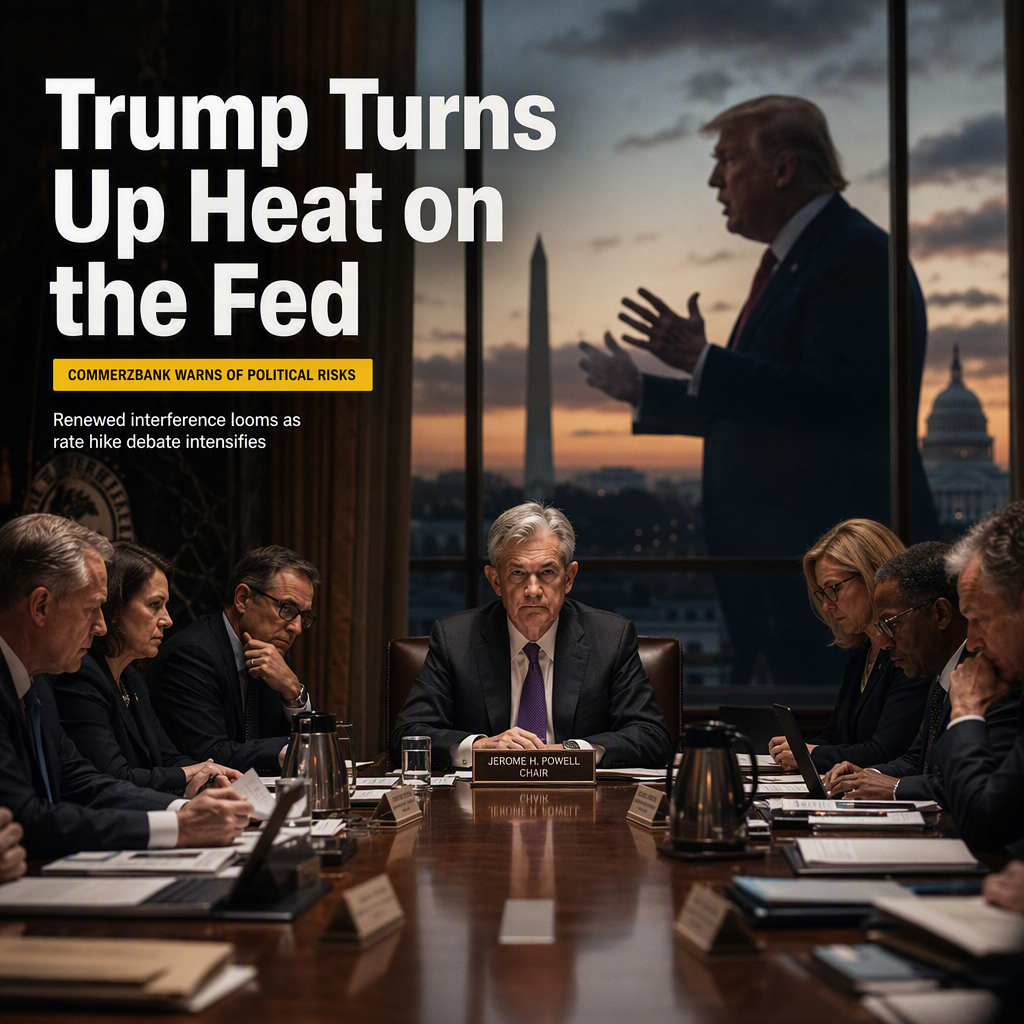
Commerzbank's Dr. Marco Wagner has analyzed the impact of Donald Trump’s past and potential future criticisms on the independence of the Federal Reserve (Fed), highlighting the risks of renewed political interference. According to Wagner, the Fed faced two major waves of verbal attacks during Trump’s terms in office, with the first occurring in 2019 and 2020, when Trump openly expressed dissatisfaction with the Fed and Chair Jerome Powell [1].
At the start of his new term in early 2025, Trump again pressured the Fed to lower interest rates more rapidly, intensifying his rhetoric with personal attacks. He labeled Powell as 'too late' and called for the resignation of both Powell and Lisa Cook [1]. Wagner notes that even the appointment of Kevin Warsh as Fed Chair did not fully resolve the tension, as Trump’s criticism only subsided temporarily after Warsh took over. Trump had previously nominated Powell, expecting him to align with his monetary policy vision, but turned against him when those expectations were not met [1].
The analysis points out that Trump’s focus may have shifted to other issues, such as the war with Iran, leading to a temporary pause in his attacks on the Fed. However, Wagner warns that this could change quickly if inflationary pressures force the Fed to consider raising interest rates. Notably, three of the twelve FOMC members recently voted in favor of a rate hike, which could prompt renewed political interference and verbal assaults from Trump [1].
The report underscores the ongoing risks to the Fed’s independence, especially in an environment where political pressure could intensify if economic conditions require tighter monetary policy.
CONCLUSION
Commerzbank’s analysis highlights the persistent risk of political interference in the Federal Reserve’s decision-making under President Trump, particularly if inflation forces the Fed to consider rate hikes. Market participants should remain alert to the potential for renewed volatility stemming from political pressure on U.S. monetary policy.