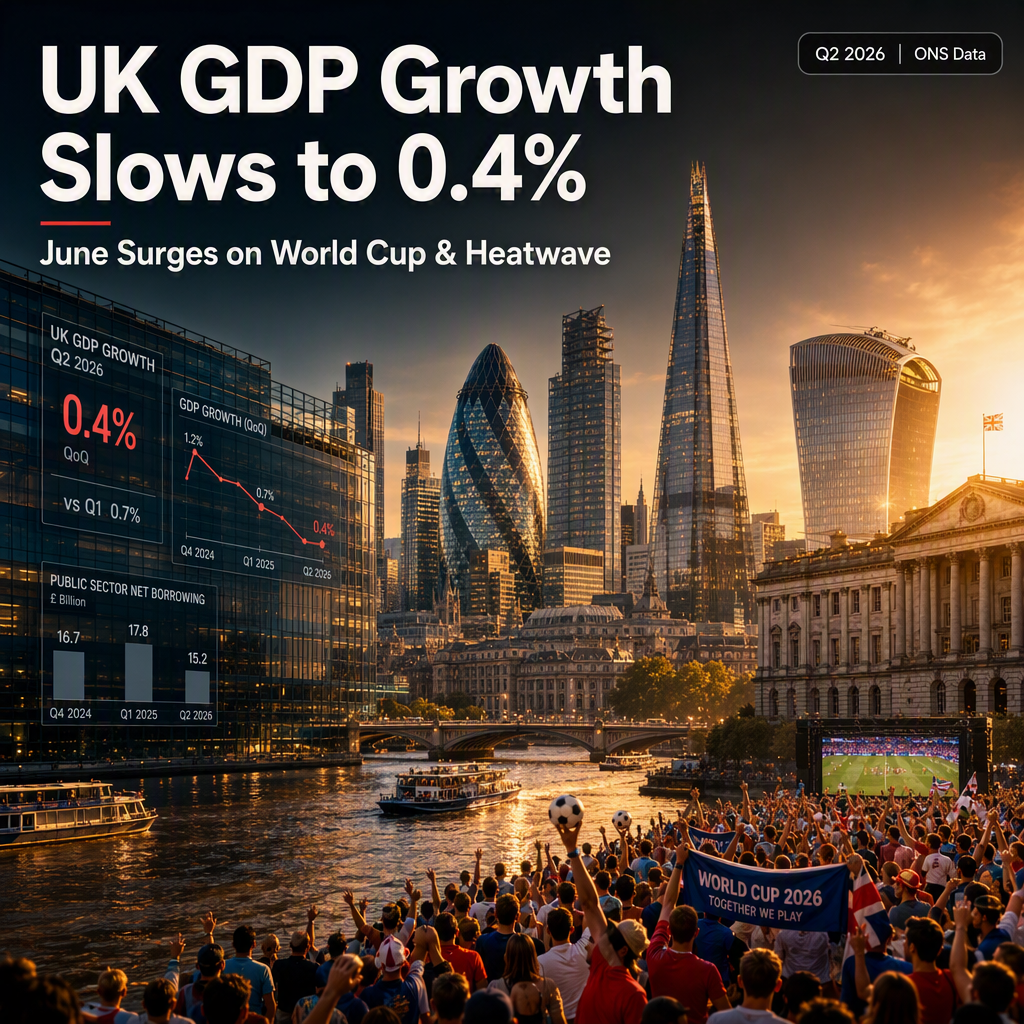
The UK economy expanded by 0.4% in the second quarter of 2026, aligning with economists' expectations and marking a slowdown from the 0.6% growth recorded in the first quarter [1]. On a year-over-year basis, GDP increased by 1.2%, while GDP per person rose 0.4% for the quarter and 1.0% over the year [1]. The Office for National Statistics (ONS) reported that June's monthly GDP grew by 0.3%, surpassing forecasts for flat growth, whereas May's figure was revised down to 0% and April remained at -0.1% [1].
The services sector was the primary driver of growth, with output rising 0.5% in the quarter. Notably, computer programming and advertising saw significant gains, up 3.7% and 4.3% respectively, while administrative and support services declined by 0.9% [1]. The ONS attributed part of June's unexpected jump to increased spending related to the World Cup and a summer heatwave, which boosted activity in arts, entertainment, and hospitality. However, these effects are considered temporary and likely faded quickly [1].
Government spending decreased, with real government consumption falling 0.3% in the quarter, partly due to school closures during the June heatwave [1]. The report also notes that Rachel Reeves served as chancellor throughout the period, with John Healey now leading the Treasury under new Prime Minister Andy Burnham [1].
In comparison with other G7 economies, the UK matched the US with 0.4% quarterly growth, trailing Canada at 0.8% and ahead of Germany, France, and Italy, each at 0.2% [1]. ONS director of economic statistics Liz McKeown commented that growth "slowed in the second quarter of the year… but remained relatively robust" [1].
The ONS did not revise earlier figures, but a more comprehensive set of historical revisions is scheduled for release on August 20 [1].
CONCLUSION
UK GDP growth slowed in Q2 2026 but remained in line with expectations, with a notable boost in June attributed to one-off events. The services sector led the expansion, while government spending contracted. Market reaction was likely positive due to the June surprise, but the underlying trend points to moderating growth.