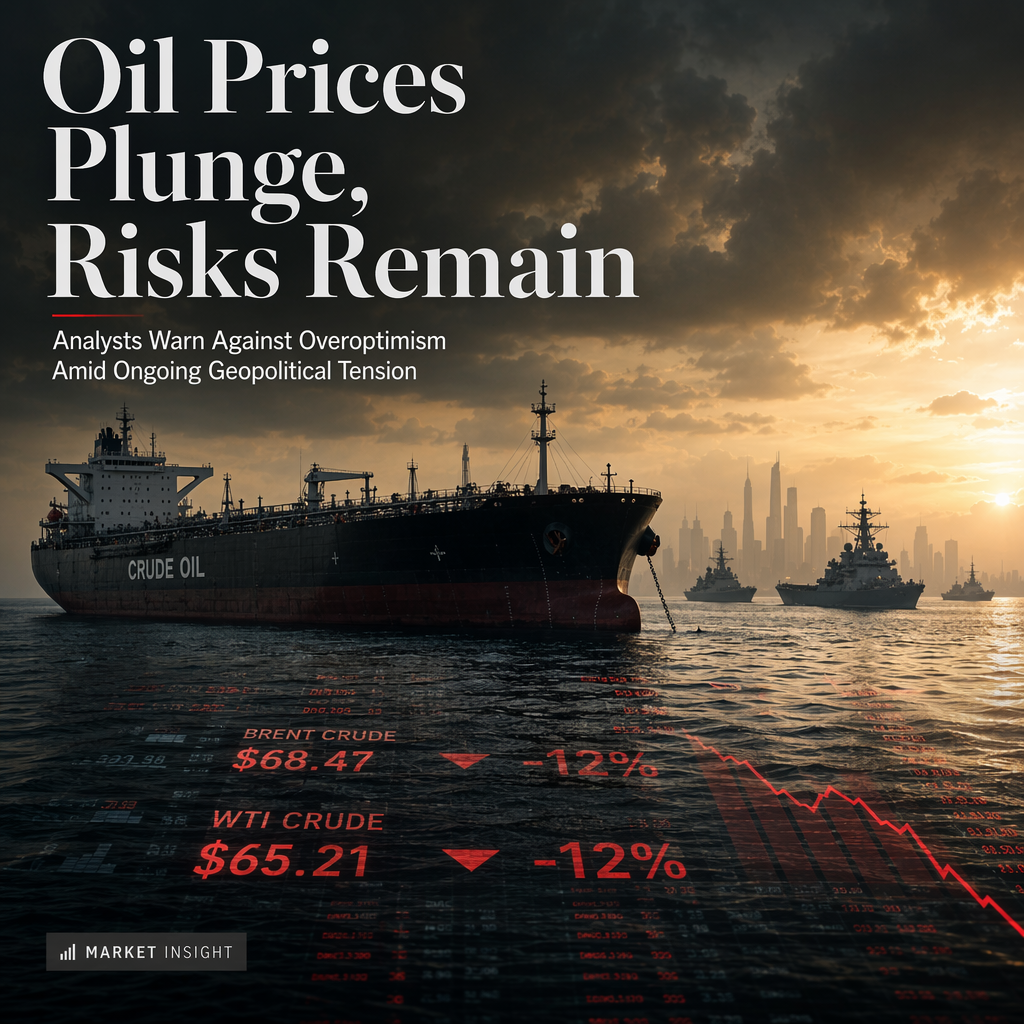
Crude Oil prices have fallen sharply, with the US benchmark West Texas Intermediate (WTI) depreciating more than 12% from last week's highs and currently holding near the $80 level as of Tuesday [1]. This decline comes as investors express optimism that a fragile truce in the Middle East could lead to renewed peace talks, but market analysts are warning that the market may be getting ahead of itself [1].
Commodity experts at ING highlight that the oil market continues to experience heavy selling, influenced by US President Donald Trump's comments that there is a 'good chance' of a deal, but also his warning that 'strikes would resume in the event a deal fails to materialise' [1]. ING analysts further note that for lower crude prices to be sustained, a recovery in flows through the Strait of Hormuz is necessary, and they caution that the market must continue to price in a significant risk premium due to the potential for deals to unravel quickly [1].
Societe Generale echoes this caution, stating that a return to pre-war and early July price levels is unlikely without a full commitment to peace and the reopening of the Strait of Hormuz [1]. Their analysts estimate that each month without a lasting resolution adds at least $10 per barrel to Brent prices, and they reiterate President Trump's warning that strikes on Iran would resume if a new ceasefire is not reached [1].
Rabobank points out that energy prices have fallen by around $10 per barrel from last week, but warns that the risk of a full-scale re-escalation and persistent disruptions to the Strait of Hormuz and the Bab el-Mandeb Strait could fuel inflationary pressures in the US [1]. Rabobank also notes that while Trump announced a pause in strikes on Iran over the weekend, this does not mean Iran has paused strikes against its neighbors, leaving the geopolitical situation fragile [1]. From a currency perspective, MUFG observes that the decline in oil prices has provided relief for several Asian currencies, but shares concerns about the potential for Middle East tensions to escalate rapidly [1].
CONCLUSION
Despite the recent 12% drop in oil prices, analysts from ING, Societe Generale, and Rabobank caution that geopolitical risks remain high and the market may be overly optimistic about a lasting resolution. Sustained lower prices depend on concrete progress in Middle East peace talks and the reopening of key shipping routes. The overall market takeaway is one of caution, with the potential for renewed volatility if tensions escalate.