
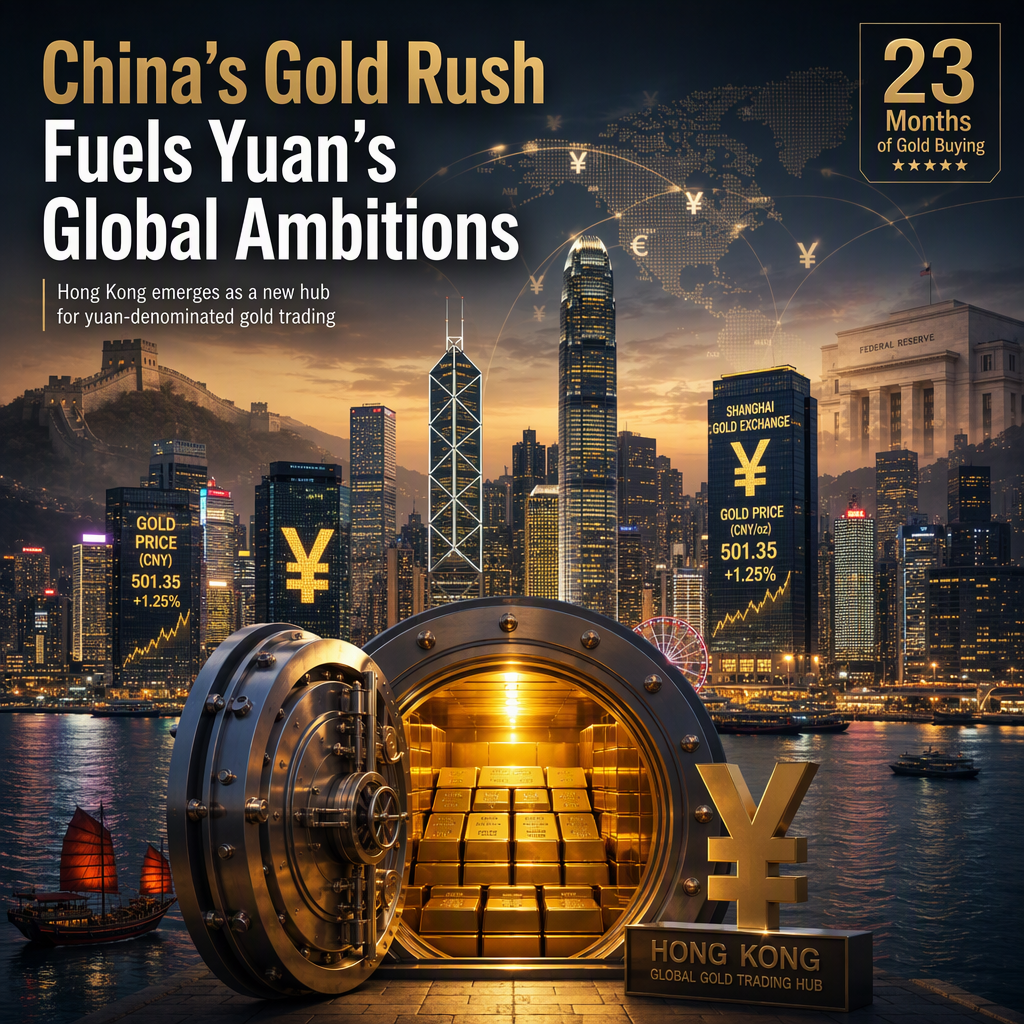
China has been purchasing gold every month for nearly two years, marking a 23-month streak of gold accumulation as part of a broader strategy to diversify away from the U.S. dollar and support the internationalization of the yuan (renminbi) [1]. This sustained buying is aimed at narrowing the gap with the U.S. in terms of gold holdings, with the U.S. currently holding over 8,100 tonnes of gold reserves compared to China's more than 2,300 tonnes, which is about one-third of the U.S. total according to World Gold Council figures for the second quarter [1].
A key development supporting this strategy is Hong Kong's initiative to become a global gold trading hub, specifically focusing on yuan-denominated transactions. Last year, Hong Kong linked its gold vault with one in Shanghai, enabling physical gold delivery to international institutions in Hong Kong denominated in yuan [1]. Over the next three years, Hong Kong plans to expand the capacity of its Shanghai-linked gold vault from 150 tonnes to over 2,000 tonnes, a scale nearly matching all of China's current gold reserves [1]. If successful, this would position Hong Kong as one of the largest gold trading centers globally.
Analysts such as Charles Chang of S&P Global Ratings and Hao Zhou of Guotai Junan International highlight that these moves reinforce the credibility of the yuan's internationalization drive and strengthen the long-term backing of China's financial system by reducing reliance on dollar-denominated reserve assets [1]. However, they also note that while gold accumulation alone will not determine the yuan's global role, it does enhance confidence in the currency and provides more channels for its use in international transactions [1].
Despite these efforts, the yuan still accounts for only a fraction of international transactions in a global financial system dominated by the U.S. dollar, and analysts do not expect major changes to this dynamic in the near term [1].
CONCLUSION
China's ongoing gold purchases and Hong Kong's push to become a yuan-denominated gold trading hub are significant steps in supporting the internationalization of the yuan and reducing reliance on the U.S. dollar. While these measures enhance confidence in the yuan and expand its potential use, analysts caution that the global dominance of the dollar is unlikely to shift dramatically in the short term.