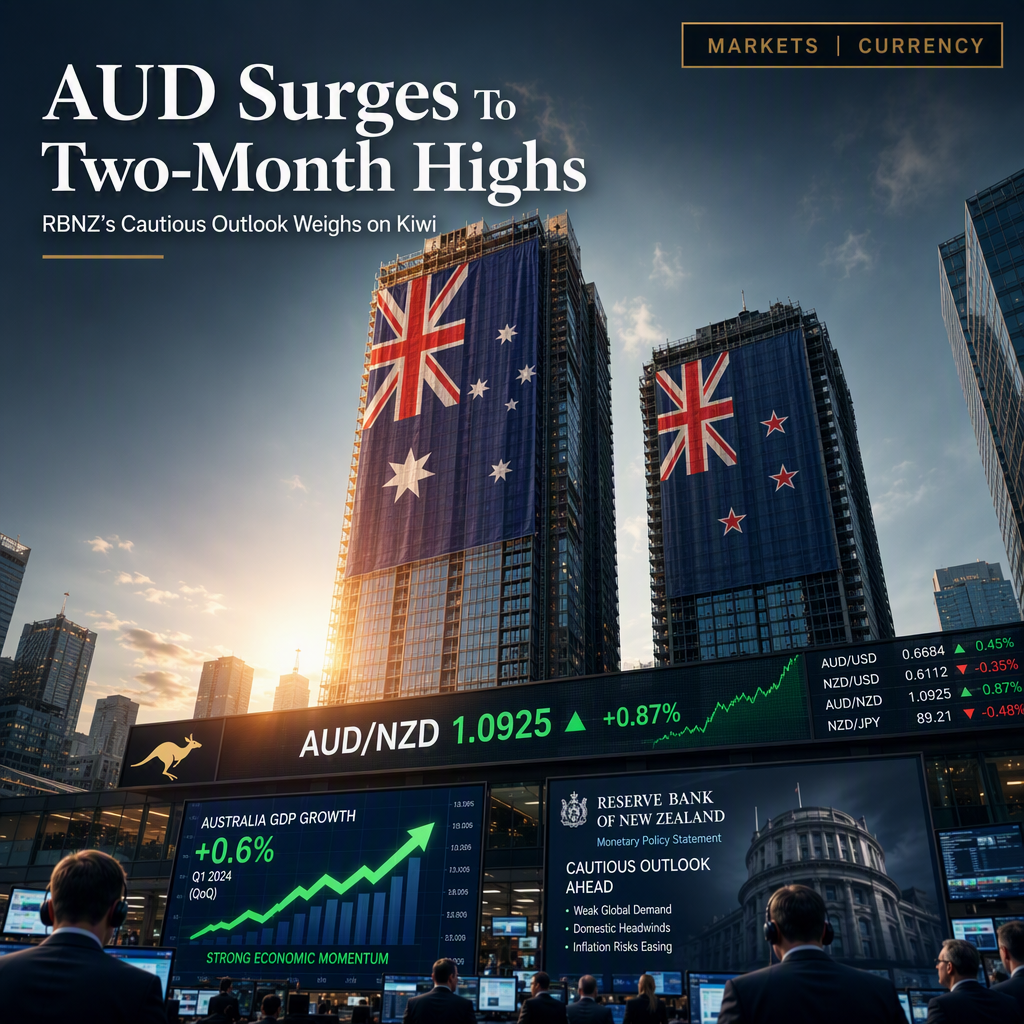
The Australian Dollar (AUD) surged nearly 0.9% against the New Zealand Dollar (NZD) on Wednesday, reaching fresh two-month highs at 1.2241. This rally was driven by a combination of investor disappointment following the Reserve Bank of New Zealand’s (RBNZ) monetary policy decision and stronger-than-expected Australian GDP data released earlier in the day [1].
The RBNZ raised its Official Cash Rate by 25 basis points to 2.75%, in line with market expectations. However, the central bank signaled a more gradual tightening path than markets had anticipated. Danske Bank analysts noted that the RBNZ's comments highlighted 'downside risks to the economy' and that its rate projections remained well below market pricing, which contributed to the NZD's weakness despite the rate hike [1]. RBNZ Governor Anna Breman stated that the key question is 'whether economic recovery expands as expected,' and while she hinted at further rate hikes, she emphasized the need for more time to evaluate the policy stance and did not commit to a fixed rate path [1].
On the Australian side, the AUD was buoyed by robust economic growth figures. The Australian economy expanded by 0.4% in the second quarter, surpassing expectations of 0.3% growth and following a 0.3% increase in the first quarter. Year-over-year, GDP grew by 2.1%, according to the Australian Bureau of Statistics [1]. Rabobank analysts suggested that these figures increase the likelihood of a Reserve Bank of Australia (RBA) rate hike this month, even as the housing market faces challenges—a scenario they describe as unexpected [1].
The market reaction was pronounced, with the AUD/NZD pair jumping about 140 pips, reflecting both the positive sentiment towards the Australian economy and the cautious outlook from the RBNZ [1].
CONCLUSION
The Australian Dollar's rally to two-month highs against the New Zealand Dollar was fueled by upbeat Australian GDP data and a dovish tone from the RBNZ despite its rate hike. Market participants are now increasingly anticipating a potential RBA rate hike, while the NZD remains under pressure due to the RBNZ's cautious outlook. The event underscores the importance of central bank guidance and economic data in driving currency markets.