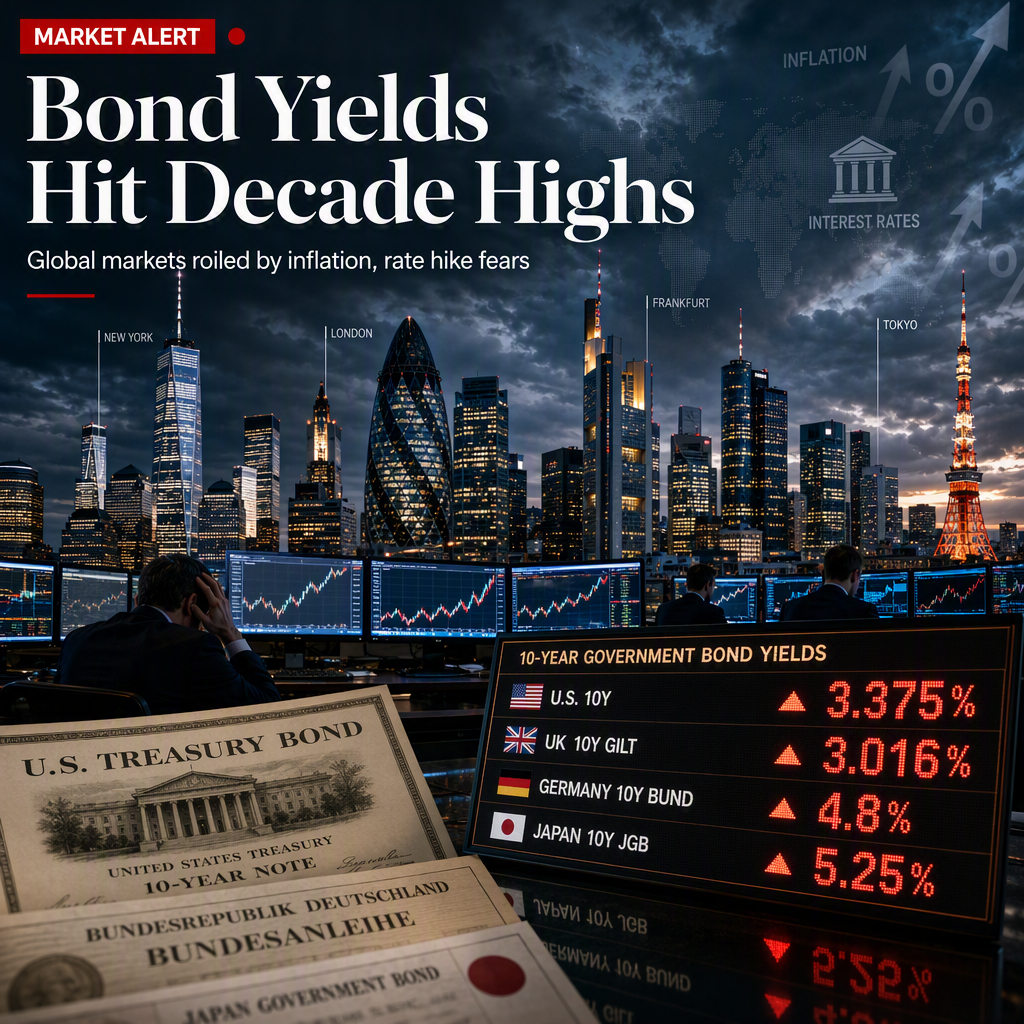
Global government bond markets experienced a significant sell-off on Wednesday, pushing benchmark borrowing costs to their highest levels in decades as investors reacted to mounting concerns over inflation, rising interest rates, and elevated debt levels in major economies [1]. The yield on German 10-year bunds rose by 4 basis points to 3.375%, marking its highest point since 2011, while Japan's 10-year yield reached 3.016% after surpassing 3% for the first time in thirty years on Tuesday [1]. U.S. 10-year Treasury yields remained above 4.8%, a threshold last seen in early 2025, and British 10-year gilts extended their post-2008 high to 5.25% [1].
The sell-off was driven by renewed inflationary pressures, exacerbated by a fresh wave of conflict in the Middle East that has pushed oil prices higher, compounding existing worries about the fiscal health and high debt burdens of countries such as the U.S., Japan, and France [1]. Central banks in the U.S., Japan, and the euro zone are widely expected to raise interest rates this month, a move typically negative for bond prices [1]. Federal Reserve Chair Kevin Warsh delivered a hawkish message at Jackson Hole last week, while the Bank of Japan is seen as potentially raising rates to support the yen, and markets are fully pricing in a European Central Bank rate hike following recent EU inflation data [1].
Equity markets have also turned risk-averse, with major U.S. indices falling for three consecutive sessions and European and Asian markets also declining, despite earlier record highs fueled by enthusiasm for artificial intelligence [1]. George Maris, chief investment officer and global head of equities at Principal Asset Management, commented that the fundamental market environment is more precarious due to rising costs of money and risk, as well as stratospheric and increasing global debt levels [1]. Maris noted a lack of political willingness to address these debt issues, warning that the current period of healthy global economic growth could become more vulnerable if disturbances arise [1].
CONCLUSION
The global bond rout underscores heightened market anxiety over inflation, rising rates, and unsustainable debt levels, with yields reaching multi-decade highs across major economies. Equity markets have also shifted to a risk-off stance, reflecting broader uncertainty. Analysts warn that without political action on debt, markets may face increased vulnerability in the event of future shocks.