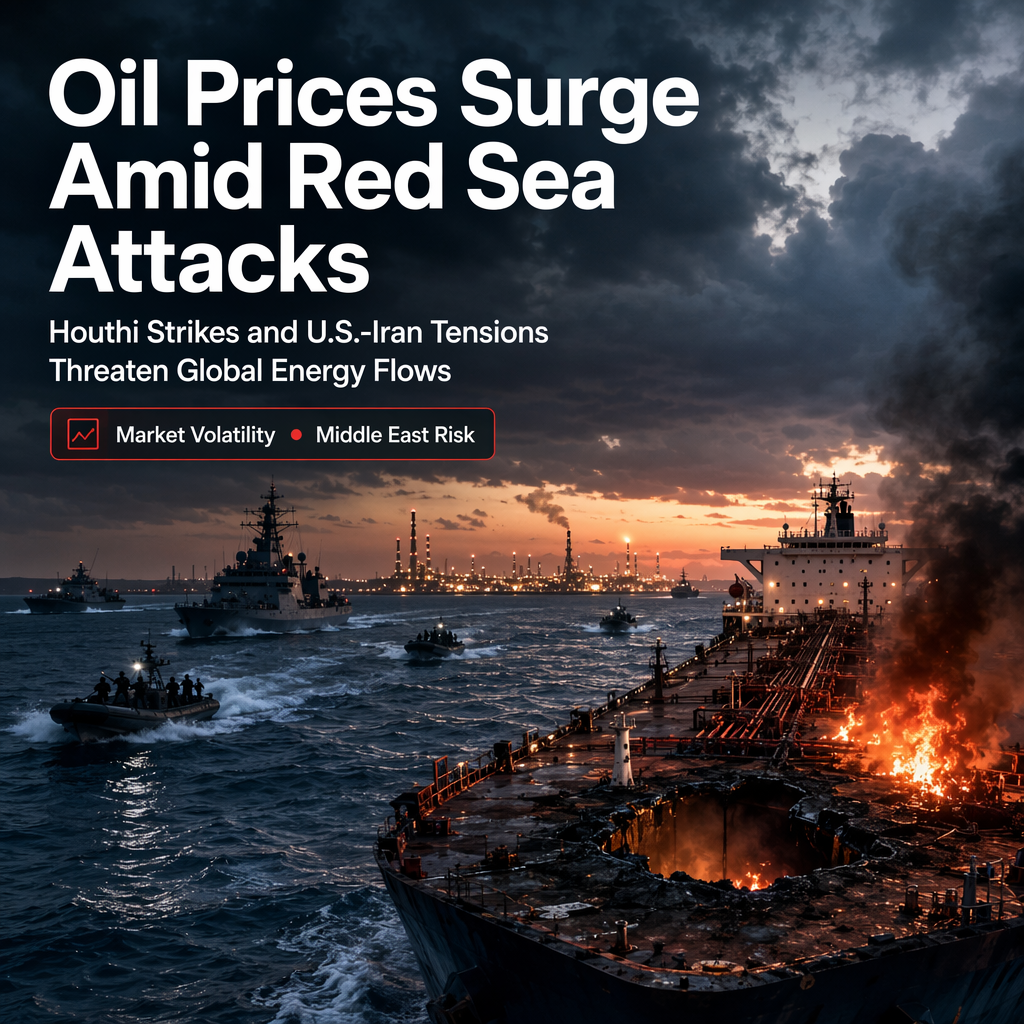
On Thursday, Yemen's Houthi group claimed responsibility for attacking two Saudi oil tankers, ENCELA and LAYLIA, in the Red Sea, citing violations of a naval blockade imposed earlier in the week. Houthi military spokesperson Yahya Saree confirmed the attacks, which were reported by the Guardian. The UK Maritime Trade Operations (UKMTO) received reports that a tanker was struck by an unknown projectile and caught fire approximately 70 nautical miles from Saudi Arabia’s Al Shuqaiq [1].
Simultaneously, oil markets reacted sharply to escalating tensions in the region. U.S. President Donald Trump threatened to bomb Iranian infrastructure if Iran attacked ships transiting the Strait of Hormuz, a critical chokepoint for global oil shipments. Trump stated, "From this point forward, any time the Islamic Republic of Iran shoots at a ship in the Strait of Hormuz, whether it be by Missile, Rocket, Drone, or any other device or weapon, the United States will bomb and destroy ONE BRIDGE OR POWER PLANT." Iran responded with threats to retaliate against U.S.-linked infrastructure and energy assets across the region if attacked [2].
These developments have driven oil prices higher. West Texas Intermediate (WTI) crude rose 3.35% to $87.05 per barrel, according to FXStreet, while CNBC reported WTI futures advancing around 1.7% to $88.27 per barrel and Brent crude futures for September delivery gaining 2% to $95.99 per barrel [1][2]. The discrepancy in WTI price levels may reflect different reporting times. HSBC analysts noted that the recent rally in oil prices reflects renewed concerns over the security of the Strait of Hormuz following the breakdown of the U.S.-Iran ceasefire. The bank warned that the outlook for oil now depends on whether diplomacy can restore predictable shipping flows [2].
Further complicating the situation, Secretary of State Marco Rubio stated that Iran was not being "serious" about reaching an agreement with Washington, though the U.S. remains "committed to diplomacy" in the Middle East. HSBC's Kim Fustier highlighted that the core issue remains unresolved: "whether passage is administered, and by whom," emphasizing the strategic importance of shipping lanes in the region [2].
CONCLUSION
The combination of Houthi attacks on Saudi oil tankers and escalating U.S.-Iran tensions has significantly increased oil market volatility, pushing prices higher. With both sides issuing threats and no diplomatic resolution in sight, the risk to Middle East energy infrastructure and shipping remains elevated, sustaining bullish sentiment in oil markets.