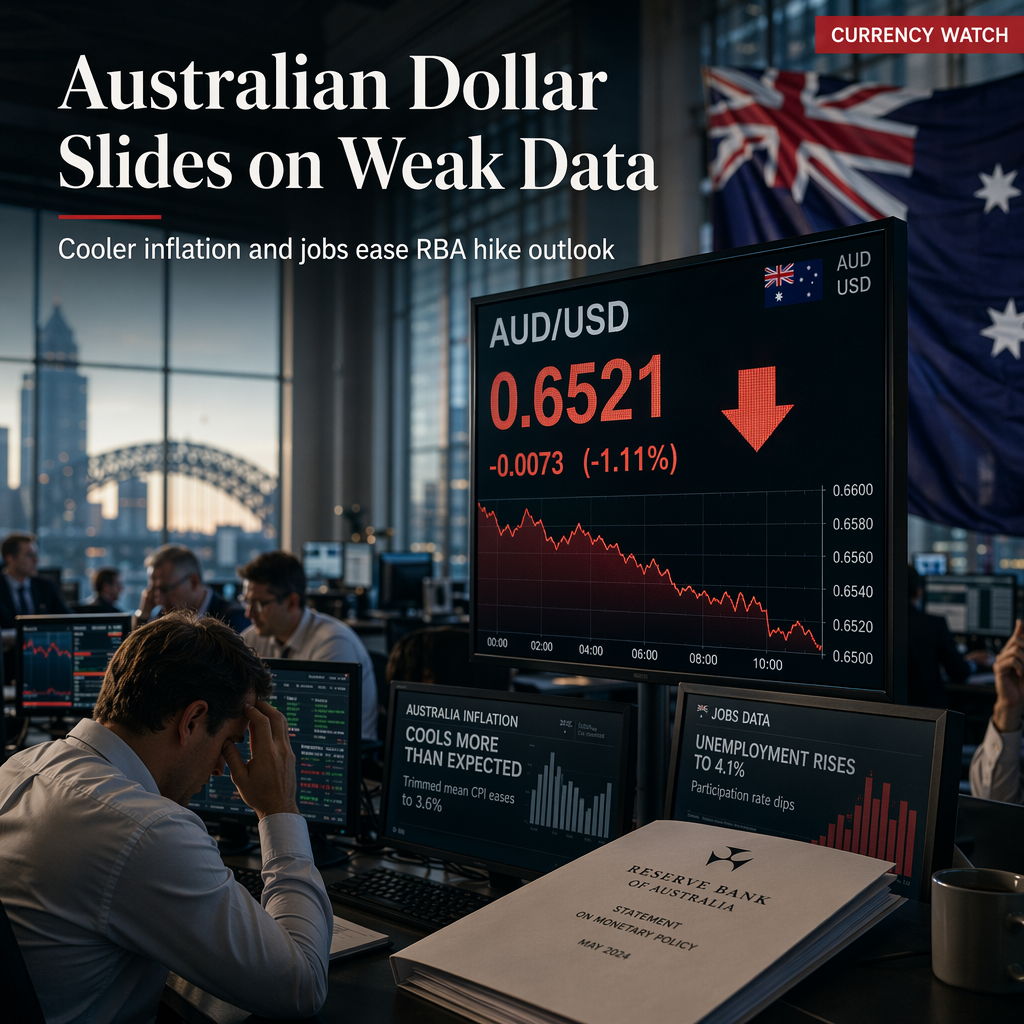
The Australian Dollar (AUD) traded moderately lower against the US Dollar (USD) on Monday, retreating to the 0.6920 area after reaching two-week highs around 0.6050 on Friday, and remaining close to three-month lows of 0.6865 [1]. This decline followed the release of the Australian TD-MI Inflation Gauge, which showed a 0.4% month-on-month contraction in June, after a 0.3% drop in May, bringing the year-on-year rate down to 3.9% from 4-4% in the previous month [1]. Additionally, the ANZ Commodity Price index contracted by 1% in June, reversing a 0.7% growth in May, while Job Advertisements fell by 0.2% after a 2% increase in the prior month [1].
These softer inflation and employment figures have reduced pressure on the Reserve Bank of Australia (RBA) to raise interest rates further, supporting expectations that the central bank will maintain a 'wait-and-see' approach to assess the impact of previous rate hikes [1]. Market sentiment was further dampened by comments from Iranian authorities regarding the Strait of Hormuz, which added to risk aversion and weighed on the risk-sensitive AUD [1][2].
On the broader currency front, the US Dollar Index held modest daily gains around 101.00 after losing about 0.5% in the previous week, with the USD gaining 0.14% against the AUD on Monday [2]. United Overseas Bank (UOB) analysts noted that after last week's sharp rise, the AUD/USD pair has stalled, with a tentative downside bias suggesting a limited dip toward 0.6910 intraday. For the next 1–3 weeks, UOB expects the pair to consolidate between 0.6870 and 0.6980, while maintaining a negative outlook over a 1–3 month horizon, targeting 0.6835 and then 0.6707 [3].
No significant forward-looking statements from the RBA were cited, but attention remains on upcoming US economic data, including the ISM Services PMI and potential commentary from Federal Reserve Governor Christopher Waller, which could further influence currency movements [1][2].
CONCLUSION
The Australian Dollar's retreat is driven by weaker-than-expected inflation and employment data, reducing the likelihood of near-term RBA rate hikes. Market sentiment remains cautious, with analysts expecting further consolidation and a possible downside bias for AUD/USD in the coming weeks. Broader risk aversion and US Dollar strength may continue to weigh on the AUD in the near term.