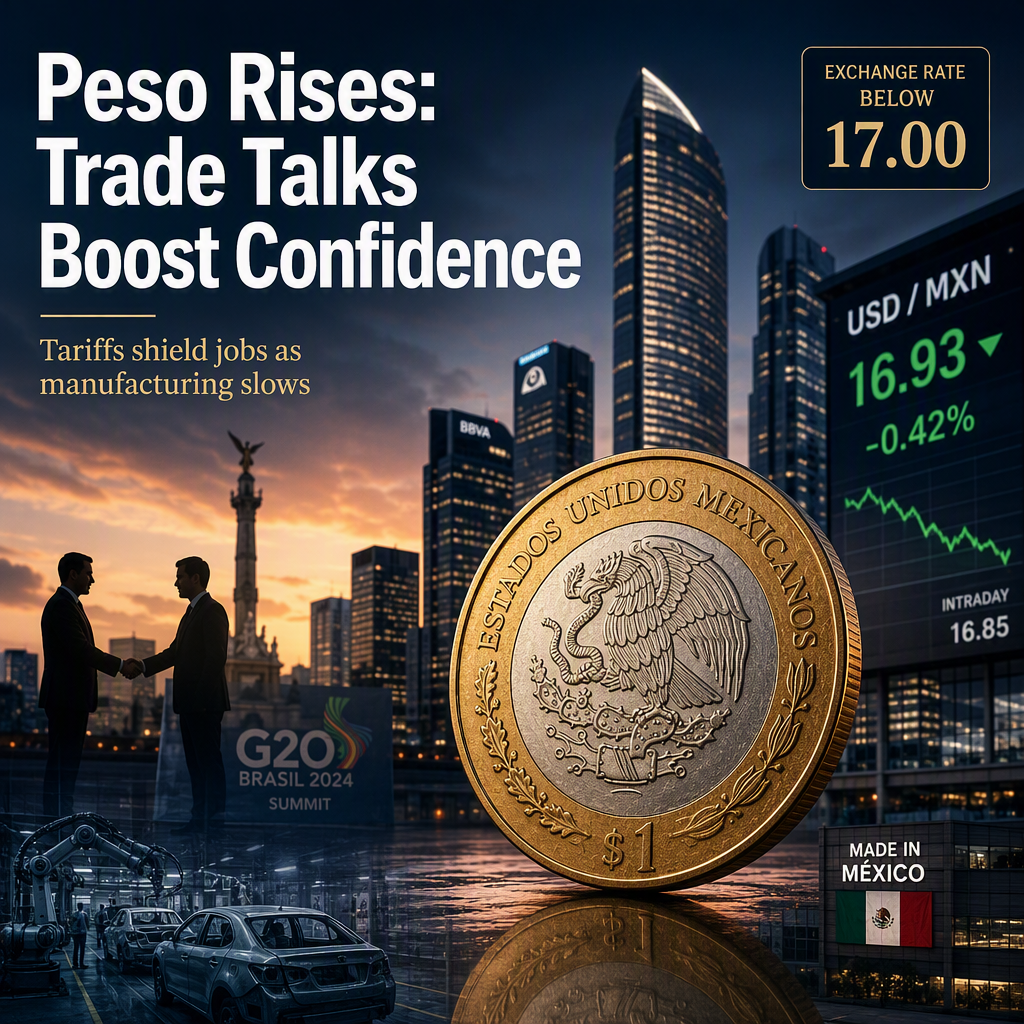
Societe Generale reports that the Mexican Peso has strengthened against the US Dollar, with the USD/MXN exchange rate moving back below 17.00. This movement is attributed to ongoing trade discussions between Mexican officials and their US counterparts, following a widening rift between the US and Canada on trade issues [1]. Economy Minister Ebrard met with US Commerce Secretary Howard Lutnick at the G20 summit to address these concerns [1].
A significant factor supporting the Peso is the sharp decline in Mexico's car imports from China, which fell by 31.1% year-over-year in the first half of 2026 to 158,571 units. This drop is linked to tariff adjustments implemented to protect approximately 350,000 local jobs from unfair trade practices [1]. President Sheinbaum has expressed optimism about reaching a trade agreement with the US soon, which could further bolster market sentiment [1].
Despite these positive developments, the manufacturing sector showed signs of weakness, with the PMI slipping back into contraction territory. The manufacturing PMI fell to 49.8 in August, down from 51.3 in July, indicating a slowdown in industrial activity [1].
Overall, the combination of proactive trade negotiations, protective tariffs, and optimism from government officials has provided support for the Mexican Peso, even as manufacturing data signals caution.
CONCLUSION
The Mexican Peso has benefited from trade talks and tariff measures, strengthening against the US Dollar despite a contraction in manufacturing activity. Optimism from President Sheinbaum regarding a potential US trade agreement adds to positive sentiment. However, the weaker PMI suggests underlying economic challenges that may temper further gains.