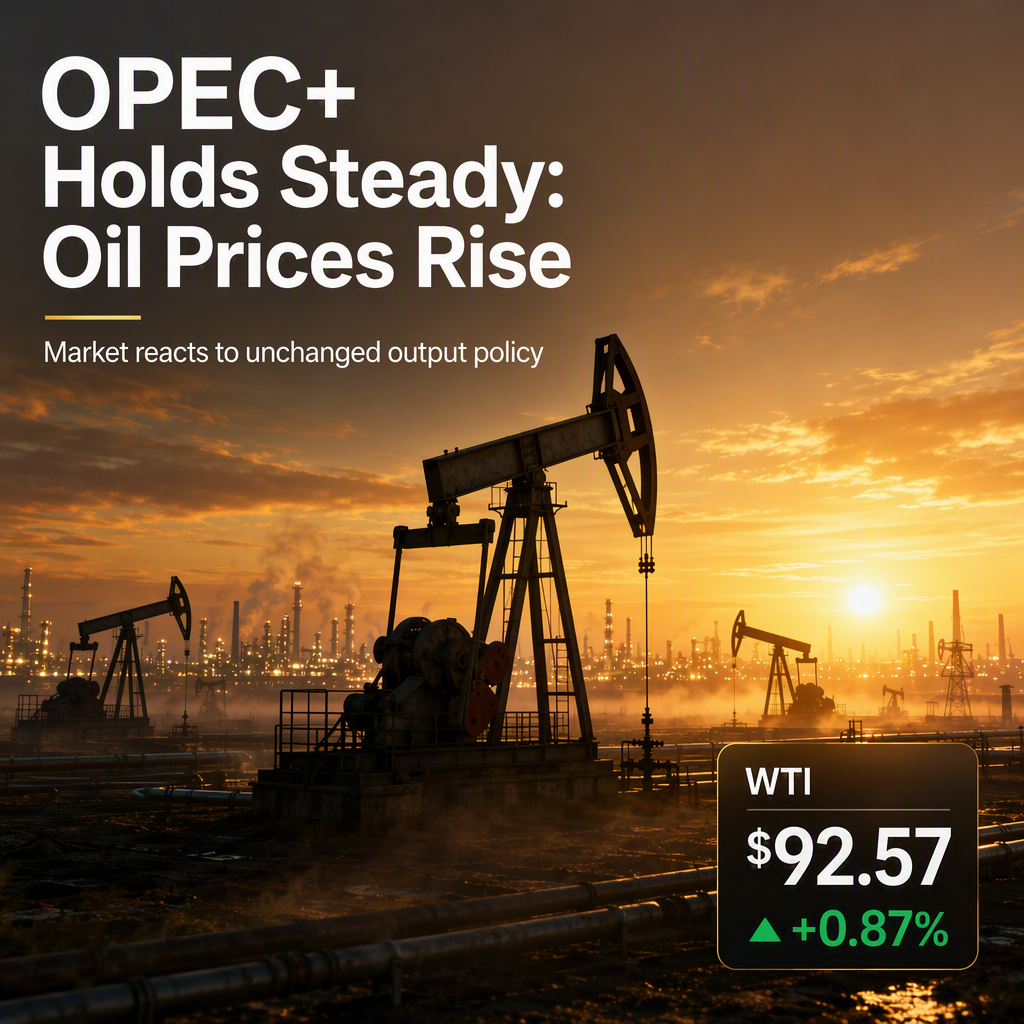
The Organization of Petroleum Exporting Countries and its allies (OPEC+) announced on Sunday that it will keep its oil output policy unchanged for October, citing the need to agree on new quotas before making further decisions regarding production levels [1]. This decision follows the group's previous agreement in August to boost production for September, which completed a phased rollback of a 1.65 million barrel-per-day (bpd) supply cut that was first implemented in 2023 [1]. Despite these increases, OPEC+ continues to produce well below its targets, a situation attributed to the ongoing war [1].
In response to the announcement, the price of West Texas Intermediate (WTI) crude oil rose by 0.87% on the day, reaching $92.57 at the time of reporting [1]. The market's reaction suggests that traders view the decision to maintain current output levels as supportive of oil prices, especially given the group's ongoing production shortfalls relative to its targets [1].
The article also highlights that OPEC's decisions are a key driver of oil prices, with changes in production quotas having a direct impact on supply and, consequently, market prices [1]. No forward-looking statements or analyst opinions were provided regarding future OPEC+ actions or potential market developments [1].
CONCLUSION
OPEC+'s decision to keep its oil output policy unchanged for October has contributed to a modest rise in WTI crude prices, reflecting market sensitivity to supply stability. The group's ongoing production shortfalls and the absence of new quotas suggest continued uncertainty in the oil market. No explicit forward guidance or analyst commentary was provided in the source.