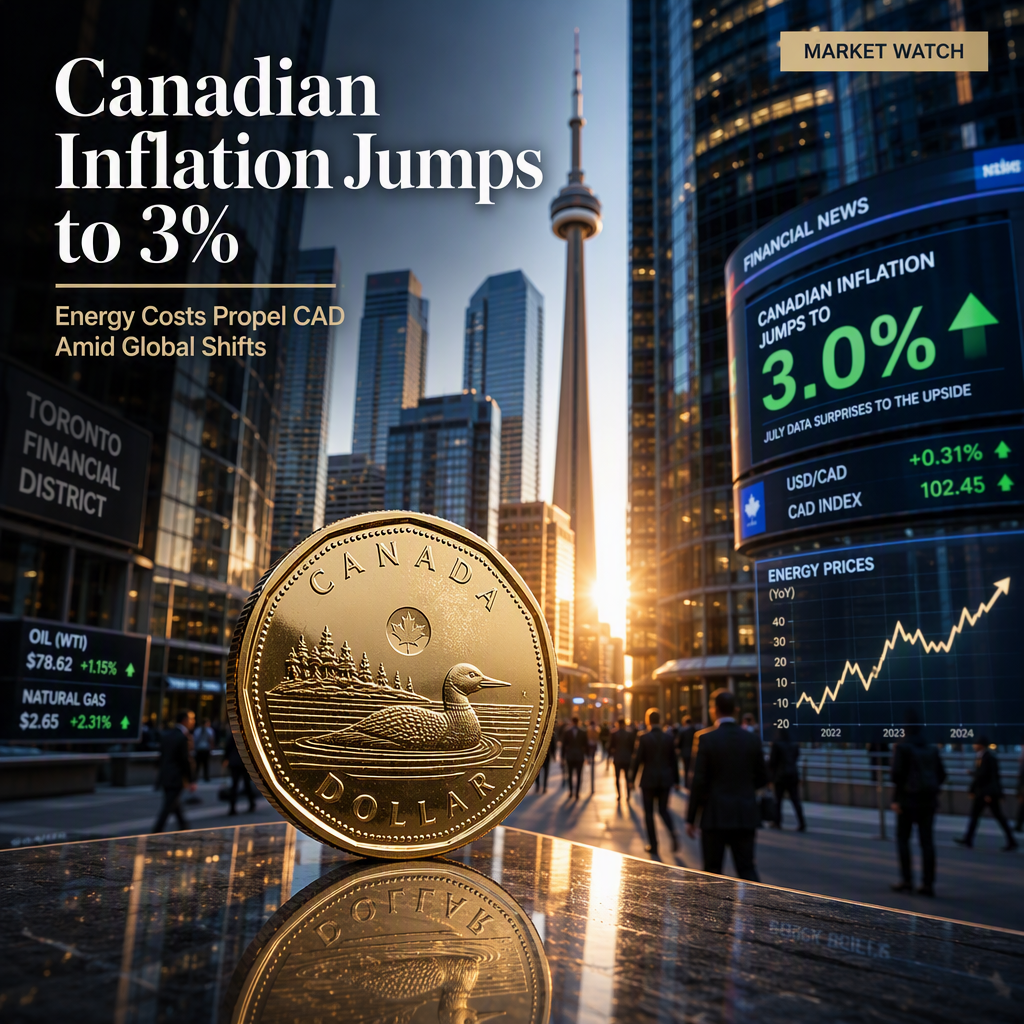
Canadian inflation accelerated to 3% year-over-year in July, up from 2.8% in June, primarily due to higher energy costs, according to RBC economists Abbey Xu and Nathan Janzen [1][2][3]. This figure exceeded the market forecast of 2.9% [2][3]. On a monthly basis, the Consumer Price Index (CPI) rose 0.5%, reversing the previous month's 0.4% decline and matching expectations [2][3]. Underlying inflation measures remained relatively contained, with the Bank of Canada’s (BoC) core CPI rising to 2.3% year-over-year from 2.1%, and a monthly increase of 0.2% [2][3]. Other core measures, such as Common CPI, Trimmed CPI, and Median CPI, registered at 2.7%, 1.9%, and 2.0% respectively [3].
Statistics Canada attributed the acceleration in headline inflation to higher gasoline and travel tour prices, with the conflict in the Middle East and the blockade of the Strait of Hormuz placing upward pressure on fuel prices [2][3]. Despite the uptick in headline inflation, core inflation measures remained close to the BoC’s 2% target, suggesting limited pass-through from energy costs to broader prices [1][2][3]. RBC economists expect the BoC to keep the overnight rate unchanged through 2026 [1]. The next BoC monetary policy decision is scheduled for September 2, with markets widely expecting the interest rate to remain at 2.25% [2].
The Canadian Dollar (CAD) strengthened against the US Dollar (USD) following the inflation data, with USD/CAD falling to its lowest level since June 3 and trading around 1.3852 at the time of reporting [2]. This move was supported by both the hotter-than-expected Canadian inflation and a weaker US Dollar, as traders reduced Federal Reserve (Fed) rate hike bets amid softer US economic data [2]. The US Dollar Index (DXY) traded around 99.45, its lowest since June 5 [2]. However, the CAD struggled to gain ground against the Euro (EUR), as EUR/CAD edged higher to 1.6070, reflecting investor confidence in potential further tightening by the European Central Bank (ECB) [3].
Analysts noted that persistent price pressures in Canada could prompt investors to reassess the BoC’s monetary policy outlook, though the current data is unlikely to shift the central bank’s near-term stance [2][3]. Meanwhile, the Euro benefited from expectations of additional ECB rate hikes, supported by resilient Eurozone economic data and narrowing yield spreads versus the US [3][4]. Scotiabank strategists highlighted bullish momentum for the EUR, with technicals pointing to further gains if key resistance levels are breached [4].
CONCLUSION
Canadian inflation’s rise to 3% in July, driven by energy costs, provided support for the Canadian Dollar against the US Dollar but was insufficient to boost it against the Euro. Despite the inflation surprise, core measures remain near target, and the Bank of Canada is expected to keep rates unchanged. The market impact is moderate, with attention shifting to upcoming central bank decisions and ongoing geopolitical developments.