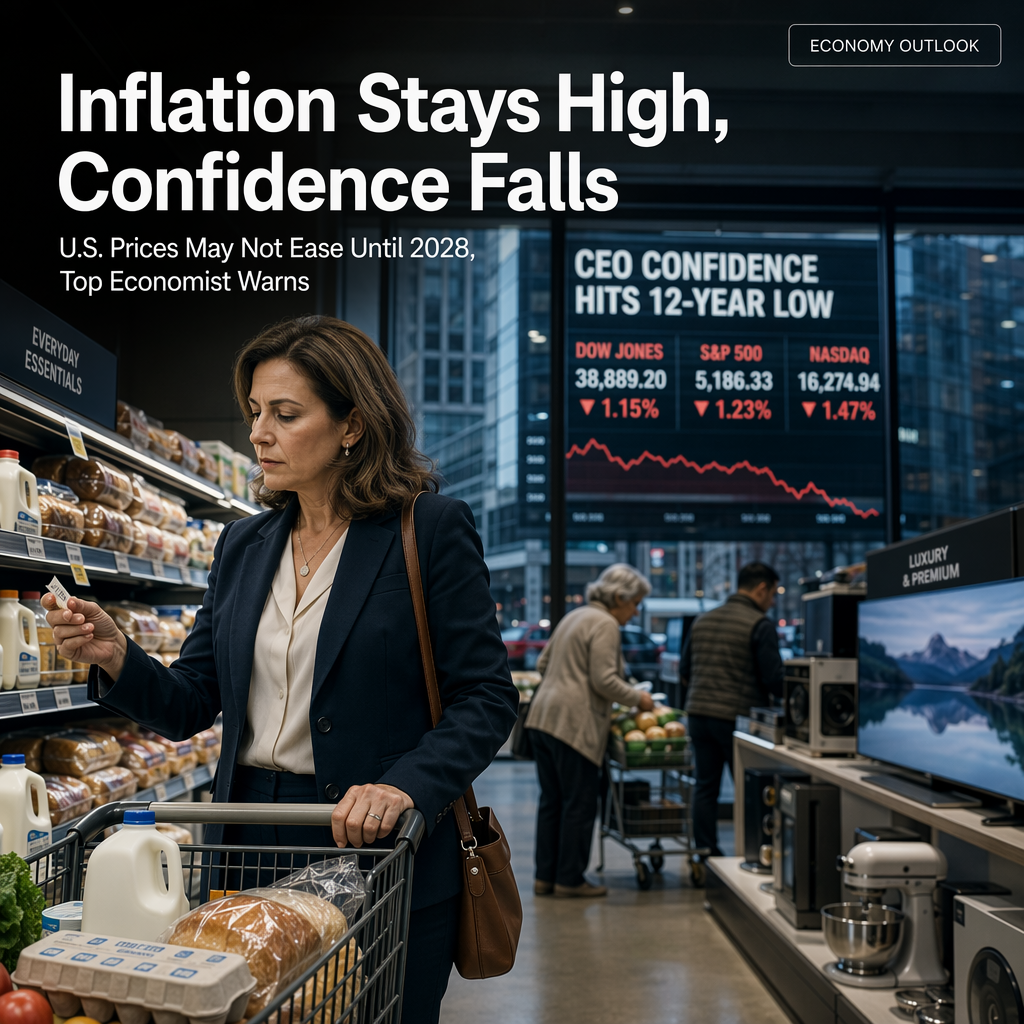
American consumers should not expect a rapid decline in prices, as inflationary pressures are projected to persist for several years, according to Dana M. Peterson, Chief Economist at The Conference Board [1]. Peterson stated that the Federal Reserve's 2% inflation target is unlikely to be achieved before 2028, citing ongoing supply chain issues and the lingering effects of global trade disruptions and geopolitical shocks [1]. She noted that while inflation likely peaked in the second quarter of this year, it will only decelerate slowly and remain elevated, with headline personal consumption expenditures expected to peak in the third quarter due to pass-through effects from recent geopolitical shocks [1].
Peterson highlighted a significant shift in consumer behavior, with Americans spending less on expensive goods and services and focusing more on essential purchases [1]. She observed that consumers are avoiding big-ticket items in favor of cheaper alternatives [1].
The Conference Board's Measure of CEO Confidence, conducted with The Business Council, revealed a sharp decline in sentiment: the overall score dropped to 47 in Q2 from 59 in Q1, indicating that negative economic outlooks now outnumber positive ones [1]. Only 15% of CEOs believe the economy is better than six months ago, down from 39% in Q1, while 47% say it is worse, up from 8% [1]. Furthermore, 40% of CEOs expect economic conditions to deteriorate over the next six months, compared to 13% in the previous quarter [1].
Peterson attributed the drop in CEO confidence to the timing of the survey, which was conducted during heightened conflict in the Middle East, though she noted that ongoing peace negotiations with Iran may have since alleviated some immediate concerns [1]. She suggested that CEO confidence may have improved since the survey, even if it remains somewhat negative [1].
CONCLUSION
Persistent inflation and declining CEO confidence signal ongoing economic challenges for U.S. consumers and businesses. With the Federal Reserve's 2% inflation target not expected until 2028, spending patterns are shifting toward necessities, and economic sentiment remains cautious. Market participants should prepare for a prolonged period of elevated prices and subdued confidence.