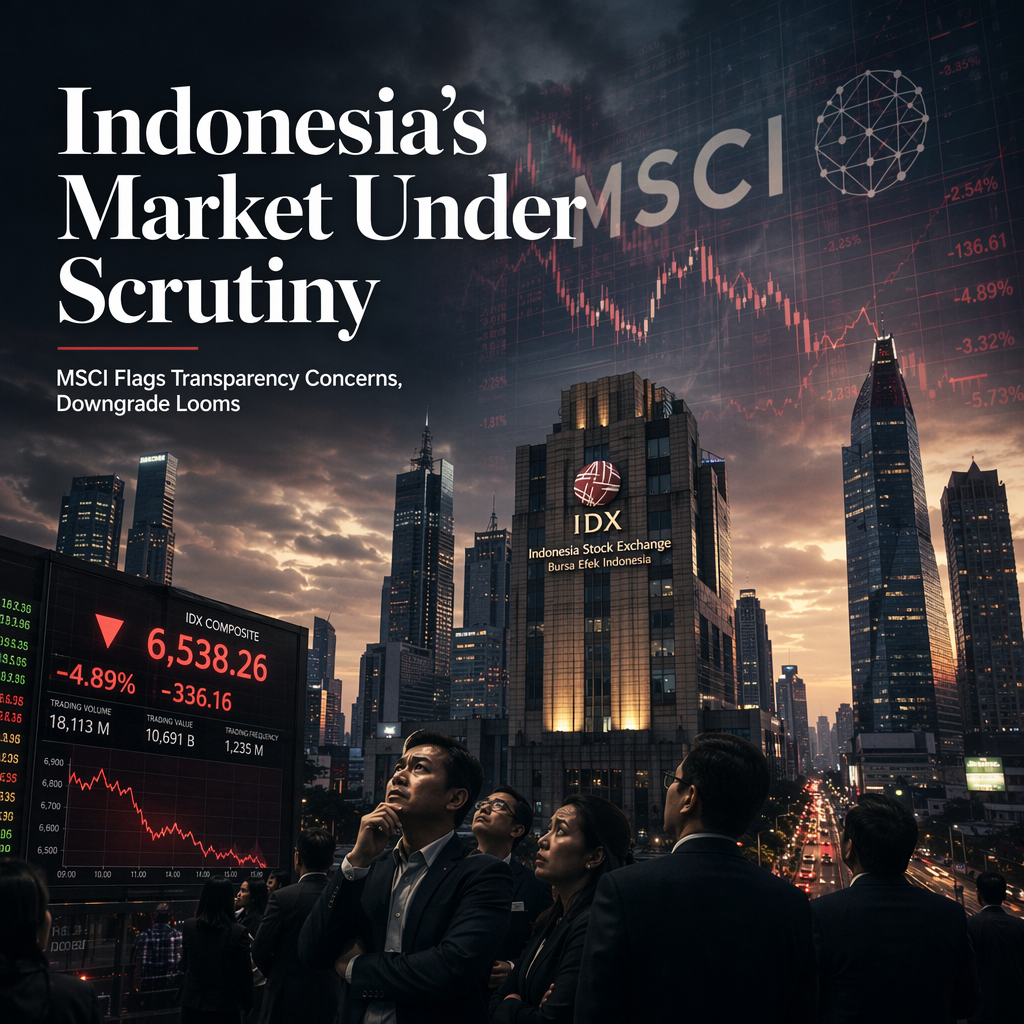
MSCI has downgraded Indonesia's information-flow rating in its annual Global Market Accessibility Review released on June 19, 2026, citing ongoing concerns about transparency and price discovery in the Indonesian stock market [1]. The index provider specifically pointed to opaque ownership structures and suspected coordinated trading, which it says undermine confidence in market pricing and limit international institutional investors' ability to assess true free float and rely on observed market prices for portfolio construction and index replication [1].
Indonesia is now facing a possible downgrade from its emerging-market status, a risk first flagged by MSCI in January. The report also noted that Turkey was cut on the same measure for similar reasons [1]. Investor confidence in Indonesia has been shaken, as evidenced by the Jakarta Composite Index erasing early gains on Friday and losing almost 30% year-to-date [1]. Previously, the index had been the best performing major Asia-Pacific index for the year, but recent developments have reversed its fortunes.
Investors have raised concerns about sharp moves in some smaller-cap Indonesian stocks and concentrated ownership structures. The report comes amid the rupiah hitting a record low versus the dollar, ongoing capital outflows, and questions about Indonesia's fiscal health. Bank Indonesia responded by raising rates in a surprise move last week [1].
MSCI stated, "Accessibility concerns have arisen from ongoing opacity in shareholding structures and indications of coordinated trading behavior that undermines proper price formation," emphasizing that these issues materially limit international institutional investors' confidence in the market [1].
CONCLUSION
MSCI's downgrade of Indonesia's information-flow rating and its warning about a potential emerging-market status downgrade have significantly impacted investor sentiment, as reflected in the sharp decline of the Jakarta Composite Index. Persistent transparency issues and market volatility are raising concerns among international investors, with further scrutiny likely unless reforms are enacted.