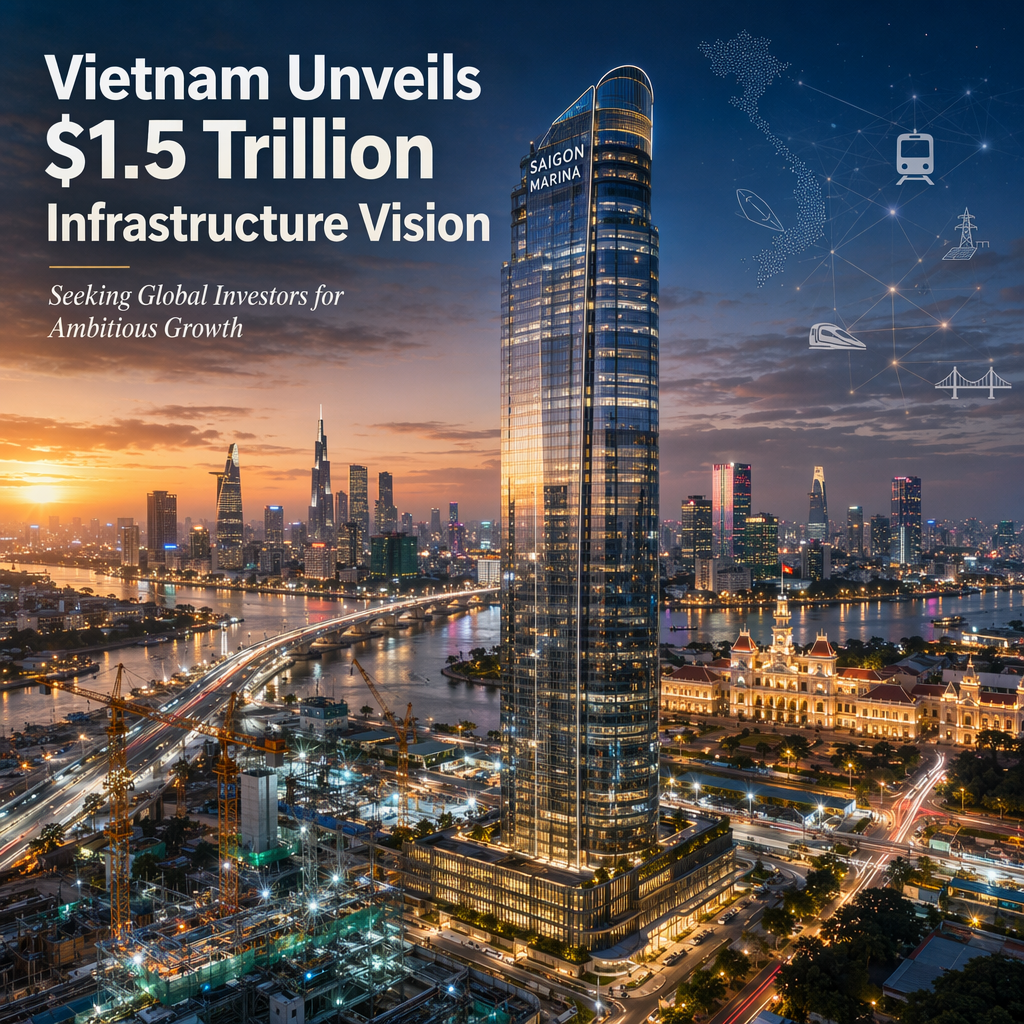
Vietnam has announced plans to seek global capital to finance an estimated $1.5 trillion in infrastructure investment over the next decade, as the country aims to become a high-income economy by 2045 [1]. Domestic funding sources have been deemed insufficient to cover the massive spending required for transportation, energy, and digital infrastructure, prompting officials to look beyond the banking system and attract international investors [1]. The Vietnam International Financial Center in Ho Chi Minh City, with the 55-story Saigon Marina skyscraper as a key building, is expected to play a central role in this effort by 2027 [1].
The government is positioning Ho Chi Minh City as a regional financial hub, leveraging its strategic location and economic growth to attract foreign direct investment, bond issuances, and public-private partnerships to fill the funding gap [1]. New regulations and incentives are being rolled out to reassure investors, with a focus on transparency, stable regulations, and robust legal frameworks [1]. Priority sectors for investment include transportation, energy, and technology, where major projects are anticipated to offer substantial returns [1].
Vietnam's rapid economic expansion has strained existing infrastructure, creating bottlenecks that could impede future growth. The projected $1.5 trillion investment aims to modernize roads, ports, airports, and energy systems to support ongoing development and attract multinational corporations [1]. Market analysts cited in the article note that, while the funding target is ambitious, Vietnam's strong economic growth and rising profile in regional supply chains may attract significant global investor interest, provided regulatory and operational risks are effectively managed [1].
CONCLUSION
Vietnam's $1.5 trillion infrastructure initiative marks a significant step toward its goal of becoming a high-income economy by 2045. The success of this plan will depend on the country's ability to attract global capital through improved regulations and investor incentives, with market analysts expressing cautious optimism about international interest.