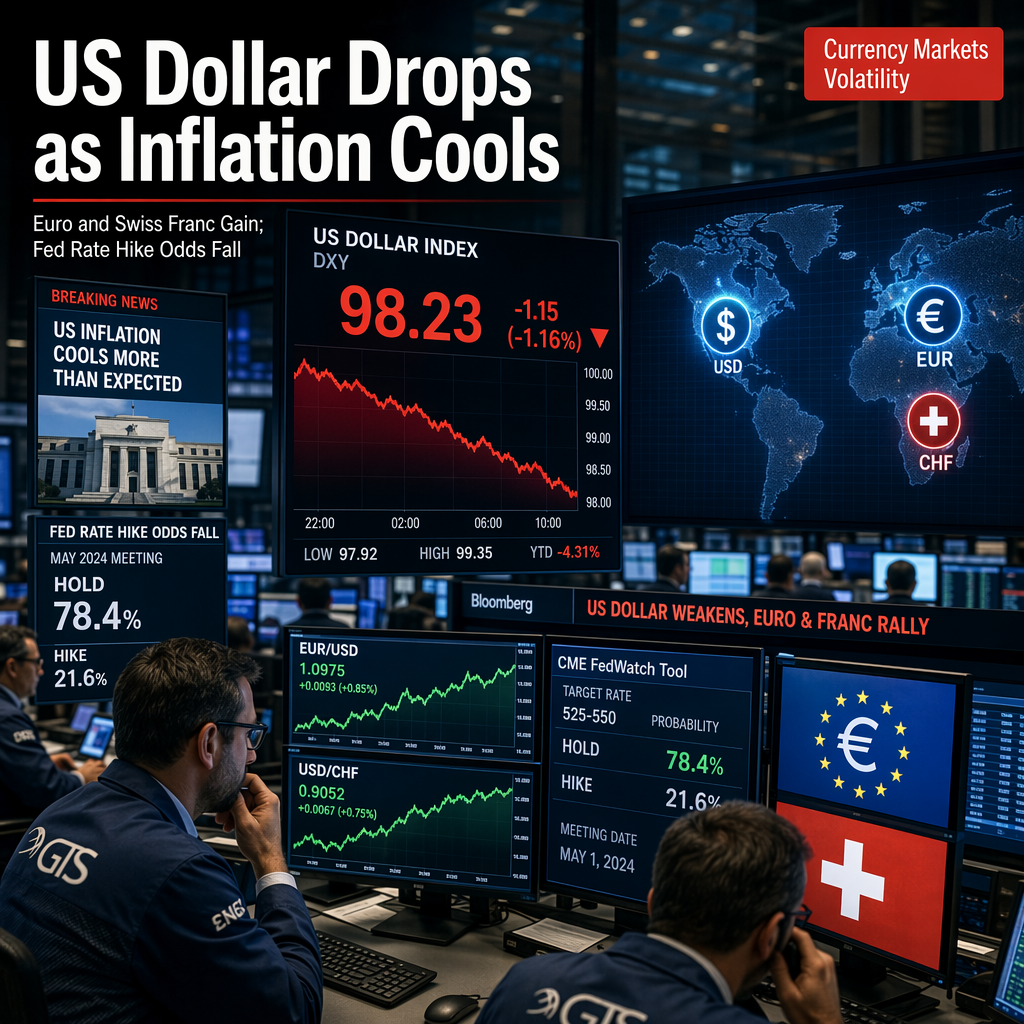
The US Dollar Index (DXY) traded 0.12% lower near 100.80 on Tuesday, underperforming its major currency peers after traders reduced expectations for Federal Reserve interest rate hikes this year. This move followed the release of softer-than-expected US Consumer Price Index (CPI) data for June, with headline inflation cooling to 3.5% year-over-year from 4.2% in May, below the market consensus of 3.8%. Core CPI also moderated to 2.6% YoY versus 2.8% estimates and 2.9% previously [1][2]. On a monthly basis, headline CPI declined by 0.4% in June, a notable shift from the 0.5% increase recorded in May [2].
Market reaction was swift: the US Dollar was the weakest against the Australian Dollar, losing 0.14%, and also declined against the Euro (-0.13%), Swiss Franc (-0.13%), and other major currencies [1][3]. The EUR/USD pair saw the Euro gain 0.18% against the US Dollar, while USD/CHF steadied after registering 0.7% losses the previous day, trading around 0.8090 during Asian hours on Wednesday [2][3].
The CME FedWatch tool showed the odds of a Fed rate hike in July dropping to 16.6% from 41.7% on Monday, while markets priced in a roughly 50% chance of a rate hike in September [1][2]. Fed Chairman Kevin Warsh, in testimony before Congress, reiterated the central bank’s commitment to restoring price stability but refrained from signaling a more aggressive policy stance, stating the Fed has "no tolerance for persistently elevated inflation" [1][2].
Geopolitical tensions escalated as the United States Central Command (CENTCOM) confirmed additional military strikes against Iran, targeting dozens of sites along the Iranian coast and near the Strait of Hormuz. This operation, involving US fighter jets, drones, and naval vessels, raised oil prices and renewed inflation concerns, potentially supporting the US Dollar’s safe-haven appeal [2].
In Switzerland, producer and import prices dropped by 2.1% year-on-year in June, accelerating from May's 1.8% decline and marking the steepest annual drop since March. On a monthly basis, prices fell 0.3%, primarily due to cheaper petroleum products, highlighting persistent weakness in domestic and imported prices [2].
Technical analysis of EUR/JPY indicated the pair remains near the symmetrical triangle top around 185.50, with buyers in control and a potential breakout toward the all-time high of 187.95 if momentum continues. The Euro was the strongest against the US Dollar, gaining 0.18% [3].
CONCLUSION
Softer US inflation data has led to a broad weakening of the US Dollar, with traders trimming expectations for further Fed rate hikes. The Euro and Swiss Franc have strengthened in response, while geopolitical tensions and technical factors continue to influence currency markets. The market takeaway is a shift toward less hawkish Fed policy and increased volatility amid global uncertainties.