
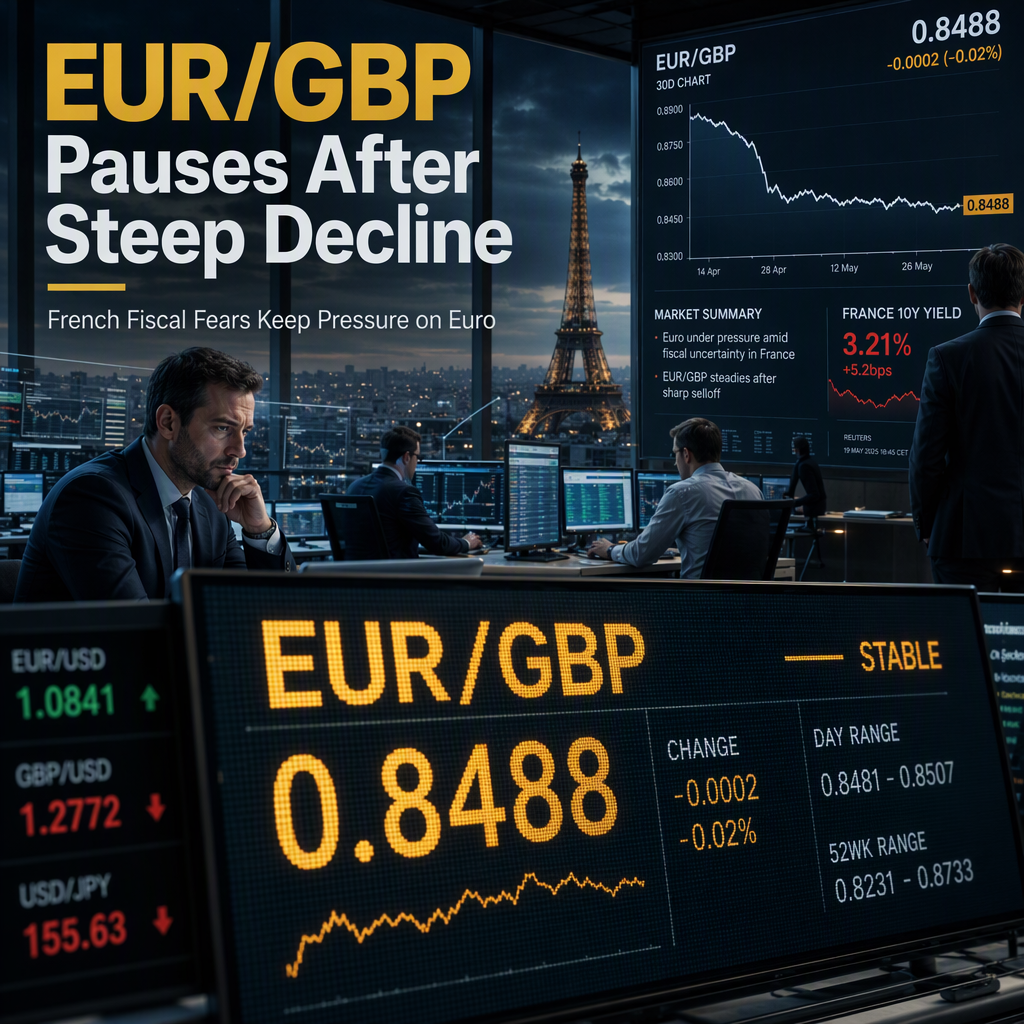
EUR/GBP paused its recent decline on Tuesday, trading around 0.8488 and remaining virtually unchanged on the day after a seven-day selloff that saw the cross hit a low of 0.8458, its weakest level since July [1]. The recent weakness in the Euro has been driven by growing concerns over France’s fiscal position, which has weighed on the currency pair [1]. The subdued price action is also attributed to a light economic calendar [1].
Rabobank analysts reported that they have revised lower their forecasts for the Euro across the board, citing that France’s political and fiscal issues are currently in a more difficult position than those of the UK. This divergence has contributed to the downward pressure on EUR/GBP ahead of the October 28 UK budget and is expected to cap any upside potential for the currency pair [1]. Rabobank’s revised three-month forecast for EUR/GBP stands at 0.85, with expectations for the pair to trade in a choppy range around current levels over the next one to three months [1].
Technical analysis shows that EUR/GBP maintains a bearish near-term tone, trading below the 50-, 100-, and 200-day Simple Moving Averages, which are clustered between approximately 0.8565 and 0.8632 [1]. Momentum indicators, including the Relative Strength Index (RSI), are hovering near oversold territory, reinforcing the downside bias [1].
The US Dollar was the strongest against the Japanese Yen on the day, while the Euro and Pound both showed minor changes against each other, with EUR/GBP virtually flat at 0.01% [1].
CONCLUSION
EUR/GBP has stabilized after a significant selloff, with market sentiment remaining bearish due to ongoing concerns over France’s fiscal outlook. Analysts expect the pair to remain under pressure and trade in a choppy range near current levels in the coming months. Technical indicators reinforce the downside bias, suggesting limited upside potential in the near term.