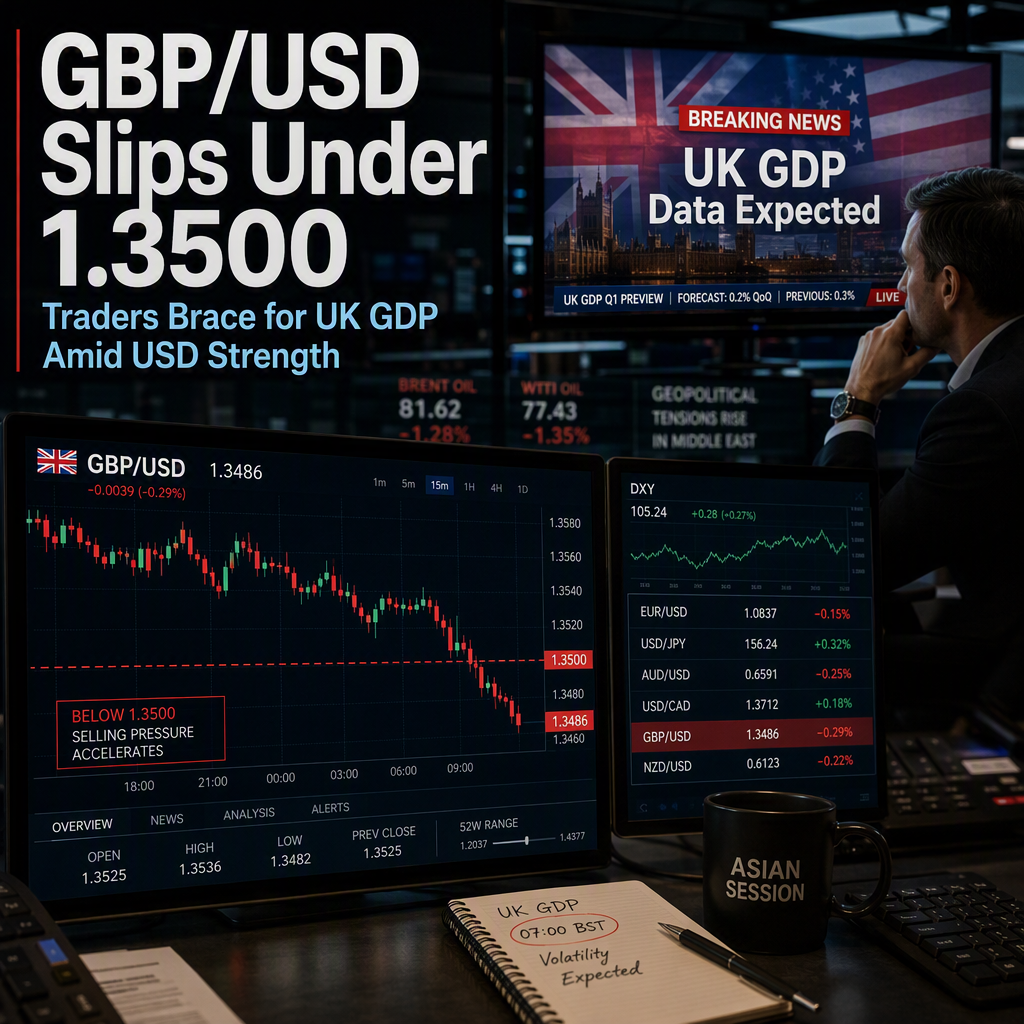
The GBP/USD currency pair is trading with a negative bias for the second consecutive day, remaining below the 1.3500 psychological mark during the Asian session on Thursday. This movement is attributed to modest strength in the US Dollar (USD), which has been supported by inflation risks stemming from volatile oil prices and prospects for a rate hike by the US Federal Reserve. Persistent geopolitical uncertainties, particularly the US-Iran standoff, have also contributed to the USD's recent bounce from the post-CPI swing low, acting as a headwind for GBP/USD [1].
Despite the current downside, the potential for further losses appears limited as traders are likely to wait for the upcoming UK macro data dump, including the Q2 GDP report, before making directional bets. The consensus for the Q2 GDP release, scheduled for August 13, 2026 at 06:00, is 0.4%, down from the previous quarter's 0.6% [1]. According to the Office for National Statistics, a rise in GDP is generally bullish for the Pound Sterling (GBP), while a lower reading is considered bearish [1].
From a technical perspective, GBP/USD spot prices have been oscillating within a one-week-old range, which may be seen as a bullish consolidation phase following the rally since late July. The pair maintains a mildly bullish near-term bias above the 100-period Simple Moving Average (SMA) on the 4-hour chart. However, momentum indicators are less supportive, with the Relative Strength Index (RSI) near the neutral 50 line and the Moving Average Convergence Divergence (MACD) slipping slightly below zero. This suggests an extension of the consolidative price action rather than strong near-term directional conviction, warranting caution for aggressive traders [1].
Further weakness below the current pivot area around 1.3491 could prompt technical selling, making spot prices vulnerable to a fall toward the 100-period SMA near 1.3415. A sustained defense of these supports would keep the bullish bias intact, while a clean break below could expose a deeper corrective phase for GBP/USD on the four-hour chart [1].
CONCLUSION
GBP/USD is currently under pressure due to a firmer USD and awaits the UK Q2 GDP release, with consensus expecting a lower reading than the previous quarter. Technical indicators suggest a consolidative phase, and traders are exercising caution ahead of key economic data. The market's next move will likely hinge on the GDP outcome and subsequent USD strength.