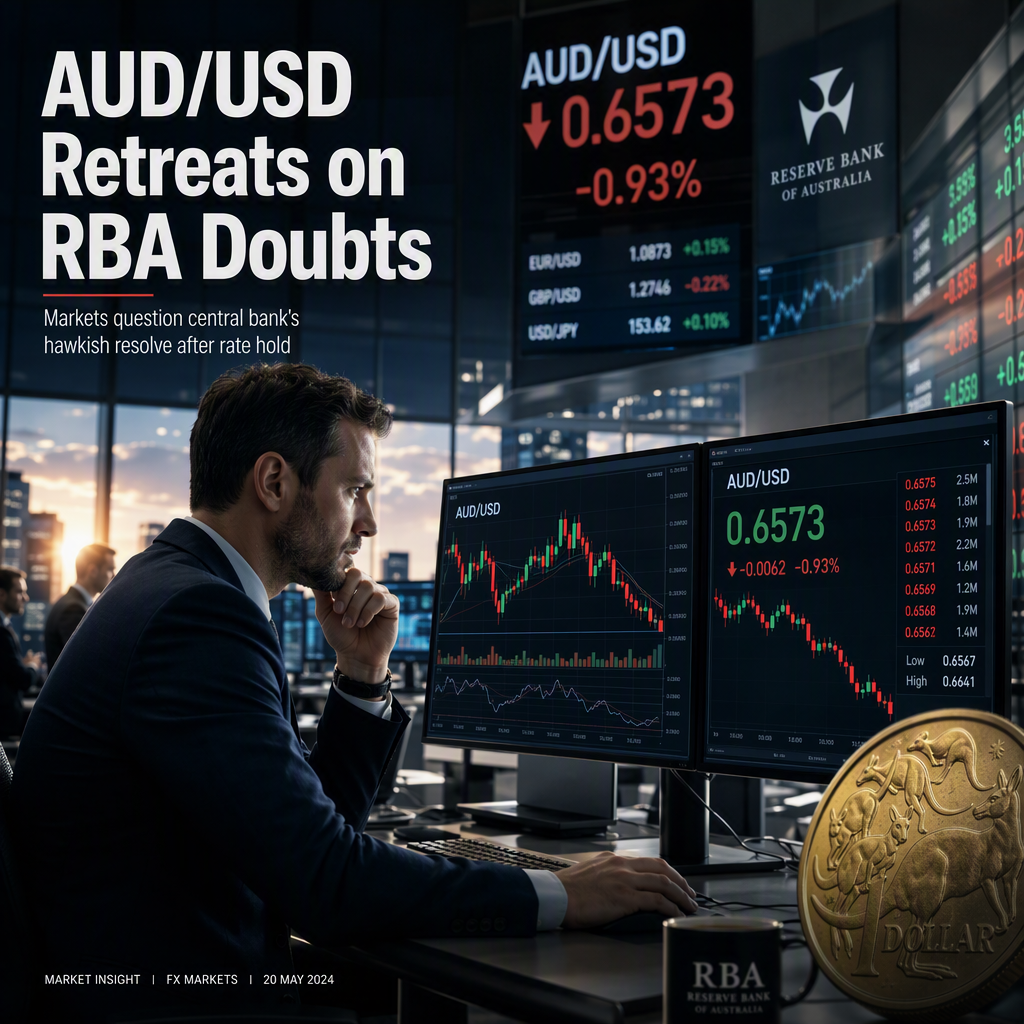
The Australian Dollar (AUD) traded 0.17% lower at around 0.7050 against the US Dollar (USD) during the early European trading session on Thursday, extending Wednesday’s correction after revisiting a two-month high near 0.7090. This pullback comes as financial markets remain unconvinced by the Reserve Bank of Australia’s (RBA) hawkish tone following its decision to leave the Official Cash Rate (OCR) unchanged at 4.35% on Tuesday, as expected [1].
The RBA explicitly stated it would not hesitate to raise interest rates further, citing upside inflation risks. However, market participants perceive the RBA’s appetite for further tightening as weak. Standard Chartered analysts noted that Governor Bullock highlighted uncertainty around the RBA’s central forecasts and did not rule out the need for more policy tightening in the immediate future if upside inflation risks materialize. Despite this, Standard Chartered’s base case remains no more RBA rate hikes in the foreseeable future, though they caution that the risk is skewed towards a hike in Q4 if demand does not slow sufficiently or if energy prices rise again, exacerbating capacity and price pressures [1].
Easing labor-market conditions, if sustained, should help contain underlying wage and price pressures, supporting the view that further tightening is not the central scenario even as the RBA keeps its options open [1]. Meanwhile, an upbeat US Dollar, despite traders paring back hawkish Federal Reserve bets for the September meeting, is also weighing on the AUD/USD pair [1].
Technically, AUD/USD remains within an upward parallel channel, trading above the 20-day exponential moving average (EMA) at 0.7024, suggesting underlying demand. The channel top near 0.7077 caps the immediate topside, while the Relative Strength Index (RSI) at 56.69 stays in positive territory, indicating bullish momentum is intact though not overstretched. Initial support is at the 20-day EMA at 0.7024, with deeper structural floors at 0.6951 and 0.6866. A sustained break above channel resistance at 0.7077 could open the way for further gains, with major hurdles at 0.7100 and the June 5 high at 0.7144 [1].
CONCLUSION
AUD/USD is under pressure as markets question the RBA's commitment to further tightening despite hawkish rhetoric and a steady rate decision. Technical indicators suggest underlying demand, but immediate resistance levels cap upside potential. The outlook remains cautious, with analysts seeing limited scope for additional rate hikes unless inflation risks intensify.