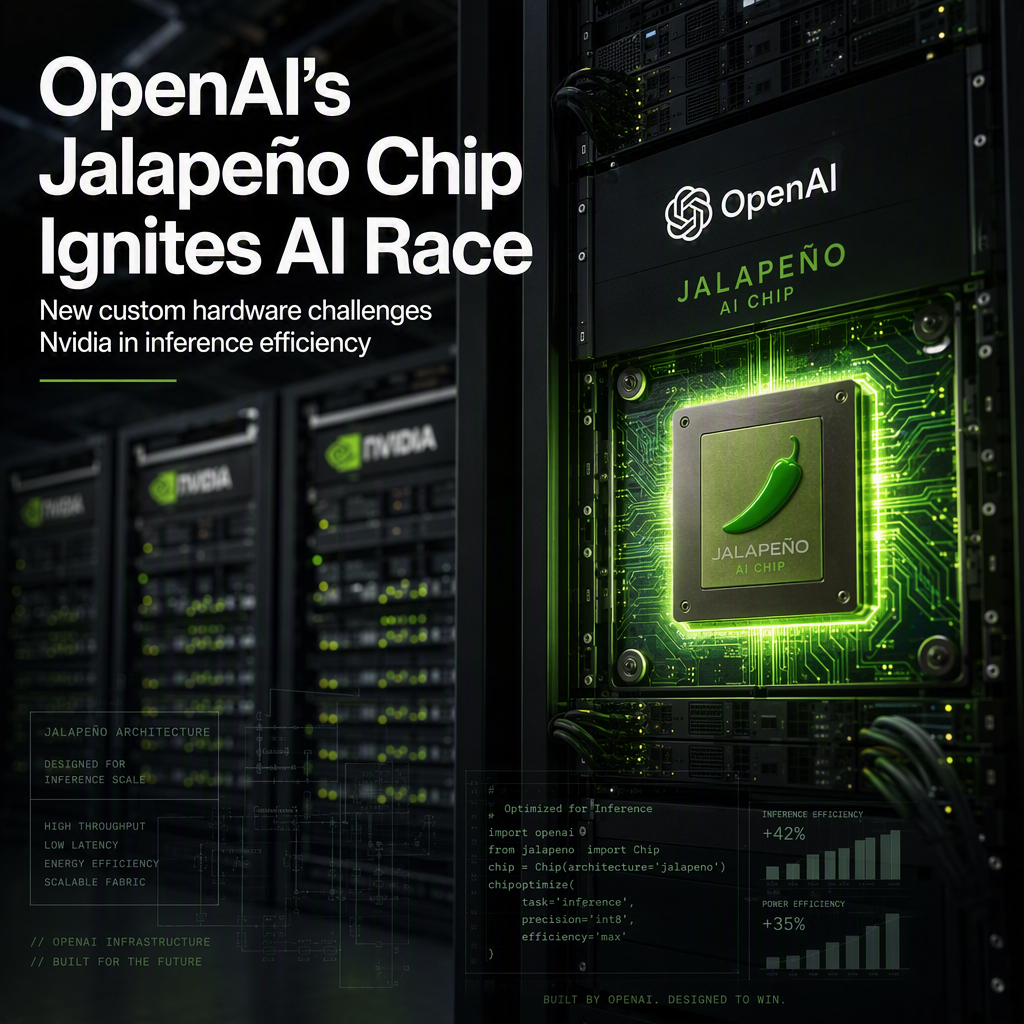
OpenAI has announced its first custom AI chip, Jalapeño, which is expected to be deployed in the company's computing infrastructure by the end of the year [1]. According to OpenAI, Jalapeño outperformed Nvidia’s Blackwell systems on performance per watt in nearly all tested scenarios, and the company claims the chip offers 'industry-leading speed and efficiency' [1]. The chip is designed specifically for inference workloads and was developed in partnership with Broadcom [1].
Analysts told CNBC that Jalapeño represents a significant threat to Nvidia’s dominance in the fast-growing inference market, as hyperscalers and AI companies like Google, AWS, and Meta are also developing their own custom AI chips [1]. Adrien Sanchez, technology analyst at Yole Group, stated that a 'hyperscaler-designed chip can now match or beat Nvidia's Blackwell-class GPUs on inference efficiency,' although Nvidia still maintains the 'vast majority' of AI compute due to its software ecosystem lock-in with CUDA [1].
Alexander Harrowell, senior principal analyst at Omdia, described Jalapeño as an 'impressive achievement, most of all in terms of efficiency,' noting that large-scale deployment could result in significant savings in power, cooling, and infrastructure, thereby improving unit economics for OpenAI [1]. TrendForce Analyst Fion Chiu added that while OpenAI's custom chip could reduce its reliance on Nvidia for inference workloads, Nvidia GPUs will likely remain important for more compute-intensive tasks such as large-scale model training and frontier AI workloads due to their programmability, performance, and broad software ecosystem [1].
OpenAI also revealed that it is already working on the second and third generations of the Jalapeño chip, which was initially announced in June as being 'built from the ground up for current and future LLMs across the industry' [1].
CONCLUSION
OpenAI's introduction of the Jalapeño AI chip marks a notable challenge to Nvidia's dominance in the inference market, with analysts highlighting its efficiency and potential to shift market dynamics. However, Nvidia is expected to retain its leadership in more demanding AI workloads due to its robust software ecosystem and hardware capabilities. The ongoing development of future Jalapeño generations signals continued competition in the AI chip sector.