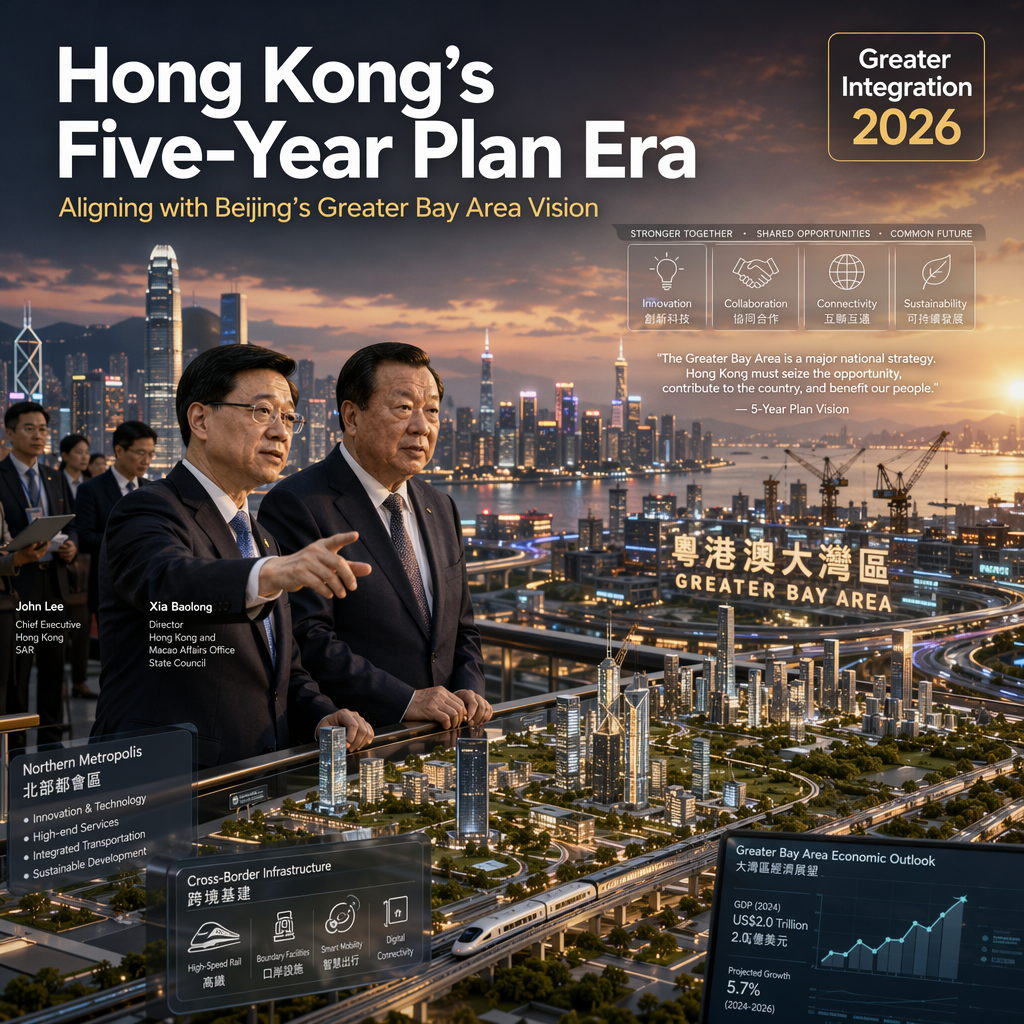
Hong Kong has initiated a two-month public consultation period for its inaugural Chinese-style five-year plan, with the aim of releasing the final blueprint in the third quarter of 2026. This marks a significant policy shift as the city seeks to align more closely with Beijing’s economic strategies, particularly the development of the Greater Bay Area in southern China, which is targeted for advanced manufacturing and high-tech industries [1].
The process was highlighted by a visit from Xia Baolong, director of the Hong Kong and Macao Work Office of the Communist Party of China Central Committee, and Hong Kong Chief Executive John Lee to the Northern Metropolis development on June 16, underscoring the city's commitment to integrating its economic future with national priorities [1]. The five-year plan is expected to include sector-specific policies, infrastructure investment priorities, and mechanisms for cross-border cooperation, although specific targets for GDP growth, job creation, and sectoral expansion have not yet been disclosed [1].
While the Hong Kong government asserts that the plan will enhance competitiveness and foster innovation, some scholars have expressed concerns that adopting the mainland’s planning model could erode Hong Kong’s traditional free-market appeal [1]. Financial analysts suggest that deeper integration with the Greater Bay Area could open new markets for Hong Kong businesses and attract mainland investment, but they also caution that increased political alignment may introduce regulatory risks and affect investor confidence [1].
Market observers are closely monitoring the consultation period for further details, especially regarding support measures for the financial sector and the implications for foreign participation in key industries. A senior economist noted that the five-year plan will serve as a test for balancing Hong Kong’s unique economic model with Beijing’s strategic vision, emphasizing that specifics on cross-border capital flow, regulatory harmonization, and incentives for high-value industries will be crucial for shaping market sentiment [1].
CONCLUSION
Hong Kong’s move to adopt a five-year plan signals a strategic pivot toward deeper integration with Beijing’s economic agenda, particularly in the Greater Bay Area. While this could unlock new opportunities for growth and investment, market participants remain cautious about potential regulatory risks and the impact on Hong Kong’s traditional economic model. The final details of the plan will be closely watched for their implications on investor confidence and sectoral development.