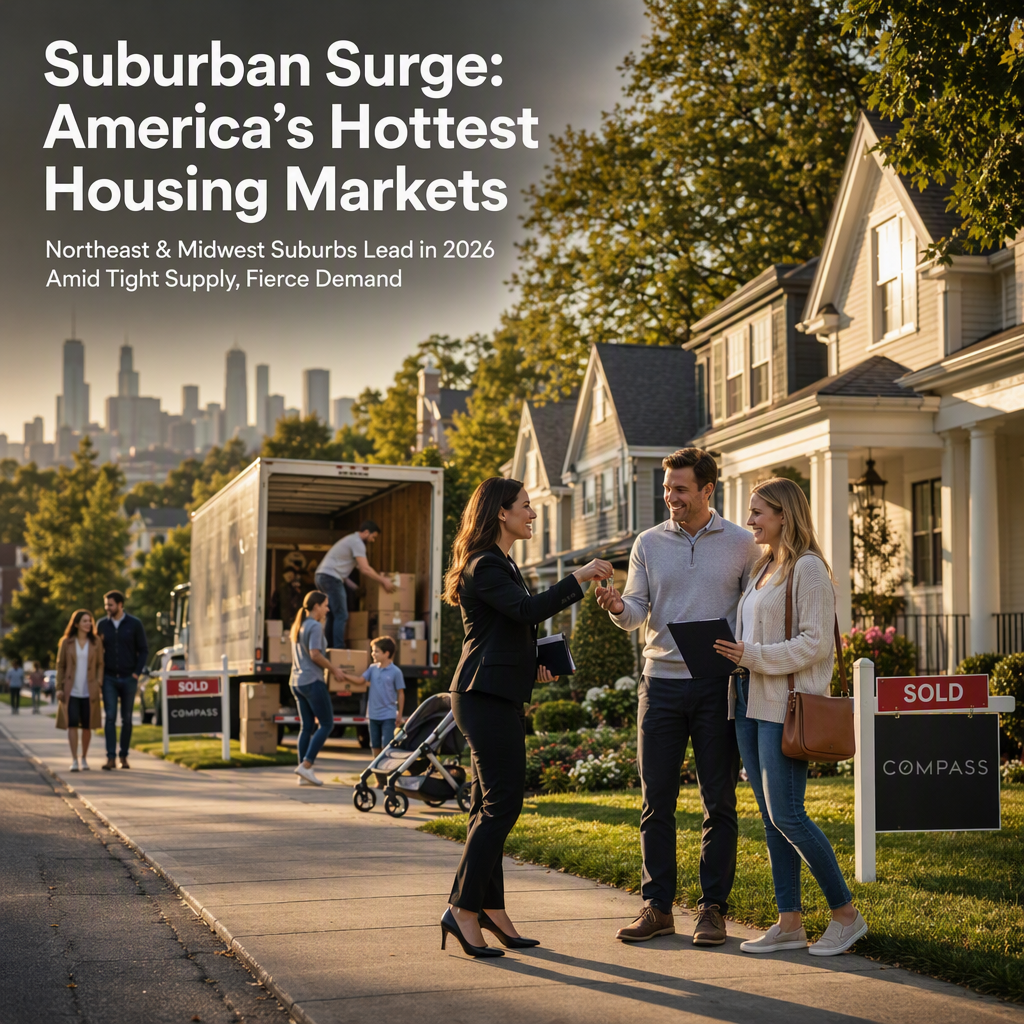
Realtor.com has released its hottest ZIP codes report for 2026, revealing that the most in-demand housing markets in the United States are concentrated in the Northeast and Midwest regions. This marks the fourth consecutive year that these two regions have swept the top 10 rankings for housing demand, according to the analysis, which is based on home shopper views and the average time homes remain listed on the market [1].
Hannah Jones, senior economist at Realtor.com, explained that many of the top ZIP codes are located in suburbs on the outer rings of major metropolitan areas such as Boston, New York, and Philadelphia. She noted that these areas offer buyers the opportunity to commute to city centers while enjoying more space and a quieter suburban lifestyle, often at a better value for their income [1].
A key factor driving these markets is a significant shortage of housing supply. Inventory levels in the top 10 communities are approximately 60% below pre-pandemic levels, compared to a nationwide inventory that is only 11% below pre-pandemic figures. This scarcity has led to competitive buying conditions, with nine out of the top 10 ZIP codes seeing homes sell at or above asking price and an average sale-to-list ratio of 103.8%. In contrast, the typical home across the country sold for about 2.3% below its list price in the first half of 2026 [1].
Buyers in these hot markets are also making larger down payments, with the typical buyer putting down about 17%, compared to the national average of 13%. Both figures are higher than pre-pandemic levels. Additionally, these buyers tend to have higher credit scores, reflecting the need for greater financial readiness in a market where mortgage rates are in the mid-to-high 6% range. Jones emphasized that today's borrowers in these markets are more financially robust than the average U.S. homebuyer [1].
Another trend noted is that most buyers in these top ZIP codes are moving from within the same metro area, rather than relocating from other regions, indicating strong local demand rather than cross-country migration [1].
CONCLUSION
The 2026 housing market is seeing intense demand in select Northeast and Midwest suburbs, driven by tight inventory and financially strong local buyers. Elevated sale prices and larger down payments highlight the competitive nature of these markets, with limited supply and higher mortgage rates shaping buyer behavior. The trend underscores the importance of financial preparedness for those seeking to enter the nation's hottest housing markets.