
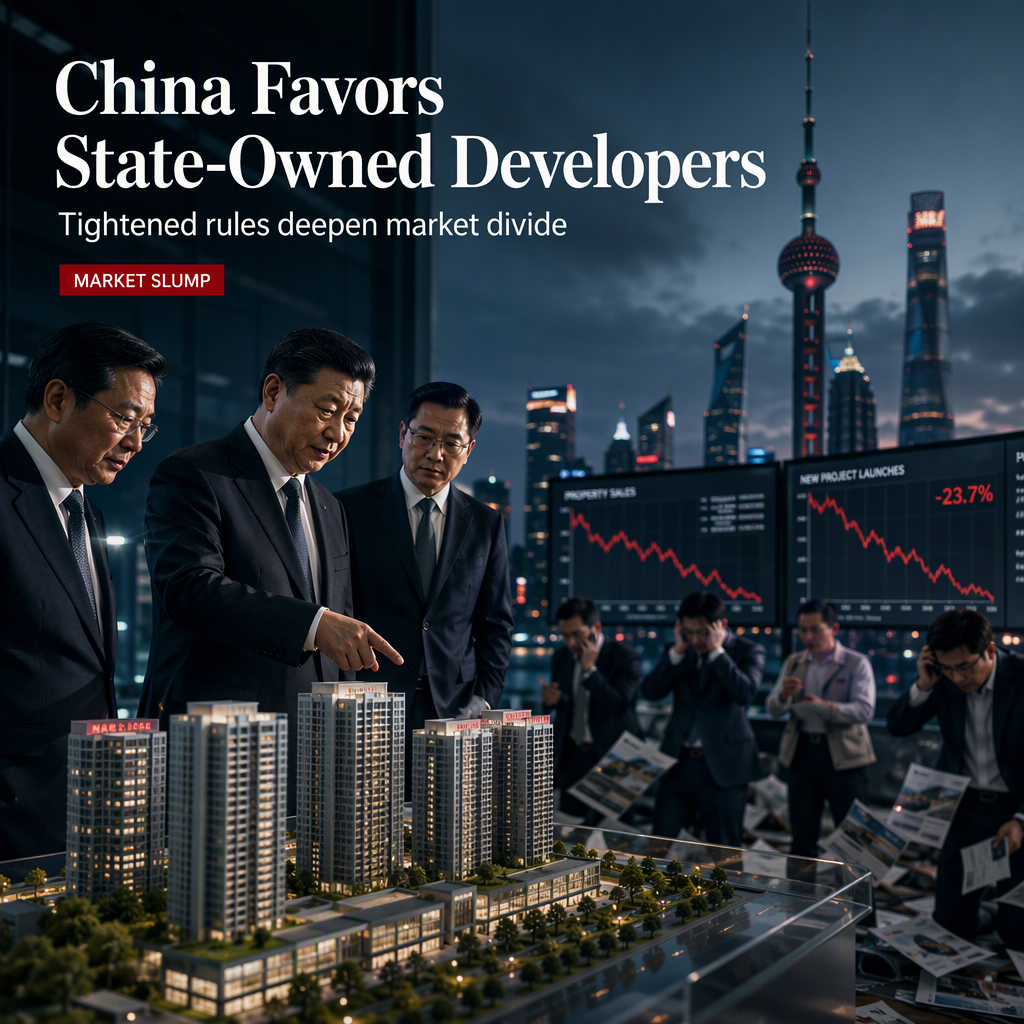
China has implemented new regulations in its property sector that restrict developers' ability to bid aggressively for land and secure financing, a move that is expected to benefit state-owned enterprises (SOEs) over private developers who are already struggling in a prolonged property downturn [1]. The changes have made land auctions less attractive to private developers due to tightened restrictions and limited financing options, resulting in declining land prices and fewer competitive bids, with SOEs increasingly dominating these auctions [1].
Market analysis indicates that property prices continue to slump, with technical indicators showing no clear support level in sight [1]. Analysts attribute this to a lack of market confidence and weak sales figures, which are significant headwinds for the sector [1]. Trading sentiment remains cautious, with many investors refraining from aggressive moves until there is greater policy clarity [1].
A Shanghai-based analyst noted that the government's new rules are intended to stabilize the market but place private companies at a disadvantage, as SOEs with stronger balance sheets and easier access to credit are better positioned to weather the current conditions [1]. A property market strategist added that unless there is a significant policy shift or stimulus, property prices are expected to remain under pressure due to the ongoing liquidity crunch and high resistance level for price recovery [1].
Overall, the regulatory revamp in China's property sector is likely to further advantage state-owned builders, while private developers continue to face challenges amid slumping prices and restricted access to financing [1].
CONCLUSION
China's recent tightening of property sector rules is deepening the divide between state-owned and private developers, with SOEs gaining a competitive edge in land auctions and financing. Market sentiment remains cautious, and analysts see little prospect for a price recovery without significant policy intervention. The sector is expected to remain under pressure in the near term.