
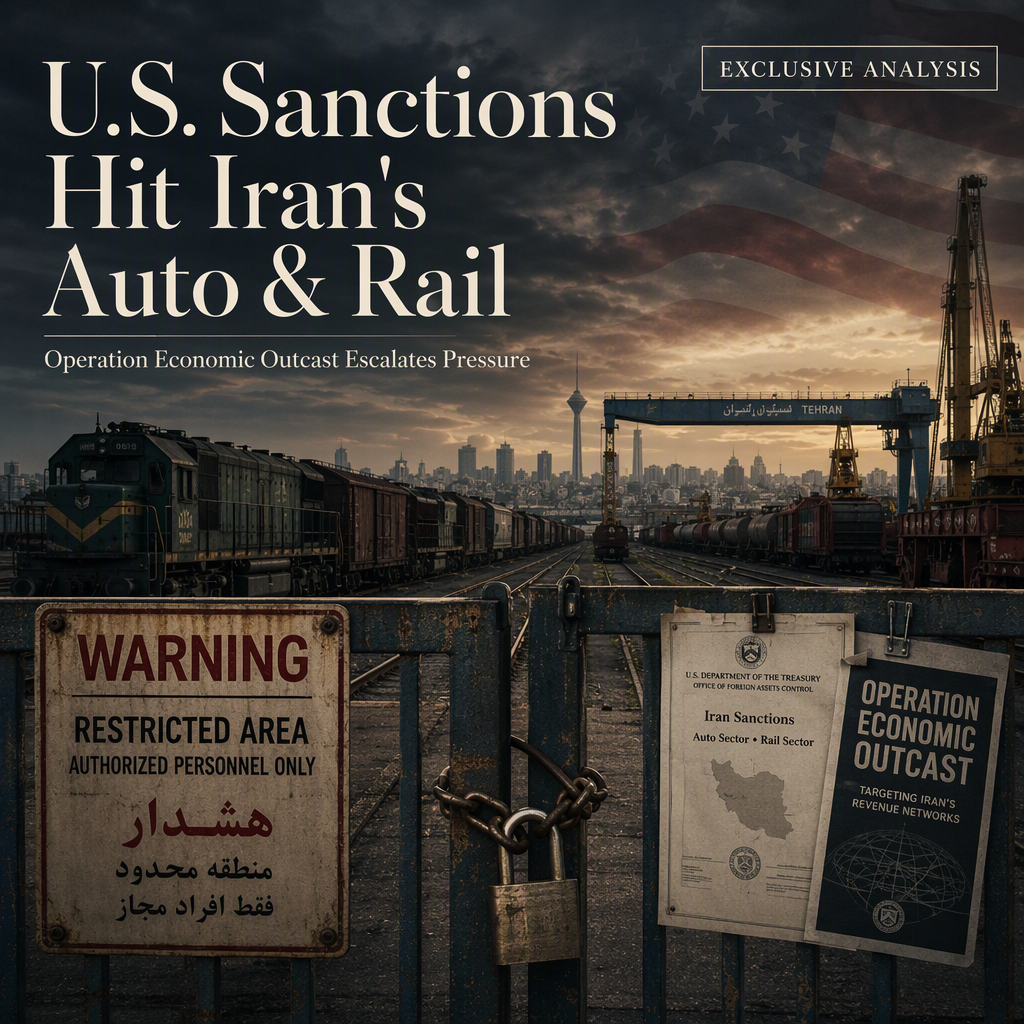
On October 1, 2026, the U.S. Treasury Department announced new sanctions targeting Iran's automotive and rail sectors as part of 'Operation Economic Outcast,' an initiative by the Trump administration aimed at cutting off Tehran's financial resources [1]. The Office of Foreign Assets Control also designated several companies connected to Iran's metals industry, including the Chinese subsidiary of Middle East machinery company HEPCO, for sanctions [1].
President Donald Trump and Treasury Secretary Scott Bessent have described 'Operation Economic Outcast' as Iran's 'economic D-Day,' emphasizing its role in severely diminishing the Iranian regime's ability to fund its military and terror activities [1]. Bessent stated, 'Today's action directly targets Iran's enablers and lays the groundwork for the United States and our partners to drain the regime's revenue once and for all' [1].
While the Treasury's news release highlighted the strategic intent behind the sanctions, it also noted that the immediate impact of these new penalties on Iran remains unclear, given the country's longstanding exposure to heavy sanctions [1]. No specific figures regarding the financial effects or market reactions were provided in the announcement [1].
This development is part of an ongoing series of measures under 'Operation Economic Outcast,' and further updates are expected as the situation evolves [1].
CONCLUSION
The U.S. Treasury's latest sanctions on Iran's automotive and rail sectors mark a continued escalation in economic pressure under 'Operation Economic Outcast.' While officials claim the regime's financial capabilities are being severely diminished, the immediate market impact remains uncertain. Investors and analysts should monitor for further updates as the situation develops.