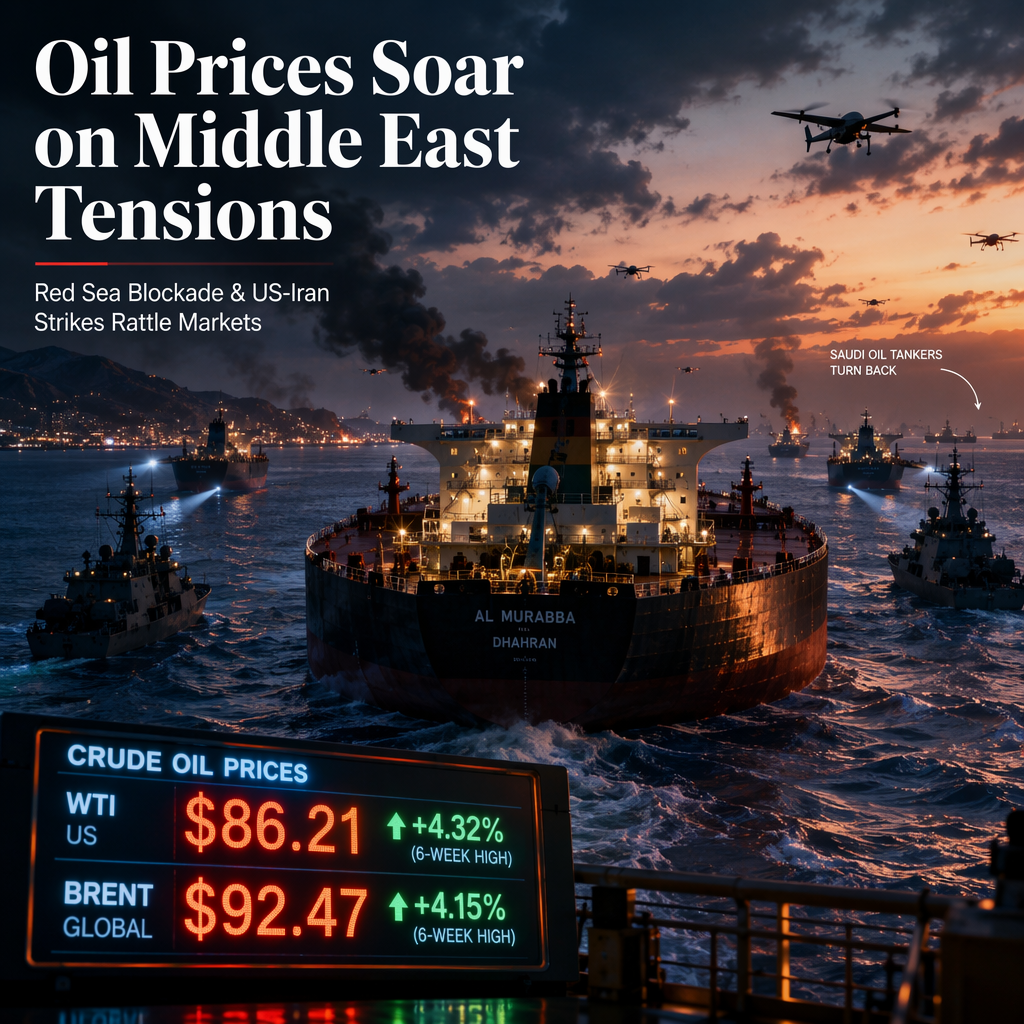
Oil prices surged sharply on Wednesday, with West Texas Intermediate (WTI) reaching fresh six-week highs above $86 per barrel and Brent crude climbing over $92, following the 11th consecutive night of US military strikes against Iran and mounting supply concerns in the Middle East [1][6]. Brent crude futures rose nearly 4% to $94.23, while WTI futures were up 3.8% to $87.46 [6]. The escalation was triggered by US President Donald Trump's threats to attack Iranian nuclear facilities and the US military's continued operations targeting Iranian assets, as well as Iran's warning that any attack on nuclear sites would expand the conflict regionally [1][3][6]. US Secretary of State Marco Rubio stated at the ASEAN Foreign Ministers' meeting that Iran was 'not serious' about peace talks, and the Strait of Hormuz remains a critical sticking point, with Iran demanding control over the waterway—a move Rubio described as setting a 'very dangerous precedent' [6].
Supply risks intensified as Yemen's Iran-backed Houthi militias announced a blockade of the Bab el-Mandeb Strait, a key corridor for Saudi crude, causing three Saudi vessels to turn around in the Red Sea [1][4]. This closure, responsible for transporting 7% of global energy, has heightened fears of broader supply disruptions and contributed to the rally in oil prices [1][4]. Rabobank analysts highlighted that overlapping disruptions—including Hormuz tensions, Russia-Ukraine strikes, CPC terminal outages, and record-tight diesel markets—have significantly escalated perceived supply risk, reinforcing the market's focus on potential constraints to global oil flows [1][4].
The surge in oil prices has had notable currency and commodity impacts. The US Dollar Index registered gains for the fourth consecutive day, reaching its highest level in over a week above 101.20, as investors reassessed geopolitical risks and the implications of higher oil prices for monetary policy [2]. The Canadian Dollar received support from higher oil prices, with USD/CAD declining to around 1.4100, as commodity-linked currencies benefited from the energy rally [3][5]. Silver prices also rose 0.8% to $59.25, but struggled to extend gains beyond $60 due to inflation fears and expectations of tighter global monetary policy [4].
Market participants are increasingly betting on hawkish Federal Reserve policy measures, with the probability of a July rate hike rising to 24.1% and a 69% chance of at least a quarter-point hike in September, according to the CME FedWatch Tool [3][6]. Analysts at OCBC and ING warned that a larger escalation could revive fears of a prolonged supply shock, potentially driving oil prices back above $100 per barrel and triggering higher market volatility, eroding the appeal of FX carry trades, and supporting a renewed USD rally [2][6]. Rabobank cautioned that energy markets cannot 'take the summer off,' given the ongoing supply threats [4].
Looking ahead, hopes for US-Iran diplomacy remain limited, with both sides signaling readiness for further escalation if provoked [3][6]. The next trigger for silver and broader markets will be the European Central Bank's monetary policy announcement, with investors closely watching for commentary on inflation [4].
CONCLUSION
Oil prices have surged to multi-week highs amid escalating US-Iran tensions and supply disruptions in key Middle Eastern corridors, driving broad market volatility and supporting commodity-linked currencies. The rally has revived inflation fears and increased expectations for hawkish central bank policy, with analysts warning of further upside risk if the conflict intensifies. Market focus remains on geopolitical developments and upcoming central bank decisions, as energy supply risks continue to dominate sentiment.