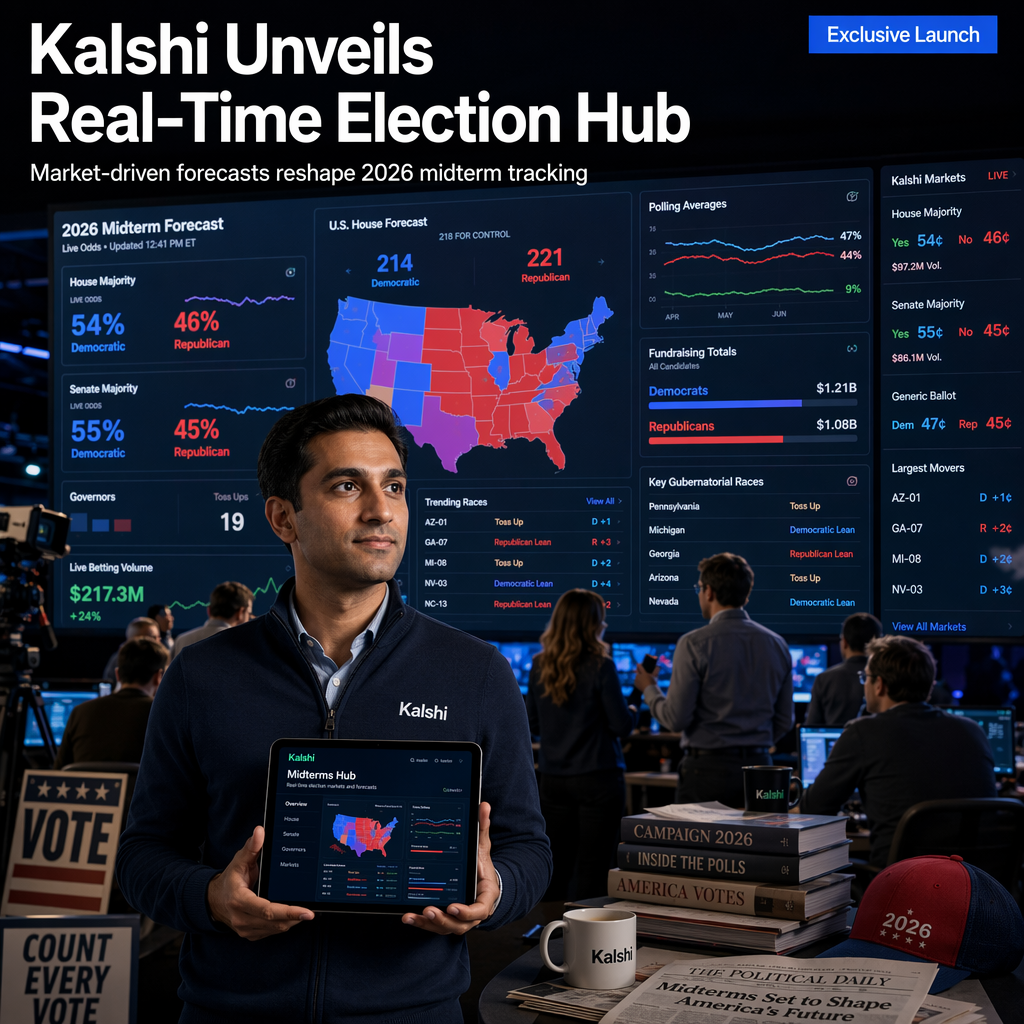
Kalshi, a federally regulated U.S.-based prediction market exchange, has launched its new Midterms Hub, a platform that aggregates live market odds, polling averages, fundraising data, historical election results, and political news to track House, Senate, and gubernatorial races in real time [1]. This launch comes as prediction markets are gaining influence as a complement to traditional polling, offering continuously updated election forecasts that reflect the latest campaign developments, such as debates, fundraising, and endorsements [1].
The Midterms Hub is designed to provide a dynamic and comprehensive view of the evolving political landscape, allowing users to monitor races by competitiveness, projected party flips, and trading volume, as well as to observe how election odds shift in response to major events [1]. According to Kalshi, approximately 75% of visitors use the platform to monitor election forecasts rather than to place trades, indicating that many view the markets as an informational resource rather than a gambling venue [1].
Kalshi's CEO, Tarek Mansour, emphasized that prediction markets offer insights based on the 'wisdom of the crowds,' backed by real money rather than rhetoric or partisanship [1]. The company also highlighted its regulatory oversight, noting that insider trading and market manipulation are illegal and that it actively monitors for suspicious activity [1].
The 2026 midterm elections, which the platform will track, are set to determine control of the House and Senate, thereby shaping President Donald Trump's legislative agenda during the final two years of his term [1]. Kalshi plans to expand the platform beyond the 2026 midterms, aiming to establish it as a permanent destination for tracking U.S. political races [1].
CONCLUSION
Kalshi's launch of the Midterms Hub marks a significant step in the evolution of election tracking, providing real-time, market-driven insights into the 2026 midterms. The platform's integration of live odds, polling, and fundraising data offers a more dynamic alternative to traditional polling, with potential implications for campaigns, political observers, and market participants alike.