
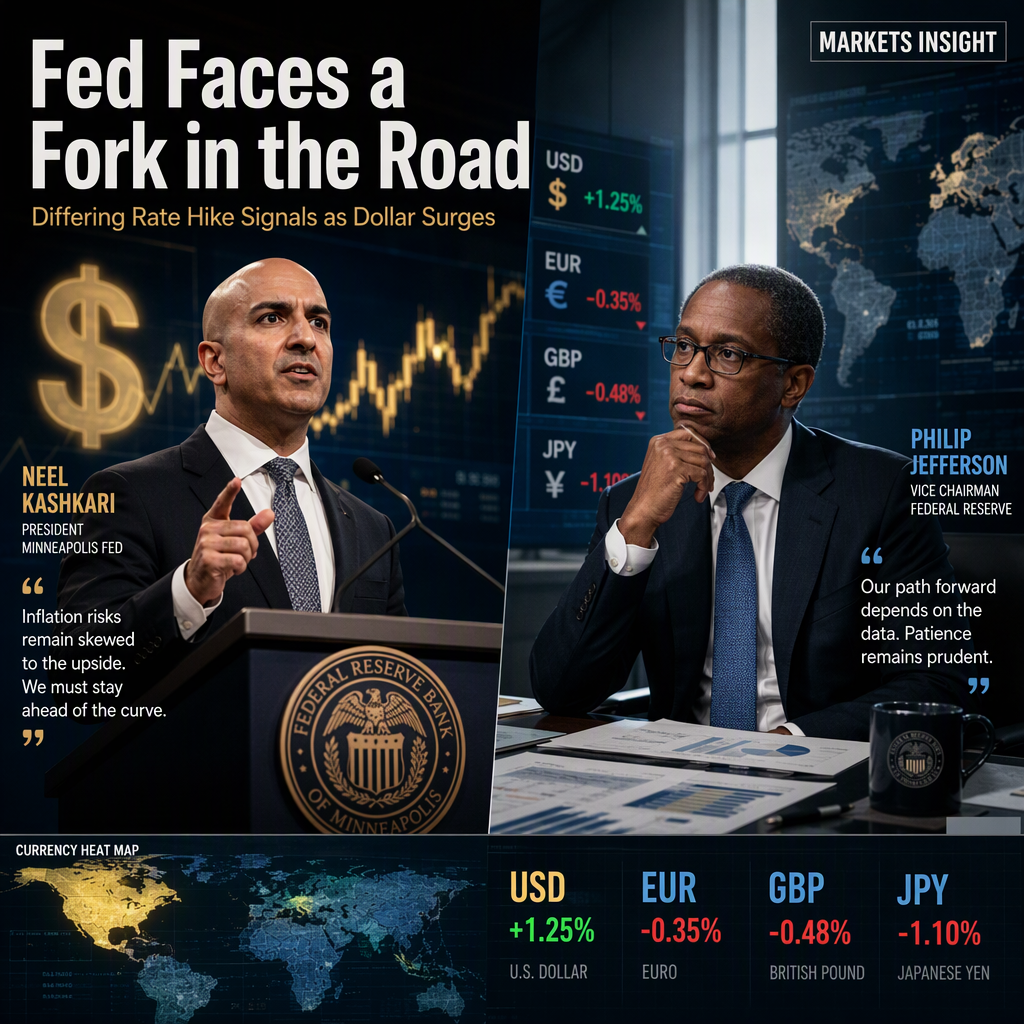
Minneapolis Fed President Neel Kashkari stated he remains open-minded about the pace of future interest rate hikes, expressing uncertainty regarding an October hike but reiterating his September projections for one more hike this year and another in 2027. Kashkari emphasized that he does not see meaningful tightening in financial conditions and noted the economy has outperformed expectations since the Fed's September policy meeting. He also mentioned that market inflation expectations remain centered on 2%, and he does not see signs of systemic risk in the financial system, even with rising yields. Kashkari's comments reflect a hawkish posture, suggesting that depending on economic performance, the Fed may need to hike more than currently expected [1].
In contrast, Fed Vice Chairman Philip Jefferson signaled a more cautious approach, stating that the Fed is fully committed to returning inflation to its 2% target and that future rate decisions should be data-driven. Jefferson indicated the central bank may take more time to decide its next rate move, echoing New York Fed President John Williams' sentiment that there is no rush to tighten monetary policy. He highlighted that economic output and the job market are broadly solid, and bond yields show market participants are rethinking their outlook. Jefferson also noted that inflation remains above target with upside risks but expects inflation pressure to ease over the longer term. He expressed concern that high inflation could spill into expectations, but expects the jobless rate to hold steady into the end of the year [2].
Both articles report that the US Dollar was the strongest against the Euro, with percentage changes of 0.94% [1] and 0.89% [2], respectively. The USD also gained against other major currencies, including GBP, JPY, CAD, AUD, and NZD, while it weakened against the Swiss Franc (-0.38% [1], -0.45% [2]). The heat maps in both sources confirm the USD's broad strength in the currency markets on the day of reporting.
While Kashkari's remarks suggest openness to further hikes and a hawkish stance, Jefferson's comments point to a more patient, data-dependent approach. Both officials agree on the importance of anchoring inflation expectations and acknowledge the resilience of the US economy, but differ in their urgency regarding additional tightening. The market implications include continued strength in the US Dollar and a cautious outlook on future rate hikes, with the Fed's next moves likely to be influenced by incoming economic data [1][2].
CONCLUSION
Fed officials are signaling diverging approaches to future rate hikes, with Kashkari open to more aggressive action and Jefferson advocating patience and data-driven decisions. The US Dollar has shown notable strength against major currencies, reflecting market confidence in the Fed's commitment to controlling inflation. Investors should expect the Fed's next steps to be shaped by economic performance and inflation data.