
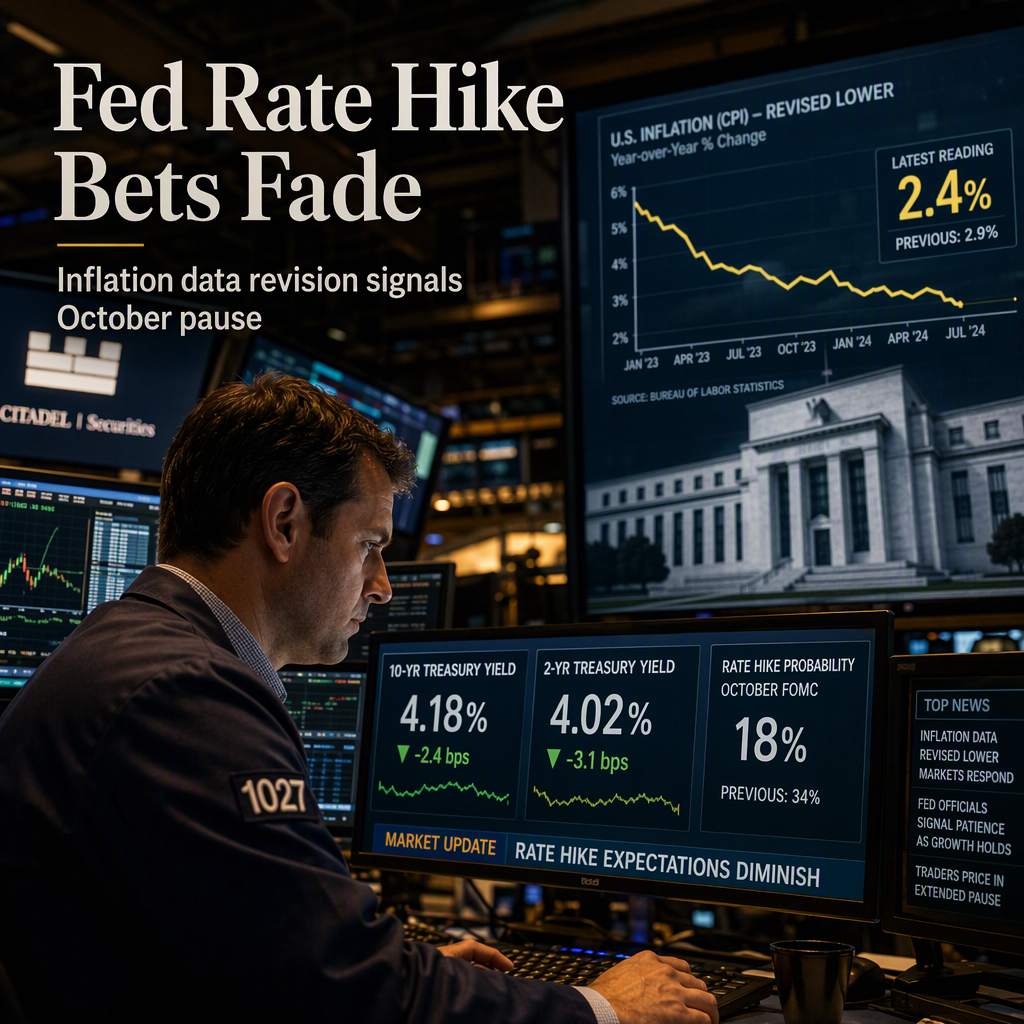
Financial markets have shifted away from anticipating another Federal Reserve rate hike in October following the release of revised U.S. inflation data. The updated figures showed that price increases are not as pronounced as previously estimated, leading to a downward revision of a key price index and reducing pressure on the Fed to raise rates at its next meeting [1].
Chairman Kevin Warsh and the Federal Reserve are now perceived as less likely to increase the benchmark rate in October, with investors scaling back bets on an imminent hike. This sentiment is reflected in interest rate futures markets, where traders have notably reduced the probability of an October move, indicating a growing belief that the central bank will opt for a pause [1].
Market analysts interpret the downward revisions as a sign that inflationary pressures may be easing, at least temporarily. This has provided relief to bond markets, which had been concerned about persistent inflation and aggressive policy tightening. U.S. Treasury yields have stabilized since the data release, with technical analysts noting that key support levels for benchmark yields have held, suggesting a potential pause in the recent sell-off [1].
Despite the current market optimism, financial strategists urge caution, emphasizing that the Federal Reserve remains data-dependent and could resume tightening if inflationary pressures return. Traders and investors are expected to closely monitor upcoming economic releases for further signals on the Fed’s policy trajectory and the broader outlook for U.S. interest rates [1].
CONCLUSION
The downward revision in U.S. inflation data has led markets to scale back expectations for a Federal Reserve rate hike in October, resulting in stabilized Treasury yields and a more cautious outlook. While the immediate pressure for further tightening has eased, the Fed’s future actions remain contingent on upcoming economic data.