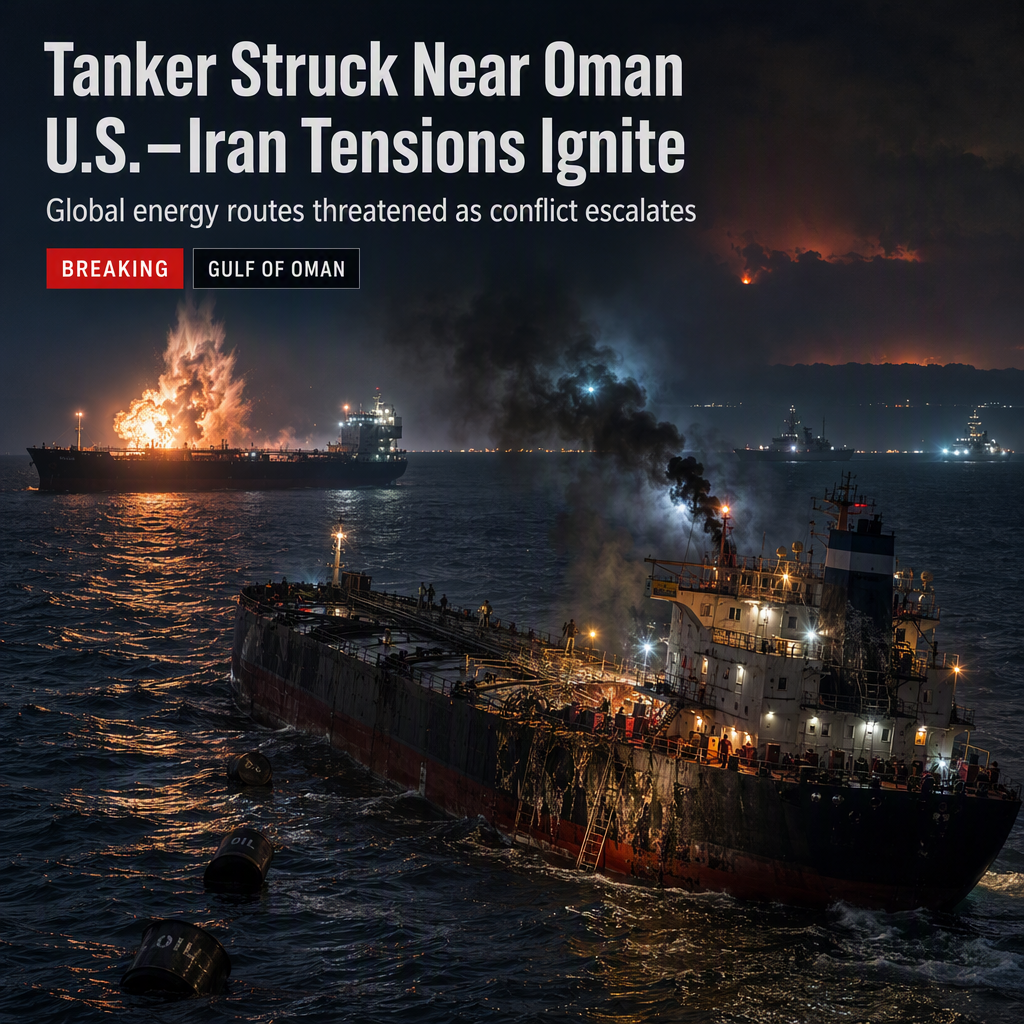
A tanker was reportedly struck near Oman overnight, with another vessel witnessing a large explosion nearby, as tensions between the U.S. and Iran intensified in the region. The United Kingdom Maritime Trade Operations Centre (UKMTO) confirmed that a tanker was hit by an 'unknown projectile,' causing damage to its engine room, though there were no reported casualties or environmental impact. The incident occurred 11 nautical miles northeast of Oman, and the regional Coast Guard was informed. Another tanker in the area reported seeing a large splash and explosion in close proximity to the vessel [1].
The escalation follows Iran's warning to Washington that the U.S. military's blockade of the Strait of Hormuz would result in the closure of key shipping routes. The conflict has also spread, with Kuwait reporting that its air defenses confronted hostile drone attacks by Iran, and Egypt confirming that a drone hit two ships at its Mediterranean port of Damietta, triggering a fire. This marks the first attack on Egyptian soil since the war began on February 28, highlighting the expanding scope of the conflict [1].
A temporary ceasefire established after a memorandum of understanding between the U.S. and Iran on June 17 has broken down, with neither side yielding on critical issues such as Iran's nuclear program and control of shipping through the Strait of Hormuz, a vital passage for about a fifth of the world's oil supplies prior to the war. Over the past week, the U.S. conducted a 'heavy wave' of strikes against Iran, targeting dozens of Islamic Revolutionary Guard Corps sites. In retaliation, Iran attacked U.S. military bases in Kuwait and Bahrain [1].
U.S. President Donald Trump is reportedly preparing for a fresh round of strikes against Iran, which could begin as early as this weekend, according to unnamed officials cited by The Wall Street Journal and Axios. However, officials noted that Trump could call off the planned strikes if diplomatic progress is made. Trump stated, 'We will be hitting them very hard,' emphasizing the U.S.'s readiness to escalate military action if necessary. An Iranian official responded by warning that continued U.S. actions would prompt Iran to tighten its control over critical maritime passages [1].
Energy prices have climbed amid the conflict, as hopes for a negotiated end to the war recede and the risk to global oil supply routes increases [1].
CONCLUSION
The attacks on tankers near Oman and the breakdown of the U.S.-Iran ceasefire have sharply escalated regional tensions, threatening vital shipping lanes and global energy supplies. With both sides signaling readiness for further military action and diplomatic efforts faltering, markets are likely to remain volatile as the situation develops.