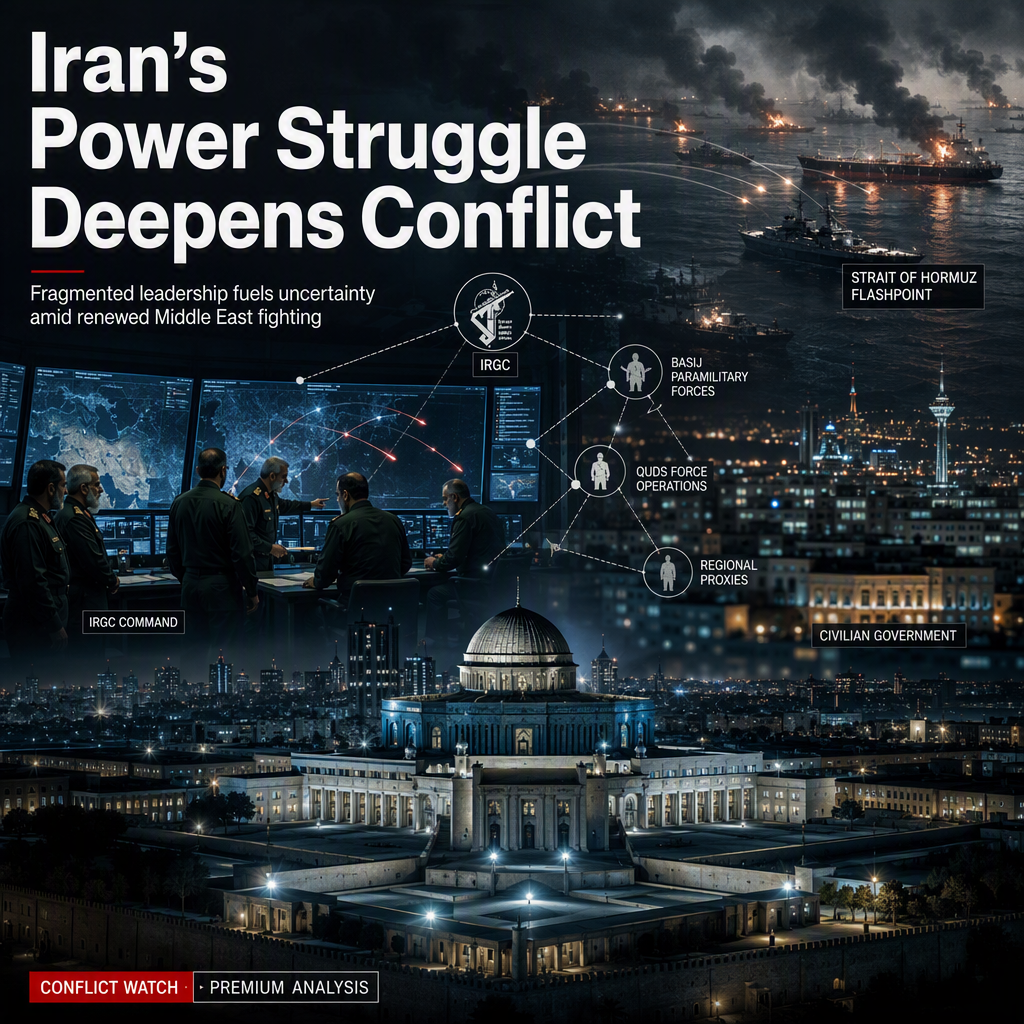
Renewed fighting in the Middle East has underscored the challenges of enforcing a ceasefire with Iran, due to the country's complex and overlapping power centers. Iran’s power structure includes the Supreme Leader, the Revolutionary Guards (IRGC), the presidency and civilian government, military commanders, Iran-aligned groups, and competing internal factions, all of which complicate decision-making and the implementation of any agreements [1].
Since the Iran war began on February 28, 2026, each pause in fighting has highlighted these complexities. A memorandum of understanding signed on June 17 opened a 60-day negotiation period over the Strait of Hormuz, sanctions, and Iran's nuclear and missile programs. However, this agreement quickly frayed as Iranian attacks on shipping escalated the conflict [1]. The U.S. responded with 13 consecutive nights of strikes, pausing on July 24, but fighting resumed shortly after, with further strikes occurring overnight on Wednesday and Thursday. On Friday, Iran's army announced it had launched attacks on strategic U.S. assets and military bases in Kuwait and Bahrain [1].
The IRGC and Tehran-aligned groups, such as Iraqi militias and Yemen's Houthis, have demonstrated their ability to widen the conflict, with recent attacks attributed to these groups targeting Saudi oil facilities and pipeline infrastructure [1]. The U.S. has emphasized the importance of reopening the Strait of Hormuz without tolls, while Iran's civilian government seeks economic relief and the unlocking of frozen funds to support its population of over 90 million, which has been severely impacted by decades of sanctions [1]. However, elements within Iran's security establishment may view continued pressure in the strait as a valuable source of leverage [1].
According to Sanam Vakil, director of the Middle East North Africa Program at Chatham House, the IRGC is the dominant force on war and national security, operating missiles, drones, intelligence networks, and regional armed partnerships, and its commanders can exercise considerable autonomy during active conflict. While the civilian government and president can shape diplomacy and economic policy, they do not command the armed forces [1].
CONCLUSION
Iran’s fragmented power structure and the autonomy of the IRGC create significant uncertainty around the enforcement of any ceasefire or diplomatic agreement. This complexity, combined with ongoing attacks and escalations, has heightened market concerns and increased the risk of further instability in the region.